
Every recruiting conversation brings excitement — but also uncertainty. Families often leave campus visits wishing they had asked one more question. The right questions can reveal far more about a program than a tour of the facilities or a scholarship discussion alone.
This guide provides 25 specific questions — organized by category — that every family should ask before making a commitment to any college athletic program at any division level. Each question includes an explanation of why it matters and what a strong answer looks like.
Bring These Questions to Every:
✓ Campus visit
✓ Official visit
✓ Recruiting phone call
✓ Zoom meeting with coaching staff
✓ Scholarship discussion
Before identifying which programs to visit and which coaches to ask these questions families benefit from knowing which programs represent genuine academic and athletic fits. Our Free College Recruiting Match Report provides 10 personalized program recommendations at no cost across every division level.
ABOUT THE COACHING STAFF
The coaching staff is the most important factor in a student-athlete's collegiate experience. These questions help families understand who they are actually committing to.
- How long have you been at this program and what are your plans going forward?
Coaching staff turnover is constant in college athletics. A head coach who leaves after an athlete's freshman year takes the recruiting relationship with them. The new staff inherits the roster but owes nothing to athletes they did not recruit.
Asking directly about a coach's plans — and listening carefully to the answer — helps families assess the stability of the commitment they are considering.
- What is your coaching philosophy and how does it apply to players at my athlete's position?
This question reveals whether the coach's system fits the athlete's specific skill set and development needs. A coach who cannot articulate a clear development philosophy for the athlete's position may not have a genuine plan for that athlete's growth.
- How do you handle conflicts between athletes and coaching staff?
This question is uncomfortable to ask — which is exactly why it is valuable. A coaching staff that has a clear, respectful answer demonstrates they have thought seriously about athlete relationships.
A staff that deflects or gives a vague answer about open door policies without specifics may not have a genuine process for addressing conflict.
- Can I speak with current athletes about their experience in the program?
A program confident in how it treats its athletes will facilitate these conversations readily. A program that limits or discourages contact with current athletes before a commitment is made warrants careful scrutiny.
- What happens to my roster spot and scholarship if the head coach leaves?
This is the question most families do not think to ask — and one of the most important.
Understand specifically what the institution's policy is regarding scholarship commitments made by a previous coaching staff. Some institutions honor all prior commitments. Others do not. Get the answer in writing if possible.
ABOUT SCHOLARSHIP AND FINANCIAL AID
Financial commitments in college athletics are more complicated than they appear. Understanding exactly what is being offered — and under what conditions it can change — is essential before signing anything.
- Is this a full scholarship or a partial scholarship and what specifically does it cover?
Scholarship offers that sound comprehensive frequently exclude significant costs — health insurance, books, housing during breaks, transportation. Understand exactly what is and is not covered before evaluating the financial value of any offer.
- Under what circumstances can my scholarship be reduced or not renewed?
Many athletic scholarships are awarded on renewable terms though institutions may structure aid differently. Families should ask each program how scholarship renewal works and request the details in writing.
For more on scholarship structures across division levels read our NCAA Division I II III NAIA NJCAA Guide.
- What happens to my scholarship if I suffer a season-ending injury?
Medical hardship waivers and injury scholarship protections vary by institution and by division level. Some programs maintain scholarship support through injury. Others do not.
This question deserves a specific answer before any commitment is made.
- What institutional academic scholarships or financial aid might my athlete qualify for in addition to athletic aid?
At many institutions institutional academic scholarships can be combined with athletic aid to produce strong financial packages. Understanding the full financial picture requires asking about both sources.
- What is the process for scholarship renewal each year and who makes that decision?
Understanding who controls scholarship renewal — the head coach alone, an athletic director committee, or an institutional process — helps families understand the stability of the commitment and what factors influence renewal decisions.
ABOUT ACADEMIC SUPPORT
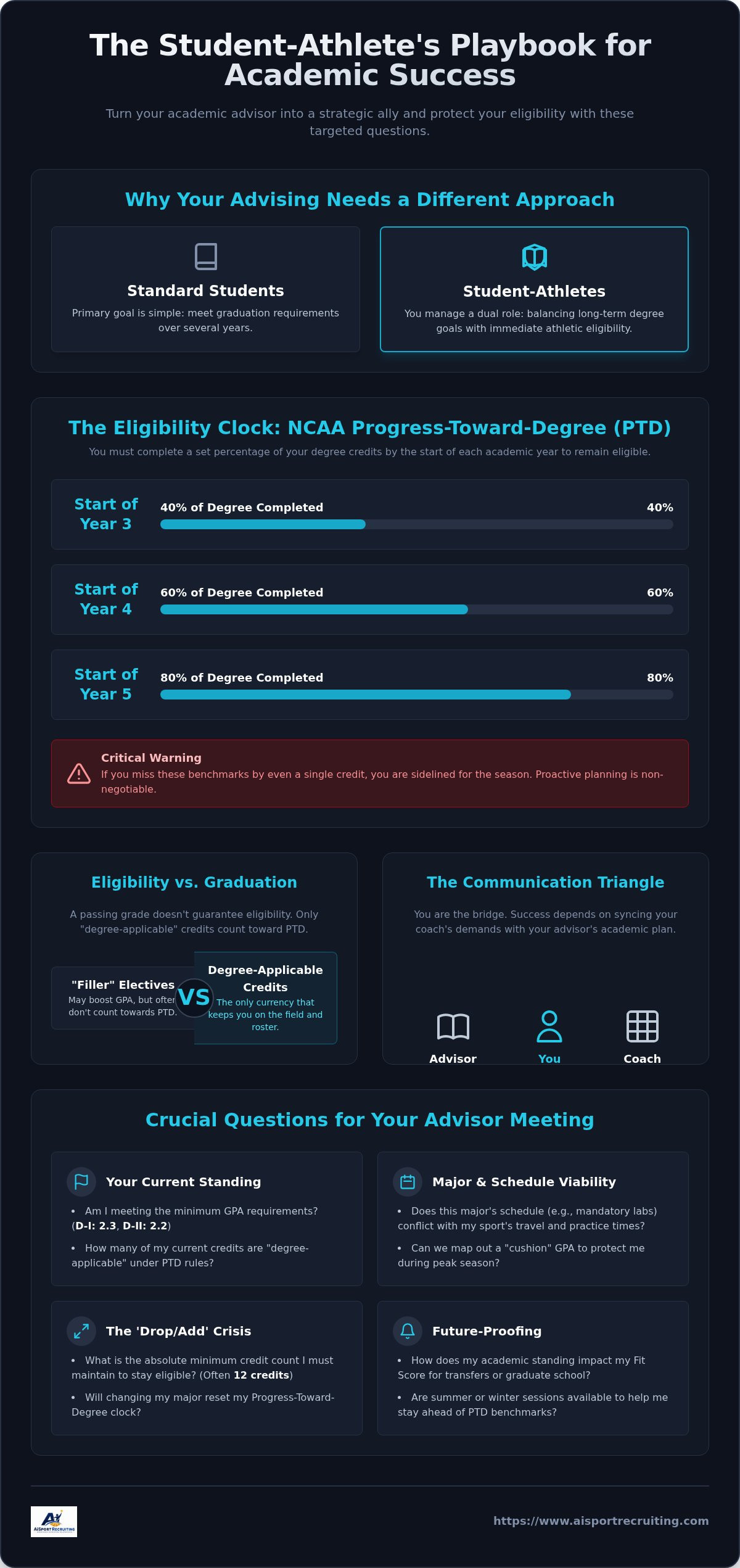
Student-athletes face academic challenges that non-athlete students do not — significant travel schedules, early practice commitments, and the physical and mental demands of competitive athletics alongside full academic loads.
- What academic support services are specifically available to student-athletes?
Some programs have dedicated academic advisors, tutoring services, and study hall requirements for athletes. Others offer only the same general resources available to all students.
Understanding what is specifically available to athletes — not the general student body — is essential.
- How does the program handle class conflicts during travel?
Athletes who travel for competitions miss class. Understanding whether coaches communicate proactively with faculty, whether institutional policies protect athletes who miss class for travel, and whether the culture expects athletes to manage these situations independently reveals how the program values academics.
Ask for specific examples of how this has been handled in the past — not just the stated policy.
- What is the graduation rate for athletes in this program?
Graduation rates are publicly available for many programs through NCAA and institutional reporting. A program whose athletes graduate at significantly lower rates than the general student body is signaling something about how athletics and academics are balanced within that program.
- What is the typical course load during the season and how do athletes manage it?
Some programs actively support athletes in taking lighter course loads during their competitive season and heavier loads in the off-season. Others expect athletes to maintain full loads regardless of competitive schedule.
Understanding how the program manages academic load across the year helps families set realistic expectations.
ABOUT PLAYING TIME AND DEVELOPMENT
Playing time conversations are uncomfortable because coaches rarely make binding promises — and families should be cautious about any coach who does. These questions reveal how a coaching staff thinks about development.
- What does my athlete need to demonstrate to earn playing time at their position?
This is not asking for a guarantee — it is asking for a philosophy. A coach who can articulate specifically what they look for when deciding who plays has thought seriously about player development.
A coach who gives a vague answer about earning it every day without specifics may not have a genuine development framework.
- How do you typically develop athletes at my athlete's position over four years?
This question reveals whether the program has a genuine long-term development plan or whether they recruit athletes to play immediately without a developmental pathway for athletes who need time to grow.
- Where do athletes at my position typically end up after their college career?
Whether an athlete's goal is professional athletics, graduate school, or a career in their academic field, understanding where previous athletes in that position have gone after their collegiate career provides real evidence of what the program actually produces.
- How do you handle situations where an athlete is not developing as expected?
This question reveals how a coaching staff responds when things do not go according to plan — whether they invest in development, have conversations about role adjustment, or simply reduce the athlete's opportunity without communication.
ABOUT CAMPUS AND CULTURE
The campus experience and program culture determine whether an athlete is genuinely happy for four years — which affects athletic performance, academic engagement, and personal development in ways that scholarship amounts and facilities do not capture.
- What do athletes typically do in their time away from practice and competition?
This question reveals the culture of the program and the campus experience outside of athletics.
Programs where athletes describe a rich campus life, genuine friendships, and meaningful activities outside of their sport are describing a fundamentally different experience than programs where athletes describe exhaustion and isolation.
- How diverse and inclusive is this program and campus community?
For families for whom campus diversity and inclusion matter — and they should for every family evaluating a four-year living environment — this question deserves a direct and specific answer.
A coaching staff that can speak to specific programs and institutional commitments is demonstrating genuine engagement with this question.
- What does a typical week look like for an athlete in your program during the season?
Understanding the time commitment of the program — practice hours, film sessions, travel, weightlifting, team meetings, and community obligations — helps families assess whether the full picture of the program's demands is compatible with the athlete's academic and personal goals.
ABOUT TRANSFERS AND THE EXIT PROCESS
The transfer portal has changed college athletics significantly. Understanding a program's culture around transfers is part of responsible program evaluation.
- What is your program's philosophy regarding athletes who enter the transfer portal?
Programs vary significantly in how they respond when an athlete enters the transfer portal — from actively supporting the athlete's search for a better fit to withdrawing scholarship support upon portal entry.
Understanding the program's actual practice — not just their stated philosophy — is important before making a commitment.
- Has any athlete in this program transferred in the last two years and what were the circumstances?
This question produces real information about how the program actually operates — not how it presents itself. A program that has had multiple transfers under difficult circumstances is revealing something about the culture.
ABOUT THE DECISION PROCESS
These final questions help families manage the commitment process itself — understanding timelines and what a commitment actually means before signing anything.
- What is your timeline for this offer and when do you need a decision?
Legitimate programs provide reasonable decision timelines. Programs that pressure families into immediate decisions — or imply the offer will disappear if the family visits other programs — are using tactics that deserve careful scrutiny.
A program genuinely confident in being the right fit should allow families time to make an informed decision.
- What does a verbal commitment mean to your program and what are the next steps toward a National Letter of Intent?
Understanding the difference between a verbal commitment — which is not binding — and a signed National Letter of Intent — which is — protects families from misunderstandings about what they have agreed to before anything is formally signed.
Ask specifically what the program expects after a verbal commitment is made.
How to Use These Questions
These 25 questions are not a script to be read verbatim in a campus visit. They are a framework for the conversations families should be having with any coaching staff before making a commitment.
Some questions are best asked during a campus visit when the conversation is flowing naturally. Others — particularly the financial aid and scholarship questions — deserve direct written responses that families can review carefully.
The goal is not to interrogate a coaching staff. It is to leave every campus visit with enough honest information to make a genuinely informed decision about whether this program is the right fit for this specific athlete at this specific stage of their life.
For a complete guide to evaluating fit across every dimension read our How to Find the Right College Athletic Fit guide and our When Should You Start College Sports Recruiting guide.
For a complete guide to what coaches are evaluating on their side of the conversation read our What College Coaches Actually Look For guide.
How AiSportRecruiting Supports Families Through This Process
AiSportRecruiting was founded by Coach Jackson after more than 30 years serving as a High School Athletic Director — helping more than 300 student-athletes earn college scholarship opportunities across his career.
The platform compares each student-athlete's academic and athletic profile against 888 verified collegiate programs across every division level — returning personalized college matches, Top 3 explanations, and athlete development guidance at no cost with no credit card required.
For families ready to move from research to action the 30-Day Standard Trial activates the full recruiting experience at no cost for 30 days — including professional coach introductions to all 10 matched programs within 24 hours, Day 7 follow-up, and a Day 14 engagement report.
👉 Activate Your 30-Day Free Trial — AUTOSEO30
For more on evaluating recruiting platforms and services read our How to Choose the Right College Recruiting Platform guide and our How Much Does a College Recruiting Service Cost guide.
AiSportRecruiting currently supports Boys Basketball, Girls Basketball, and Football. Additional sports are in development.
The AiSportRecruiting Standard
Families deserve recruiting information they can trust. Accuracy before assumptions. Evidence before opinion. Families before technology.
AiSportRecruiting does not guarantee scholarships, roster positions, coach responses, or recruiting offers. The platform provides honest evidence-based recruiting intelligence designed to help families navigate the recruiting process with greater clarity and confidence.
The most important conversations in college recruiting are not the ones where a coach tells a family what they want to hear. They are the ones where a family asks the right questions and listens carefully enough to hear what the answers actually reveal.
Twenty-five questions. Seven categories. One goal — making sure every family arrives at a commitment with the information they need to make a genuinely good decision.
Every recruiting journey is different — but every family deserves access to accurate information, honest guidance, and the opportunity to pursue the college path that best fits their student-athlete.
Ready to See Which Programs Match Your Athlete?
✅ 10 personalized college program recommendations
✅ Detailed Top 3 Why You Match explanations
✅ Personalized athlete development recommendations
✅ No cost. No obligation. No credit card required.
👉 www.AiSportRecruiting.com
Because every student-athlete deserves the opportunity to be seen. And every family deserves recruiting information they can trust.
Frequently Asked Questions
When should families start asking these questions?
As soon as a program expresses genuine recruiting interest — typically during junior year for most division levels. Campus visits are the natural setting for many of these conversations. Financial aid and scholarship questions deserve specific written answers. For a complete recruiting timeline read our When Should You Start College Sports Recruiting guide.
Is it appropriate to ask coaches about playing time?
Yes — but frame the question around development philosophy rather than playing time guarantees. Asking what a player needs to demonstrate to earn playing time and how the program develops athletes at a specific position over four years produces more useful information than asking directly about playing time.
What if a coach gives evasive answers to these questions?
Evasive answers are information. A coaching staff that cannot clearly answer questions about scholarship conditions, development philosophy, or how they handle conflicts may not have genuine answers to those questions. Families should weigh the quality of a coach's answers alongside the attractiveness of the program's other attributes.
Should families ask these questions at every program they visit?
Yes. Asking consistent questions across every program visit produces comparable information — which makes the final decision easier. A program whose coaching staff answers every question clearly and specifically stands out from one whose answers are vague or evasive.
What is the difference between a verbal commitment and signing a National Letter of Intent?
A verbal commitment is not binding for either party. A signed National Letter of Intent is a binding agreement. Understanding the difference — and what each program expects between a verbal commitment and a signed NLI — protects families from misunderstandings before anything formal is in place.
Does AiSportRecruiting help families identify which programs to ask these questions of?
Yes. AiSportRecruiting's free match report identifies 10 programs where genuine academic and athletic fits may exist — giving families a verified starting list of programs worth visiting and asking these questions of.
Which sports does AiSportRecruiting currently support?
AiSportRecruiting currently supports Boys Basketball, Girls Basketball, and Football. Additional sports are in development.


