
One of the most common questions families ask when they begin the college athletic recruiting process is also one of the most misunderstood.
Do I need SAT or ACT scores to be eligible to play college sports?
Short answer: In many cases standardized test scores are no longer the primary factor in NCAA initial eligibility. However SAT or ACT scores may still be important for university admissions, academic scholarships, or specific institutions. Because policies change families should always verify current NCAA requirements at ncaa.org and each target college's admissions standards directly.
Understanding the full picture requires understanding two separate processes — and that distinction is the foundation of effective academic preparation for any student-athlete.
This guide reflects current recruiting guidance but families should always verify the latest NCAA requirements at ncaa.org before making decisions based on this guide.
The Critical Distinction: NCAA Eligibility vs. University Admission
Before going further families need to understand a distinction that is the source of most confusion around standardized testing and college sports.
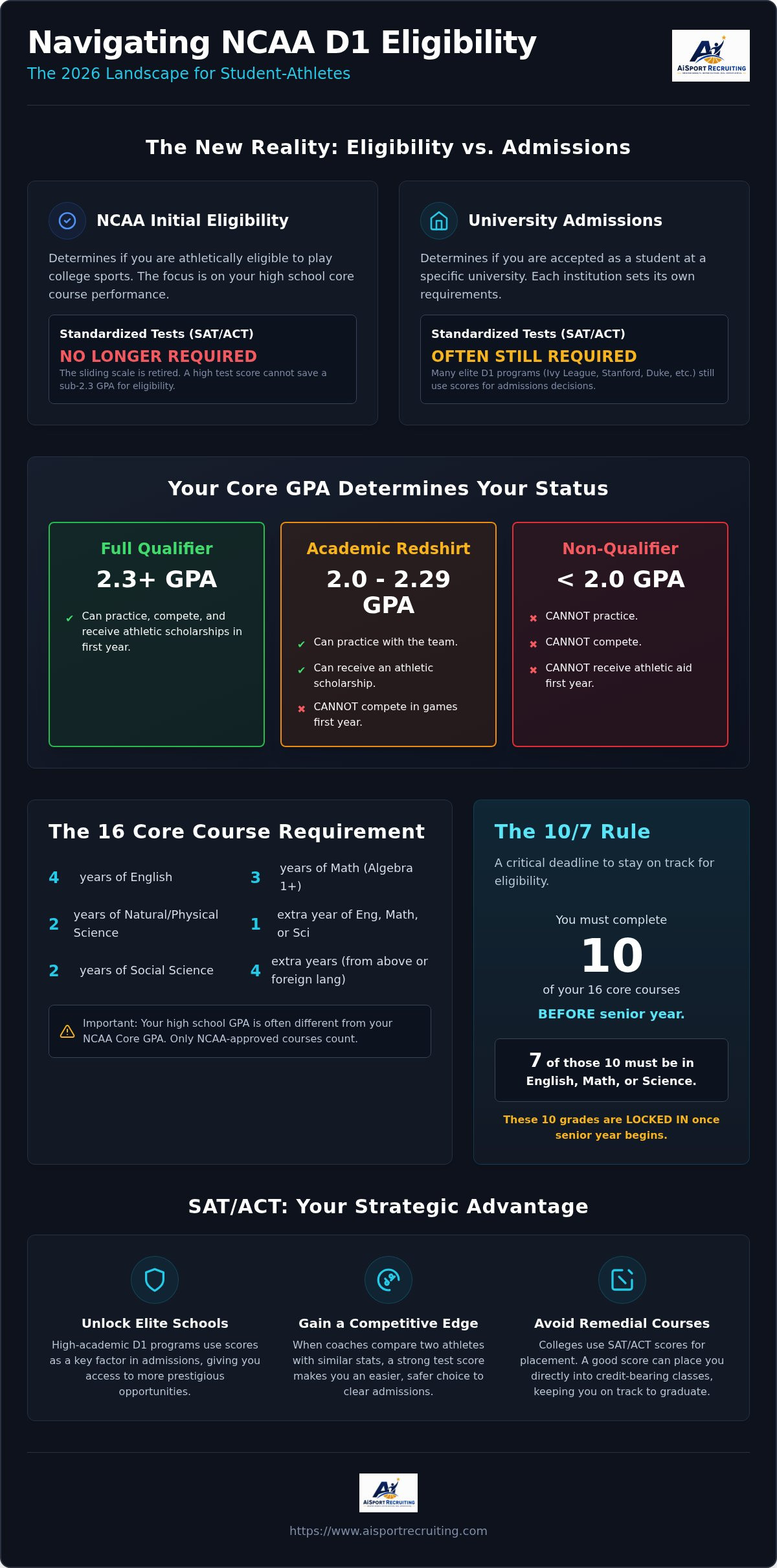
NCAA eligibility is determined by the NCAA Eligibility Center. It establishes whether a student-athlete is academically cleared to practice, compete, and receive athletic scholarships at NCAA Division I or Division II programs. The NCAA Eligibility Center evaluates core course completion, core GPA, and in some cases standardized test scores based on current NCAA rules. Families should verify current NCAA eligibility standards directly at ncaa.org.
University admission is determined by the individual university's admissions office. It establishes whether a student is admitted to attend the institution. Many universities — including some that compete at the NCAA Division I level — have their own SAT or ACT requirements for admission that are separate from and independent of NCAA eligibility standards.
An athlete can be cleared by the NCAA Eligibility Center but still not be admitted to a specific institution if they do not meet that institution's admission standards. Both clearances are required before an athlete can compete.
This distinction matters because an athlete who focuses only on meeting NCAA eligibility minimums may still find doors closed at specific programs — not because of NCAA rules but because of that institution's independent admissions requirements.
NCAA Academic Eligibility — The General Framework
For student-athletes entering NCAA Division I or Division II programs directly from high school the NCAA Eligibility Center evaluates academic eligibility based on core course completion and core GPA.
Families must verify current specific standards — including exact GPA thresholds, core course requirements, and any test score provisions — directly at ncaa.org as rules change periodically.
Core courses: NCAA Division I and Division II eligibility requires completion of a specific set of core courses across subject areas including English, mathematics, natural science, social science, and additional courses. Families should confirm that their specific courses are NCAA approved through the high school's listing on the NCAA Eligibility Center portal — a course that does not appear on the approved list does not count toward core course requirements regardless of the grade earned.
Core GPA: The NCAA calculates a core GPA based only on the approved core courses — not the overall high school GPA families see on report cards. This NCAA core GPA is frequently different from the school-reported GPA and is the figure that determines eligibility status. Families should verify current minimum core GPA thresholds at ncaa.org.
Standardized test scores: The role of standardized test scores in NCAA eligibility has evolved in recent years. Families should verify the current NCAA policy regarding standardized test scores for eligibility determination directly at ncaa.org before making any decisions about testing strategy.
Full Qualifier, Academic Redshirt, and Non-Qualifier
NCAA Division I eligibility generally places entering students into one of three categories based on academic standing. Verify current thresholds for each category at ncaa.org.
Full Qualifier: Meets all current NCAA academic standards. Can practice, compete, and receive athletic scholarships during the first year of enrollment.
Academic Redshirt: Meets some but not all current NCAA academic standards. Can receive a scholarship and practice but cannot compete in games during the first year.
Non-Qualifier: Does not meet minimum NCAA academic standards. Cannot practice, compete, or receive athletic aid during the first year.
Understanding which category a student-athlete is on track to enter — and identifying that as early as sophomore year — gives families time to address any gaps before the recruiting process reaches its most critical windows.
The 10/7 Rule — Why Junior Year Matters
The NCAA requires that a specified number of core courses be completed before the start of a student-athlete's seventh semester of high school — the beginning of senior year. This is commonly called the 10/7 rule. Verify current specific requirements at ncaa.org.
The key principle is that a portion of required core courses must be completed and locked in before senior year begins. Courses taken after the seventh semester starts cannot be used to meet this specific requirement retroactively.
Families who discover a core course gap at the beginning of senior year may not be able to close it in time. Identifying and addressing potential gaps during sophomore and junior year is the most reliable approach.
Do SAT Scores Still Matter for Student-Athletes?
The honest answer is — it depends on which programs the athlete is targeting and for what purpose.
For NCAA initial eligibility: Verify the current NCAA policy on standardized test scores directly at ncaa.org. Current standards should be confirmed before any testing strategy is built around eligibility assumptions.
For university admissions: Many universities continue to use SAT or ACT scores as part of their independent admissions process regardless of NCAA eligibility standards. An athlete targeting programs at highly selective universities should research each institution's current admissions requirements directly.
For academic scholarships: Some universities use standardized test scores in determining eligibility for institutional academic scholarships separate from athletic aid. Families interested in combining academic and athletic financial aid should research each institution's specific policies directly.
The general principle — standardized test scores may no longer be the primary driver of NCAA initial eligibility but they remain relevant to the broader process of gaining admission and funding at many programs.
NCAA vs. NAIA Eligibility — A Brief Comparison
This article focuses specifically on NCAA Division I and Division II eligibility. NAIA eligibility follows a different framework with a separate eligibility center — PlayNAIA. For a complete guide to NAIA eligibility read our Complete NAIA Eligibility Checklist.
NCAA Division III programs do not require NCAA Eligibility Center clearance in the same way as Division I and Division II. Division III institutions manage their own academic requirements through their admissions offices.
For a complete comparison of what each division level offers read our NCAA Division I II III NAIA NJCAA Guide.
Academic Eligibility Checklist for NCAA Student-Athletes
Use this checklist as a structured starting framework. Verify all current requirements at ncaa.org before taking action.
✓ Register with the NCAA Eligibility Center early. Ideally during freshman or sophomore year to identify any potential gaps before they become problems.
✓ Confirm which courses at your high school are NCAA approved. Only approved courses count toward core course requirements.
✓ Track your core course completion against the current requirement. Verify the current number and distribution at ncaa.org and map your current schedule against that requirement.
✓ Understand the junior year core course deadline. A specified number of core courses must be completed before the start of senior year. Verify at ncaa.org and confirm your athlete is on track during sophomore and junior year.
✓ Calculate your NCAA core GPA — not your school GPA. Based only on approved core courses. Use the NCAA's core GPA calculator to understand where you stand.
✓ Research each target program's individual admissions requirements. NCAA eligibility clearance does not guarantee admission to any institution.
✓ Determine whether standardized testing is required for your target programs. Some institutions require SAT or ACT scores for admission regardless of NCAA policy changes.
✓ Understand the early enrollment deadline if applicable. Athletes planning to enroll early must complete all requirements and receive Eligibility Center clearance before the January enrollment date. Verify at ncaa.org.
✓ Understand reclassification implications. Moving your graduation date earlier compresses your core course completion timeline. Verify requirements and confirm your timeline before reclassifying.
Ready to See Which Programs Match Your Athlete's Academic and Athletic Profile?
Before reaching out to any program families benefit from knowing which programs represent genuine academic and athletic fits.
✅ 10 personalized college program recommendations
✅ Detailed Top 3 Why You Match explanations
✅ Personalized athlete development recommendations including academic guidance
✅ No cost. No obligation. No credit card required.
👉 www.AiSportRecruiting.com
Common Academic Mistakes Families Make
Assuming the NCAA GPA is the same as the school GPA. The NCAA calculates core GPA using only approved core courses. Many families find their NCAA core GPA is lower than expected because elective courses they assumed counted do not.
Assuming test-optional university policies mean scores do not matter. University admissions policies and NCAA eligibility standards are separate. Even if a university's general admissions process is test-optional athletic admissions at that institution may still use test scores.
Not verifying course approval before taking a class. A course not on the approved list does not count toward core course requirements regardless of the grade earned.
Waiting until senior year to identify gaps. Core course requirements that need to be met before senior year cannot be addressed retroactively.
Not researching individual university admissions standards. NCAA eligibility clearance does not mean admission to any institution.
For more on what coaches evaluate academically read our What College Coaches Actually Look For guide.
Why Academic Preparation Matters for Recruiting
Coaches evaluate academic risk. A student-athlete whose academic profile raises eligibility concerns is a higher risk for a coaching staff. Coaches prefer academically stronger profiles when evaluating equally talented athletes.
Academic standing affects division-level fit. Programs at academically selective institutions have independent admissions standards that set a practical floor on the academic profile they can recruit regardless of NCAA eligibility rules.
Financial aid opportunities. Institutional academic scholarships at many programs are independent of athletic aid. Athletes with strong academic profiles may be eligible for institutional aid that complements athletic scholarship packages.
For a complete guide to how academic profile affects division-level fit read our How to Find the Right College Athletic Fit guide and our When Should You Start College Sports Recruiting guide.
How AiSportRecruiting Supports Families Navigating Academic Eligibility
AiSportRecruiting was founded by Coach Jackson after more than 30 years serving as a High School Athletic Director and coaching at the high school, AAU, and college levels — helping more than 300 student-athletes earn college scholarship opportunities across his career.
The platform compares each student-athlete's academic and athletic profile against AiSportRecruiting's current verified database of 888 collegiate programs across NCAA Division I, Division II, Division III, NAIA, and NJCAA — returning personalized college matches, detailed Top 3 explanations, and athlete development guidance including academic recommendations. All at no cost with no credit card required.
For more on how the platform works read our College Recruiting Platform for Student Athletes guide.
AiSportRecruiting currently supports student-athletes in three sports:
🏀 Boys Basketball
🏀 Girls Basketball
🏈 Football
Additional sports are in development and will be introduced as they complete AiSportRecruiting's quality validation process.
The AiSportRecruiting Standard
Everything AiSportRecruiting publishes and every recommendation the platform produces is guided by one principle:
Families deserve recruiting information they can trust.
That means accuracy before assumptions. Evidence before opinion. Families before technology. Opportunity for every athlete across every level of college athletics. And transparency in every recommendation we provide.
AiSportRecruiting does not guarantee scholarships, roster positions, coach responses, or recruiting offers. The platform provides honest, evidence-based recruiting intelligence designed to help families navigate the recruiting process with greater clarity and confidence.
That is the AiSportRecruiting Standard.
NCAA academic eligibility is one of the most important and most misunderstood aspects of the college athletic recruiting process. Understanding the distinction between NCAA eligibility clearance and university admission — and preparing for both — gives student-athletes the strongest possible foundation.
Start early. Verify current requirements at ncaa.org. Research each target program's individual admissions standards. Do not wait until senior year to address gaps that should have been identified in sophomore or junior year.
Every recruiting journey is different — but every family deserves access to accurate information, honest guidance, and the opportunity to pursue the college path that best fits their student-athlete.
Ready to Move From Research to Action?
Start with your free Match Report — then activate your 30-Day Standard Trial when you are ready to begin coach outreach.
The Coach Outreach Agent introduces your athlete to all 10 matched programs within 24 hours, follows up with non-responding programs on Day 7, and provides a personalized engagement report on Day 14. After the trial the Standard subscription continues at $24.99 per month unless canceled. Reminder emails are sent before the first charge.
👉 Activate Your 30-Day Free Trial — AUTOSEO30
Because every student-athlete deserves the opportunity to be seen. And every family deserves recruiting information they can trust.
Frequently Asked Questions
Do student-athletes need SAT scores for NCAA eligibility in 2026?
In many cases standardized test scores are no longer the primary factor in NCAA initial eligibility. However SAT or ACT scores may still matter for university admissions, academic scholarships, or specific institutions. Verify the current NCAA policy at ncaa.org and each target institution's admissions requirements directly.
What is the difference between NCAA eligibility and university admission?
The NCAA Eligibility Center determines whether a student-athlete meets academic standards to compete in NCAA athletics. The university's admissions office determines whether the student is admitted to attend. Both are required. NCAA eligibility clearance does not guarantee admission to any specific institution.
What is the NCAA core GPA and how is it different from my school GPA?
The NCAA calculates a core GPA using only courses that appear on the high school's list of approved NCAA core courses. This core GPA is frequently different from the school-reported GPA and is the figure used for eligibility determination. Verify current core GPA requirements at ncaa.org.
What is the 10/7 rule?
The 10/7 rule refers to an NCAA requirement that a specified number of core courses be completed before the start of a student-athlete's seventh semester — the beginning of senior year. Core course completion cannot be addressed retroactively after the seventh semester begins. Verify current specific requirements at ncaa.org.
What is the difference between a Full Qualifier, Academic Redshirt, and Non-Qualifier?
Full Qualifiers can practice, compete, and receive scholarships in their first year. Academic Redshirts can receive scholarships and practice but cannot compete in games in their first year. Non-Qualifiers cannot practice, compete, or receive athletic aid in their first year. Verify current standards for each category at ncaa.org.
Should student-athletes still take the SAT or ACT even if not required for NCAA eligibility?
Many universities continue to use standardized test scores in their independent admissions process regardless of NCAA policy. Research each target institution's current requirements directly before deciding whether to test.
Does the NCAA count middle school courses toward core course requirements?
In some cases middle school courses may count if they appear on the high school transcript with a grade and credit. Verify the current policy at ncaa.org and confirm with the high school counselor whether specific courses qualify.
Does AiSportRecruiting guarantee NCAA eligibility clearance?
No. AiSportRecruiting provides data-driven program matching and recruiting intelligence. NCAA eligibility determination is made by the NCAA Eligibility Center based on each student-athlete's individual academic record.
Which sports does AiSportRecruiting currently support?
AiSportRecruiting currently supports Boys Basketball, Girls Basketball, and Football. Additional sports are in development.


