
Most athletes think the campus visit is the finish line, but in the competitive 2026 recruiting cycle, it's actually just the opening whistle. You've toured the facilities and met the staff, yet now you're staring at a blank email draft, worried that one "pushy" sentence might ruin your hard-earned momentum. It's a high-stakes moment where silence is your biggest enemy, but being annoying is a close second. You want to stay on the radar without crossing the line into desperation, especially when you're competing against hundreds of other talented recruits for a single roster spot.
We understand that mastering how to follow up with a college coach after a visit is what separates top-tier prospects from the rest of the pack. This guide provides a clear, professional pathway to turn a polite "thank you" into a strategic data-update that validates your fit for the program. You'll gain access to a precise communication timeline and email templates designed to get replies from busy recruiting coordinators. We will also show you how to use your visit notes to improve your "Fit Score," ensuring you remain a priority on their 2026 board through a modern, data-driven approach.
The Strategic Importance of the Post-Visit Follow-Up
The campus visit is a significant milestone, but it doesn't guarantee a roster spot. Knowing how to follow up with a college coach after a visit is the specific skill that moves you from a name on a list to a priority on the recruiting board. Coaches evaluate hundreds of athletes every season. If you don't confirm your interest immediately, they often assume you've moved on to another program. This communication is your "recruiting close," where you transition from being a passive prospect to an active, engaged recruit.
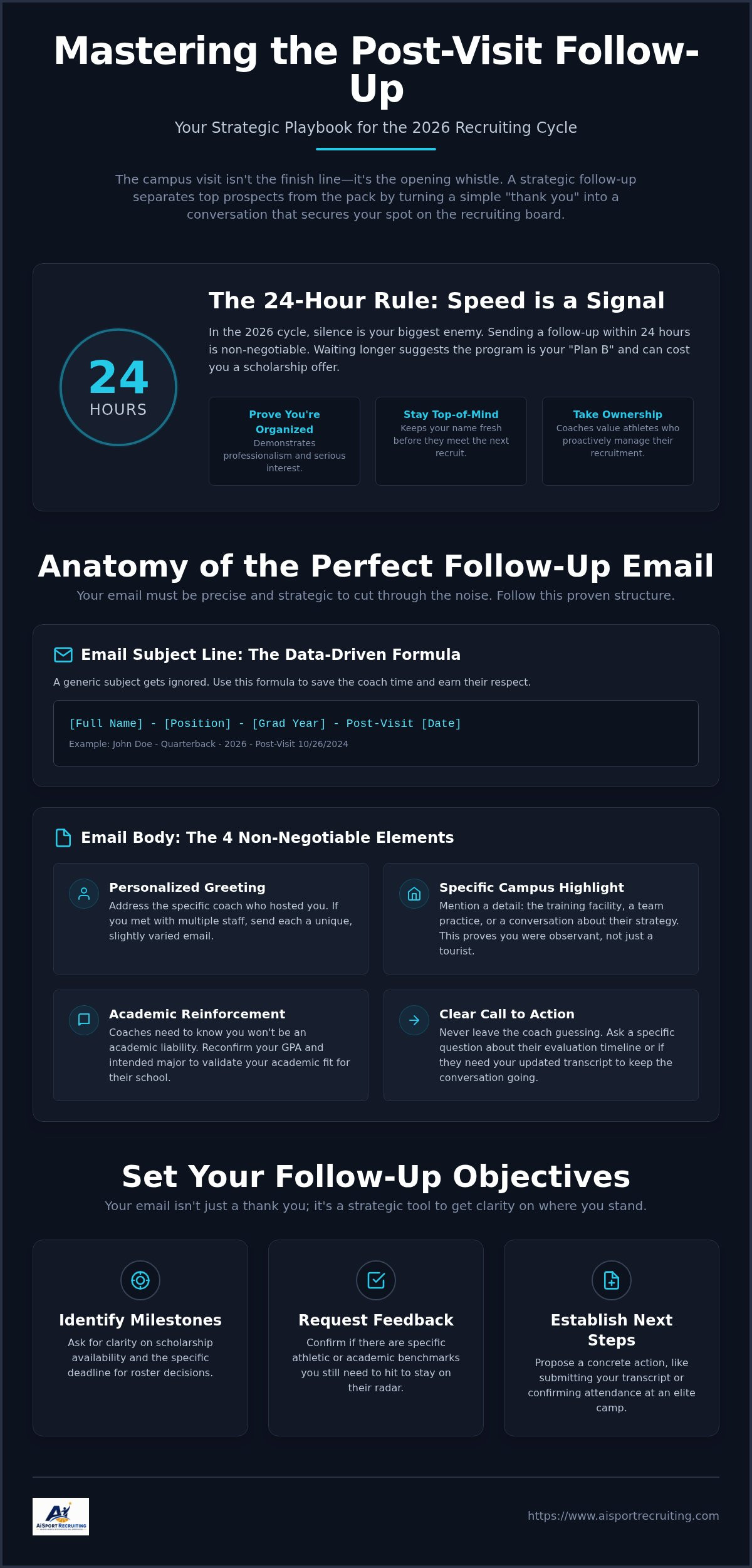
Speed serves as a vital signal in the 2026 cycle. Sending a message within 24 hours proves you are organized and serious. It keeps your face and your performance fresh in the coach's mind before they pivot to the next recruit on their schedule. Waiting too long suggests the program is your "Plan B," which is a quick way to lose a scholarship offer to someone more responsive. Coaches want to invest their time in athletes who are clearly invested in them.
Many athletes hesitate because they fear being too pushy. In reality, college coaches are looking for prospects who take ownership of their journey. They don't have time to chase every visitor who walks through their doors. By initiating the follow-up, you demonstrate the professional maturity required to succeed at the collegiate level. You aren't just a player; you're showing that you can handle the administrative and social responsibilities of a high-level program.
The 2026 Recruiting Landscape
The current environment is tighter than ever. With the transfer portal moving at high speed, coaching staffs are under pressure to fill spots with "sure things" who won't hesitate when an offer is extended. They rely on Fit Scores and internal data to compare prospects across 888 verified programs. Recruiting Momentum is the temporary window of high-interest and emotional connection established during an in-person meeting that begins to fade the moment you leave campus. To combat this decay, your follow-up must be immediate and include specific details from your conversations with the staff.
Setting Your Follow-Up Goals
Your email needs a purpose beyond simple gratitude. You are looking for clarity on where you stand in their current hierarchy. Use this communication to reach the following objectives:
- Identify Milestones: Ask for clarity on scholarship availability or the specific deadline for roster decisions.
- Request Feedback: Confirm if there are specific athletic or academic benchmarks you still need to hit.
- Establish Next Steps: Propose a concrete action, such as submitting an official transcript or confirming your attendance at an upcoming elite camp.
This approach turns a polite gesture into a strategic tool. It forces a response and keeps the conversation moving toward a commitment.
The 24-Hour Thank You Checklist: What to Include
Timing is everything in the 2026 recruiting cycle. Your visit might have ended, but the evaluation process continues the moment you step off campus. To master how to follow up with a college coach after a visit, you need a structured approach that avoids generic fluff. Coaches receive hundreds of emails daily; yours must be surgical in its precision to stay at the top of their priority list.
Email Subject Line Strategies
Coaches scan inboxes for specific identifiers to prioritize their reading. A vague subject line like "Great Visit" often gets buried or ignored. Instead, use a data-driven formula: "[Full Name] - [Position] - [Grad Year] - Post-Visit [Date]". Including your Match Report ID or Fit Score immediately signals that you've done the work to verify your compatibility with their specific program requirements. It saves the recruiting coordinator time, which is the fastest way to earn their respect in a crowded inbox.
Every follow-up must contain four non-negotiable elements to be effective:
- Personalized Greeting: Address the specific coach or recruiting coordinator who hosted you. If multiple coaches spent time with you, send individual, slightly varied notes to each.
- The Campus Highlight: Mention a specific facility, the intensity of a team practice, or a particular conversation about their offensive or defensive scheme. This proves you were an observant recruit, not just a tourist.
- Academic Reinforcement: Coaches need to know you won't be a liability. Reconfirming your current GPA and intended major helps prove your academic fit within their specific institution.
- The Call to Action: Never leave the coach guessing about what happens next. Ask a specific question about their evaluation timeline or whether they need your updated senior year transcript.
The Anatomy of a Perfect Follow-Up Email
Start with a professional opening that expresses sincere gratitude for their time. Mention the specific date of your visit to help them quickly reference their notes. In the body of the email, connect a visit observation to your personal athletic goals. If the coach mentioned a need for more disciplined defenders, briefly explain how your current training reflects that priority. It's about showing, not just telling, that you belong on their roster.
Close with a professional sign-off and include a direct link to your updated highlight reel. This ensures the coaching staff has every data point they need to move you to the next stage of the process without having to search for your profile. If you aren't sure where you stand compared to other recruits, using a platform like AiSportRecruiting can help you benchmark your profile against 888 verified programs before you send that final click.
Engaging the Recruiting Coordinator vs. the Head Coach
While the head coach is the face of the program, the Recruiting Coordinator (RC) is the gatekeeper of the 2026 roster. Most athletes make the mistake of focusing all their energy on the head coach, ignoring the person who actually manages the recruiting board and daily communications. In a modern athletic department, the head coach relies on the RC to filter hundreds of prospects down to a manageable list of priority targets. If you haven't won over the coordinator, your film might never reach the head coach's desk for a final evaluation.
Identifying the right contact person is your first task after leaving campus. Review the staff directory or your visit itinerary to see who coordinated your schedule. Usually, this is the Director of Player Personnel or the Recruiting Coordinator. When you determine how to follow up with a college coach after a visit, you should tailor your message based on their specific role. Use your communication with the head coach to discuss technical athletic fit or program culture. Save the logistical questions, such as transcript submissions or camp dates, for the coordinator.
Think of the Recruiting Coordinator as your primary internal advocate. This is the "Scout Agent" approach. By being professional, responsive, and organized, you make their job easier. When a coordinator likes a recruit's "off-field" maturity, they are far more likely to push that athlete's name during staff meetings. You want them to be the one saying, "This player is a perfect fit and has been incredibly proactive since their visit."
Building the Coordinator Relationship
Ask the coordinator for the program's specific recruiting timeline for your position. Do they plan to extend offers after their summer elite camp, or are they waiting for mid-season senior film? Provide them with "easy-to-share" data, such as a one-page PDF of your Match Report or a direct link to your latest highlight reel. This allows them to forward your information to the rest of the staff with a single click. To keep this connection active without manual errors, many athletes use automated coach outreach to ensure they stay on the staff's radar during the busiest weeks of the season.
Handling Non-Responses Professionally
Silence doesn't always mean "No." Coaches at all 888 verified programs are balancing current rosters, transfer portal windows, and their own game schedules. Follow the "7-Day Rule": if you haven't received a reply within a week, send a polite "nudge" that provides a new piece of value, such as an updated test score or a recent game stat. If a coordinator goes silent for more than two weeks, pivot your strategy by sending a high-value update like a new "Game of the Week" highlight to the position coach to restart the momentum from a different angle.
Using Visit Data to Refine Your Top 10 Match Report
The campus visit is more than a tour; it's a high-stakes data collection mission. While you're on the ground, you gather qualitative information that helps you refine your entire recruiting strategy. Learning how to follow up with a college coach after a visit involves synthesizing what you saw with the hard facts of your recruitment. If the facility tour was impressive but the academic support felt like an afterthought, your Fit Score needs a manual adjustment. You aren't just looking for a school that wants you; you're looking for the program that provides the best return on your athletic and academic investment.
Objectivity is your greatest asset during the 2026 cycle. It's easy to get swept up in the excitement of a packed stadium or a high-end locker room. However, you must cross-reference coach promises with historical data from 888 verified programs to ensure the pitch matches reality. If a coach claims they "rarely use the portal" but data shows they took five transfers at your position last year, that's a data point you can't ignore. Use your follow-up period to rank your visits against each other using a consistent, objective framework.
The Post-Visit Evaluation Checklist
Run every visit through this three-point filter before sending your next round of communication:
- Academic Support: Did you see the tutoring centers and study halls in person? A program's commitment to your degree is often visible in the quality of their dedicated academic space.
- Player Development: Does the weight room and training staff match your specific physical needs? Look for programs that have a clear plan for your 2026 development cycle.
- Roster Depth: Ask specifically how many 2026 recruits they are taking at your position. If they are over-recruiting your spot, your path to the field might be blocked.
Validating the "Coach Pitch"
Watch for red flags in how the staff communicates once you leave campus. A coach who was high-energy during the visit but takes two weeks to reply to a simple question is sending a clear signal about your priority level. Use AI tools to verify if a program is truly "elite" or if they are simply a high-volume recruiter. Adjust your target list based on the actual level of interest shown. If a program isn't reciprocating your energy, move them down your Top 10 and focus on the matches where your engagement is being rewarded. Compare your visit data with a Free Match Report to see where you truly stand.
Maintaining Momentum: The Smart Follow-Up Schedule
Consistency is the final piece of the recruiting puzzle. Mastering how to follow up with a college coach after a visit requires more than a single "thank you" note. It demands a sustained communication rhythm that mirrors a professional development cycle. You've already established the initial spark; now you must protect that investment by staying visible without being overbearing. Coaches at 888 verified programs are constantly updating their 2026 boards. If you aren't providing regular updates, you're effectively allowing other recruits to outwork you for that roster spot.
Your post-visit communication should follow a logical, three-stage progression to ensure you remain a priority:
- The Day 1 Thank You: Send this immediately to express gratitude and reconfirm your genuine interest in the program. Mention one specific detail you learned during the visit to prove you were paying attention.
- The Day 7 Update: Use this as a "nudge" to keep the conversation alive. Attach a specific piece of new film, a recent stat line from a game, or an updated academic transcript.
- The Monthly Check-In: Keep your name in their database as you progress through your season. These updates should be brief and focused on your growth as an athlete and a student.
Managing this level of outreach across multiple programs is challenging. Many elite recruits utilize Smart Follow-Up tools to automate the process. This ensures no program falls through the cracks while still maintaining the personal touch required to build a real relationship with the coaching staff.
When to Send Performance Updates
Coaches want to see progress, not just participation. When formatting a "Highlight Update," keep the clips under 30 seconds and focus on the specific skills the coach mentioned during your visit. If you've seen improvements in measurable metrics like your 40-yard dash, vertical jump, or shooting percentage, lead with those numbers. A Value-Add follow-up provides a new, tangible data point that improves your recruiting profile, whereas a "Checking In" follow-up offers no new information and risks becoming a nuisance.
Transitioning to the Official Offer
As your communication continues, watch for signals that a coach is ready to move from "interested" to "offering." These signals often include direct cell phone access to the head coach, invitations to unofficial game-day visits, or detailed questions about your family's timeline. When the timing feels right, ask a direct, professional question about the next steps in their scholarship process. This shows you are ready to make a decision. To ensure you are focusing your energy on the right programs, get your Top 10 Match Report to see which coaches you should be following up with today.
Turn Your Campus Visit into a Commitment
The campus visit is a powerful tool, but its value depends entirely on your execution once you leave the facilities. By prioritizing the 24-hour thank you note and building a professional rapport with the Recruiting Coordinator, you prove that you possess the maturity required for the collegiate level. Don't let your recruitment stall by relying on a "wait and see" approach. Mastering how to follow up with a college coach after a visit is the final hurdle between being a visitor and becoming a rostered athlete in the 2026 cycle.
Success in this competitive landscape requires a blend of personal effort and modern technology. Led by 30-year recruiting veteran Coach Jackson, our platform scans 888 verified programs to ensure you are targeting the schools where you actually fit. You can take control of your future today without any financial risk. Get Your Free Top 10 Match Report & Automate Your Follow-Ups with no credit card required. You've done the hard work on the field; now it's time to use the right data to close the deal and secure your spot on the roster.
Frequently Asked Questions
How long should I wait to email a college coach after a visit?
You should send your initial email within 24 hours of leaving campus. Speed is a vital signal that you are organized and serious about the program. Waiting longer than 48 hours allows your recruiting momentum to decay as coaches move on to the next set of visitors. This is the most critical window for how to follow up with a college coach after a visit to ensure you stay at the top of their 2026 board.
Should I text a college coach or email them after a campus visit?
Email is the professional standard for your primary thank-you note. It allows you to include structured data like your Match Report or updated highlight links. Only send a text message if the coach has already initiated a text conversation with you or explicitly requested that you use their mobile number. Keeping the initial follow-up in an email thread ensures the entire coaching staff can easily access your information.
What if a coach doesn’t reply to my follow-up email after a visit?
Follow the 7-Day Rule if you don't receive an immediate response. Wait one full week before sending a polite nudge that includes a new piece of value, such as a recent game stat or an updated test score. Coaches at all 888 verified programs deal with massive inbox volume. A lack of a reply usually means they are busy; it doesn't necessarily mean they have lost interest in your profile.
Is it okay to follow up with multiple coaches at the same school?
It is perfectly acceptable to message multiple coaches, provided you personalize each email. Send separate notes to the recruiting coordinator and the position coach rather than CC'ing them on one thread. This shows you've taken the time to understand their specific roles within the program. Tailor your message to the coordinator for logistics and to the position coach for technical athletic fit or feedback on your performance.
What is the best subject line for a post-visit follow-up email?
The best subject line follows a clear, searchable formula: [Full Name] - [Position] - [Grad Year] - Post-Visit [Date]. This structure allows a recruiting coordinator to identify your profile instantly in a crowded inbox. Including your Grad Year is essential for the 2026 cycle so coaches can categorize you correctly. A professional, data-driven subject line significantly increases your open rates and proves you understand the business side of college sports.
Should parents send a thank-you note to the coach as well?
Athletes must lead all communication to demonstrate professional maturity. Coaches are evaluating your independence and leadership skills as much as your athletic ability. While parents are a huge part of the support system, a parent sending a thank-you note can sometimes signal that the recruit isn't ready for the demands of a college roster. Let the coach see your voice and your commitment through your own direct outreach.
How often is too often when following up with a recruiting coordinator?
Following up once a week is generally the maximum frequency unless a coach asks for more. If you are in the middle of your season, a monthly check-in with a new highlight reel is a great way to maintain visibility. The key is to always provide a "value-add" rather than just asking for an update. Over-communicating without new data points can quickly move you from a priority to a nuisance.
Can I send a DM on social media as a follow-up after a visit?
Social media DMs should only be used as a secondary touchpoint to supplement your email. While DMs are great for sharing a quick highlight or reacting to a program's recent win, they aren't the place for formal recruitment talk. When learning how to follow up with a college coach after a visit, remember that coaches prefer a professional email thread where they can easily forward your transcripts and data to the rest of the staff.


