
Of the five dimensions families should evaluate when assessing a college athletic program — academic fit, athletic fit, system fit, roster fit, and institutional fit — academic fit is the one that gets the least attention and causes the most problems.
Families spend months researching athletic programs. They watch game film to understand coaching systems. They research roster composition to identify positional needs. They attend showcases to get in front of coaches. And throughout all of that preparation many families give academic fit only passing consideration — assuming their athlete will qualify for any program that wants them athletically.
That assumption is incorrect. And it is the source of some of the most painful and avoidable disappointments in the college recruiting process.
This guide explains specifically how academic fit affects athletic recruiting, what coaches evaluate before they ever watch a highlight reel, and how families can assess academic fit honestly before building a recruiting target list.
Is Your Athlete Academically Ready?
Ask yourself these four questions before reading further:
✓ Do you know your athlete's current GPA?
✓ Do you know whether it differs from the NCAA core GPA?
✓ Have you researched the admissions standards of your target schools?
✓ Is your athlete's academic performance improving each semester?
If you answered no to any of these this guide will help you build a more realistic recruiting plan.
What Academic Fit Actually Means
Academic fit is not simply about whether a student-athlete is smart enough to attend a particular institution. It is about whether the athlete's current academic profile — GPA, course rigor, test scores where applicable, and academic trajectory — aligns with what a specific program requires for admission and eligibility.
Academic fit has two distinct components that families need to understand separately.
Component 1 — NCAA or NAIA Eligibility
For student-athletes targeting NCAA Division I or Division II programs the NCAA Eligibility Center evaluates core course completion and core GPA to determine whether the athlete is cleared to practice, compete, and receive athletic scholarships. This is a separate process from university admission handled by a separate organization.
Families should verify current NCAA eligibility standards directly at ncaa.org. For NAIA programs eligibility is determined through PlayNAIA — a separate process with different academic standards. Verify current NAIA eligibility standards at naia.org.
For a complete guide to NCAA eligibility requirements read our Do You Need SAT Scores for NCAA Eligibility guide. For NAIA eligibility read our Complete NAIA Eligibility Checklist.
Component 2 — Institutional Admission Standards
Every college and university has its own admissions standards that are independent of NCAA or NAIA eligibility requirements. An athlete can be cleared by the NCAA Eligibility Center and still not be admitted to a specific institution because their academic profile does not meet that institution's independent admissions requirements.
This is the distinction most families miss. NCAA eligibility clearance opens the door to competing in NCAA athletics. It does not open the door to any specific institution. Each institution's admissions office makes that decision independently.
A coaching staff at an academically selective institution — regardless of division level — cannot recruit an athlete whose academic profile does not meet the institution's admissions standards. The coach may want the athlete. The athletic department may support the recruitment. But if the admissions office will not admit the student the recruitment ends there.
Why Coaches Evaluate Academic Profile Before Athletic Profile
When a college coach opens a recruiting email the first thing they are evaluating is not the highlight film link. It is the academic information in the message — graduation year, GPA, and academic standing. The film link gets clicked only after the academic profile passes the first filter.
There are two practical reasons for this.
Reason 1 — Eligibility risk.
A coaching staff that invests recruiting resources in an athlete who turns out to be academically ineligible has wasted scholarship budget, roster space, and recruiting effort. Coaches screen for academic eligibility first because the cost of recruiting an ineligible athlete is significant.
Reason 2 — Admissions reality.
At institutions with competitive admissions standards the coaching staff must advocate for an athlete's admission with the admissions office. That advocacy is only possible if the athlete's academic profile is within range of what the admissions office will consider. A coach who cannot make a credible academic case for an athlete to the admissions office cannot complete the recruitment regardless of how much they want the athlete.
For more on what coaches evaluate and in what order read our What College Coaches Actually Look For guide.
How Academic Profile Affects Division-Level Fit
One of the most practical applications of academic fit evaluation is understanding which division levels a student-athlete's current academic profile realistically opens.
This is not about labeling athletes as academically strong or weak. It is about honest evaluation of where a specific academic profile aligns with what specific programs require — because that alignment determines which programs are realistic recruiting targets.
Academically selective Division I programs.
Some Division I programs — particularly in academically prestigious conferences — have institutional admissions standards that effectively set a minimum academic floor for athletes they can recruit. An athlete whose GPA and course rigor fall significantly below that floor will not be admitted regardless of athletic talent.
Division II programs.
Division II institutions vary significantly in their academic selectivity. Some have admissions standards comparable to academically selective Division I programs. Others are more accessible. Research each specific institution's admissions standards rather than assuming Division II means less academically rigorous.
Division III programs.
Division III institutions do not require NCAA Eligibility Center clearance but many — particularly academically prestigious Division III programs — have highly competitive admissions standards. An athlete who cannot gain admission to a Division III institution cannot compete there regardless of athletic ability.
NAIA programs.
NAIA programs generally have more flexible academic admission standards than many NCAA programs though this varies by institution. The NAIA's eligibility framework focuses on overall academic performance rather than specific course-by-course evaluation. For many athletes whose academic profile creates challenges at NCAA programs the NAIA represents a genuine alternative with competitive athletics and scholarship opportunities.
NJCAA programs.
NJCAA programs provide a pathway for athletes whose academic profile needs additional development before four-year university admission. A strong performance at an NJCAA institution can open doors to four-year programs that would not have been accessible directly from high school.
For a complete comparison of what each division level offers read our NCAA Division I II III NAIA NJCAA Guide.
The Five-Fit Framework — Academic Fit in Context
AiSportRecruiting evaluates program fit across five dimensions — and academic fit is always the first filter applied because it determines which programs are realistic before any other dimension is evaluated.
Academic Fit — Does the athlete's current academic profile meet the institution's admission standards and the relevant eligibility organization's requirements?
Athletic Fit — Does the athlete's competitive level align with what the program is building?
System Fit — Does the athlete's specific skill set match what the coaching staff's system requires?
Roster Fit — Does the program have a genuine positional need in the athlete's graduation year?
Institutional Fit — Does the overall college experience the program provides match what the family is looking for?
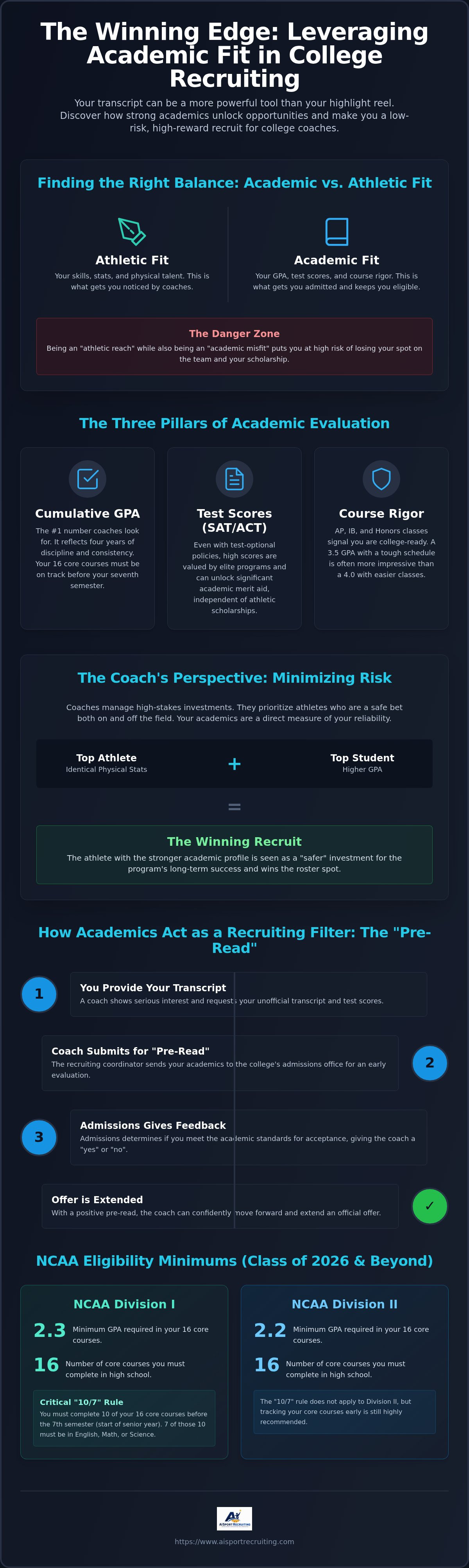
Academic fit is evaluated first because it is the most binary dimension. An athlete either meets a program's academic requirements or they do not. Every other dimension of fit is evaluated only for programs where the academic filter has been passed.
For a complete guide to evaluating fit across all five dimensions read our How to Find the Right College Athletic Fit guide.
The Academic Trajectory Factor
One dimension of academic fit that families frequently overlook is trajectory — not just where the athlete's GPA is today but where it is heading.
Recruiting is often based on where an athlete is headed — not just where they are today.
A student-athlete with a 2.8 GPA at the end of sophomore year who has shown consistent improvement each semester is on a different trajectory than a student-athlete with a 2.8 GPA whose grades have been declining. Coaches at programs that value academic performance can see both pictures from a transcript.
Why trajectory matters:
For NCAA programs the core GPA is calculated based on all approved core courses completed through the recruiting period. A rising trajectory improves the final core GPA meaningfully. A declining trajectory can reduce it below eligibility thresholds even if earlier grades were strong.
For admissions offices at competitive institutions academic trajectory signals whether a student is likely to succeed academically in a rigorous environment. A declining trajectory raises concerns that an improving one does not.
What families can do about trajectory:
Identifying academic challenges early — during freshman or sophomore year — and addressing them with appropriate support gives athletes time to improve their trajectory before the most critical recruiting windows open. Waiting until junior year to address academic gaps that began in freshman year produces outcomes that cannot be fully corrected in time.
For a complete grade-by-grade guide to academic and recruiting preparation read our When Should You Start College Sports Recruiting guide.
Common Academic Fit Mistakes Families Make
Targeting programs whose admissions standards exceed the athlete's academic profile.
This is the most common academic fit mistake. Families who direct recruiting outreach at academically selective programs without first confirming the athlete's profile meets those programs' admissions standards waste outreach effort and miss opportunities at programs where the athlete is a genuine academic fit.
Assuming NCAA eligibility clearance means admission.
NCAA eligibility clearance and university admission are separate processes. Clearing the NCAA Eligibility Center does not mean any specific university will admit the student.
Not calculating the NCAA core GPA separately from the school GPA.
The NCAA core GPA — based only on approved core courses — is frequently different from the school-reported GPA. Families who assume these numbers are the same are often surprised to find their NCAA core GPA is lower than expected.
Overlooking division levels where the academic profile is a genuine strength.
An athlete whose academic profile is strong relative to a Division II or NAIA program's admissions standards is a more attractive recruit. Academic strength is an asset in recruiting at every level where the athlete's profile exceeds the floor.
Waiting too long to address academic gaps.
Core course requirements that need to be completed before senior year cannot be addressed retroactively. Identifying and addressing academic gaps during freshman and sophomore year is the most reliable approach.
For more on the questions families should ask about academic support at specific programs read our 25 Questions Every Family Should Ask Before Choosing a College Athletic Program.
How AiSportRecruiting Evaluates Academic Fit
AiSportRecruiting was founded by Coach Jackson after more than 30 years serving as a High School Athletic Director — helping more than 300 student-athletes earn college scholarship opportunities across his career.
The platform compares each student-athlete's academic and athletic profile against 888 verified collegiate programs — returning personalized college matches, detailed Top 3 explanations, and athlete development guidance including academic recommendations. Academic fit is the first filter applied in the matching process ensuring every recommended program represents a realistic academic opportunity.
All at no cost with no credit card required.
For families ready to move from intelligence to action the 30-Day Standard Trial includes professional coach introductions to all 10 matched programs within 24 hours, Day 7 follow-up, and a Day 14 engagement report. After 30 days the subscription continues at $24.99 per month unless canceled.
👉 Activate Your 30-Day Free Trial — AUTOSEO30
For more on how the platform works read our College Recruiting Platform for Student Athletes guide.
AiSportRecruiting currently supports Boys Basketball, Girls Basketball, and Football. Additional sports are in development.
The AiSportRecruiting Standard
Families deserve recruiting information they can trust. Accuracy before assumptions. Evidence before opinion. Families before technology.
AiSportRecruiting does not guarantee scholarships, roster positions, coach responses, or recruiting offers. The platform provides honest evidence-based recruiting intelligence designed to help families navigate the recruiting process with greater clarity and confidence.
The strongest recruiting plan is not built around the most famous schools. It is built around the schools where your athlete can be admitted, compete, graduate, and thrive.
Academic fit is the first and most important dimension of finding that program. Families who evaluate it honestly — and who build their recruiting target list around programs where the athlete's academic profile is a genuine strength rather than a concern — consistently find more productive recruiting conversations than those who target programs where they are hoping academics will be overlooked because of athletic talent.
Every recruiting journey is different — but every family deserves access to accurate information, honest guidance, and the opportunity to pursue the college path that best fits their student-athlete.
Ready to See Which Programs Match Your Athlete's Academic and Athletic Profile?
✅ 10 personalized college program recommendations
✅ Detailed Top 3 Why You Match explanations
✅ Personalized athlete development recommendations including academic guidance
✅ No cost. No obligation. No credit card required.
👉 www.AiSportRecruiting.com
Because every student-athlete deserves the opportunity to be seen. And every family deserves recruiting information they can trust.
Frequently Asked Questions
What is academic fit in college athletic recruiting?
Academic fit is whether a student-athlete's current academic profile — GPA, course rigor, test scores where applicable, and academic trajectory — aligns with what a specific program requires for admission and eligibility. It has two components: eligibility clearance through the NCAA Eligibility Center or PlayNAIA, and institutional admission standards set independently by each university.
Why do coaches evaluate academic profile before watching film?
Coaches screen for academic eligibility first because recruiting an ineligible athlete wastes scholarship budget and roster space. At academically selective institutions coaches must also advocate for an athlete's admission with the admissions office — which is only possible if the academic profile is within range of what that office will consider.
Does NCAA eligibility clearance mean a university will admit the athlete?
No. NCAA eligibility clearance and university admission are two separate processes. Clearing the NCAA Eligibility Center means the athlete meets academic standards to compete in NCAA athletics. Whether any specific university admits the student is a separate decision made by that institution's admissions office.
How does academic profile affect which division level is realistic?
Each division level has different academic requirements. Some Division I programs have highly selective admissions standards. Division III programs vary significantly in selectivity. NAIA programs generally have more flexible academic standards. An honest evaluation of academic profile against specific institutional admissions standards — not just eligibility minimums — determines which programs are realistic recruiting targets.
What is the difference between school GPA and NCAA core GPA?
The NCAA calculates a core GPA using only approved core courses — not the full high school transcript. This core GPA is frequently different from the school-reported GPA and is the figure used for NCAA eligibility determination. Verify current core GPA requirements at ncaa.org.
How does academic trajectory affect recruiting?
Coaches and admissions offices evaluate not just current GPA but whether it is improving or declining. Recruiting is often based on where an athlete is headed — not just where they are today. Families who identify and address academic challenges early give athletes time to improve their trajectory before the most critical recruiting windows open.
Does AiSportRecruiting evaluate academic fit in its program recommendations?
Yes. Academic fit is the first filter applied in AiSportRecruiting's matching process — ensuring every program in a family's personalized match report represents a realistic academic opportunity. Every family receives 10 personalized program recommendations at no cost with no credit card required.
Which sports does AiSportRecruiting currently support?
AiSportRecruiting currently supports Boys Basketball, Girls Basketball, and Football. Additional sports are in development.


