
Your athlete has been working for years. Early mornings. Late practices. Academic discipline alongside athletic commitment. And now the college recruiting process is here — and nobody handed you a roadmap.
Most parents enter recruiting feeling like they are already behind. They are not sure what to do first, who to contact, or how to evaluate whether their athlete has realistic options at the level they are targeting. They spend money on showcases without knowing if the right coaches are attending. They contact head coaches when they should be contacting Recruiting Coordinators. They build target lists based on school names they recognize rather than programs where genuine fit exists.
This checklist is designed to change that.
Parents are often the primary organizer of the college recruiting process — managing timelines, tracking communications, researching programs, and keeping the athlete focused on development while the administrative work gets done. This guide gives parents a clear, stage-by-stage action plan built around AiSportRecruiting's proven methodology.
The AiSportRecruiting AIDA Standard
Every recruiting decision should follow four stages:
Attention — Understand what matters now.
Interest — Learn how the recruiting process works.
Desire — Build a realistic recruiting plan around genuine program fit.
Action — Take the next evidence-based step.
This checklist is organized around that sequence. At every stage the right action becomes clear when families follow this framework.
The AiSportRecruiting Five-Fit Framework — Your Evaluation Standard at Every Stage
Before diving into the stage-by-stage checklist families should understand the framework that governs every evaluation and every decision in this guide.
AiSportRecruiting evaluates college program fit across five dimensions. Academic fit comes first — always — because it is the most binary filter in the entire process. Every other dimension is evaluated only for programs where the academic filter has been passed.
The AiSportRecruiting Five-Fit Framework
Academic Fit — Does the athlete's academic profile meet the institution's admission standards and eligibility requirements?
Athletic Fit — Does the athlete's competitive level align with what the program is building?
System Fit — Does the athlete's specific skill set match what the coaching staff's system requires?
Roster Fit — Does the program have genuine positional need in the athlete's graduation year?
Institutional Fit — Does the overall college experience match what the family is actually looking for?
Every program on the target list should pass all five filters before outreach begins. Programs that fail any filter are not realistic targets — regardless of how recognizable the name is.
For a complete guide to evaluating fit across all five dimensions read our How to Find the Right College Athletic Fit guide.
The Parent's Role in College Recruiting
Before the stage-by-stage checklist one principle deserves clarity.
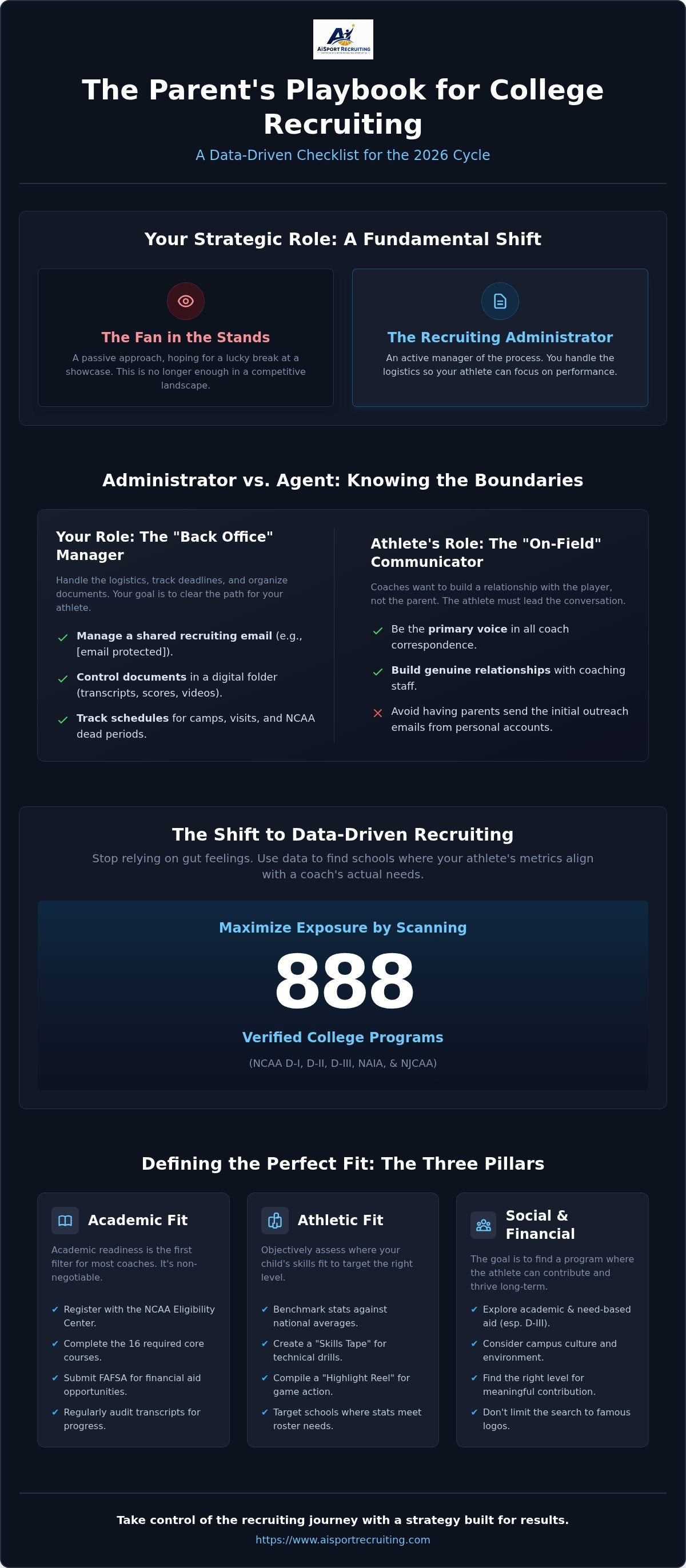
Parents manage the process. Athletes lead the communication.
Coaches want to build relationships with the athlete — not the parent. When outreach emails come from a parent's personal account rather than the athlete's it signals something coaches notice. The athlete should be the primary voice in every message to a coach.
The parent's role is the organizational back office — calendar management, deadline tracking, document organization, program research, and ensuring nothing falls through the cracks. That role is genuinely important and genuinely demanding. But it operates behind the scenes.
Setting up the parent-athlete organizing system:
Create a dedicated recruiting email address for the athlete — something professional like [email protected] — that both the athlete and parent can access and monitor.
Create a shared digital folder containing the athlete's current transcript, updated GPA, test scores where applicable, and highlight film link. This folder should be updated every semester.
Create a master tracking document with target programs, contact names, outreach dates, responses received, and follow-up schedules.
FRESHMAN YEAR CHECKLIST
The objective in freshman year is not to get recruited. It is to avoid creating problems that become difficult to fix later.
✓ Register with the NCAA Eligibility Center.
Even as a freshman. Early registration ensures the academic record is being tracked correctly from the beginning. Verify current registration guidance at ncaa.org.
✓ Confirm which courses at the athlete's high school are NCAA approved.
The NCAA core GPA — which determines eligibility — is calculated using only approved core courses. A course that does not appear on the approved list does not count regardless of the grade earned. Confirm course approval through the NCAA Eligibility Center portal.
✓ Establish the academic foundation.
Freshman year GPA contributes to the cumulative record colleges will eventually evaluate. Academic problems that begin in freshman year are difficult to reverse by junior year when recruiting windows open.
✓ Begin developing game film.
Quality game film takes time to accumulate. Freshman year film is the earliest baseline for athletic development. It does not need to be highlight-reel quality yet — but having footage that shows development over four years is genuinely valuable context for coaches.
✓ Research the collegiate landscape.
Understand what the different division levels offer — NCAA Division I, Division II, Division III, NAIA, and NJCAA. Where might the athlete's current trajectory realistically align in two to three years? For a complete division comparison read our NCAA Division I II III NAIA NJCAA Guide.
SOPHOMORE YEAR CHECKLIST
Sophomore year is when recruiting preparation becomes meaningfully more active — even though active outreach to most programs does not begin until later.
✓ Monitor the NCAA core GPA — not the school GPA.
These two numbers are frequently different. The NCAA calculates core GPA using only approved core courses. Verify current core GPA requirements at ncaa.org.
✓ Update the athlete's physical profile and statistics.
Sophomore year is when measurables begin to stabilize enough to be meaningful recruiting data. Height, weight, and position-specific performance statistics should be documented and updated regularly.
✓ Create a preliminary target program list.
Using the Five-Fit Framework begin identifying programs across every division level where a genuine academic and athletic fit may exist. This is research — not outreach.
✓ Prepare for Division II contact windows.
June 15 following sophomore year is when Division II coaches can begin making direct phone and electronic contact with recruits in most sports. Verify current contact window timing at ncaa.org.
✓ Create a free AiSportRecruiting match report.
AiSportRecruiting's free match report provides 10 personalized program recommendations based on the athlete's current academic and athletic profile — across every division level at no cost. Use it during sophomore year as a data-grounded starting point for the preliminary target list.
For a complete grade-by-grade guide read our When Should You Start College Sports Recruiting guide.
JUNIOR YEAR CHECKLIST
Junior year is the most important year in the college recruiting process. Scholarship budgets are being allocated. Recruiting boards are being built. This is the window the entire freshman and sophomore year preparation was building toward.
✓ Narrow the target list to 20 to 30 programs where genuine Five-Fit alignment exists.
Programs that do not pass all five fit filters should be removed regardless of how attractive they seem for other reasons.
✓ Identify the right contact at each target program.
At most Division I and Division II programs the Recruiting Coordinator — not the head coach — manages initial prospect evaluation. For a complete guide read our Who Should You Contact First guide.
✓ Initiate professional outreach to target programs.
The athlete sends the first message. Every message leads with academic credentials in the first sentence. Every message includes a direct film link that opens immediately without a login. For complete outreach guidance read our College Recruiting Email Templates guide and our Best Way to Contact College Coaches guide.
✓ Update game film continuously throughout junior year.
Junior year film carries the most weight in recruiting evaluation. New film should be added throughout the season.
✓ Follow up professionally and consistently.
A single unanswered message is not rejection. Professional follow-up with new information every two to three weeks keeps the conversation alive. For a complete follow-up framework read our Best Follow-Up Strategy guide.
✓ Schedule unofficial visits to programs showing genuine interest.
Use the 25 questions framework during every visit. For the complete question guide read our 25 Questions Every Family Should Ask guide.
✓ Apply the Four-Part Post-Visit Follow-Up Framework after every campus visit.
Reflect — Thank — Update — Continue. For the complete post-visit guide read our What to Do After a College Campus Visit guide.
✓ Review academic eligibility standing.
Verify the athlete's NCAA core GPA and confirm core course completion is on track. For complete eligibility guidance read our Do You Need SAT Scores for NCAA Eligibility guide.
For the complete junior year strategy read our Junior Year College Recruiting guide and our Ultimate Junior Year College Recruiting Strategy.
SENIOR YEAR CHECKLIST
Senior year looks different depending on what happened in junior year.
For families who completed the junior year preparation:
✓ Evaluate official visit invitations carefully.
Official visits are a strong signal of genuine interest. Use the 25 questions framework during every official visit.
✓ Evaluate financial aid packages with the full picture.
Athletic scholarships, institutional academic aid, need-based aid, and merit-based scholarships can all be combined at some programs. For complete financial guidance read our How Much Does a College Recruiting Service Cost guide.
✓ Understand the difference between a verbal commitment and a National Letter of Intent.
A verbal commitment is not binding. A signed NLI is. Do not sign anything without understanding exactly what is being agreed to.
✓ Make the decision from a position of honest fit evaluation — not pressure.
The right program is the one where this specific athlete will be academically eligible, athletically valued, positionally needed, developed meaningfully, and genuinely happy over four years.
For families beginning the process in senior year:
✓ Apply urgent targeted outreach to programs with confirmed positional needs.
Many Division II, Division III, NAIA, and NJCAA programs continue recruiting into the spring of senior year.
✓ Evaluate NJCAA as a genuine strategic option.
For a complete assessment read our Junior College Recruiting guide.
ONGOING PARENT CHECKLIST — APPLIES AT EVERY STAGE
✓ Keep the athlete's academic profile current and accurate — update every semester.
✓ Update game film regularly — strongest and most recent footage belongs at the beginning.
✓ Monitor the recruiting email account daily during active recruiting periods.
✓ Document every coach interaction — date, coach name, program, content, and follow-up timing.
✓ Evaluate programs honestly — not aspirationally.
✓ Ask the right questions at every program interaction. Read our 25 Questions Every Family Should Ask guide.
How AiSportRecruiting Supports Parents Through Every Stage
AiSportRecruiting was founded by Coach Jackson after more than 30 years serving as a High School Athletic Director and coaching at the high school, AAU, and college levels — helping more than 300 student-athletes earn college scholarship opportunities across his career.
The platform compares each student-athlete's academic and athletic profile against AiSportRecruiting's current verified database of 888 collegiate programs — returning personalized college matches, detailed Top 3 Why You Match explanations, and athlete development guidance at no cost with no credit card required.
Start with your free Match Report:
Before building a target list know where your athlete's current profile aligns across the full collegiate landscape.
✅ 10 personalized college program recommendations
✅ Detailed Top 3 Why You Match explanations
✅ Personalized athlete development recommendations
✅ No cost. No obligation. No credit card required.
👉 www.AiSportRecruiting.com
When you are ready to move from research to action:
Activate your 30-Day Standard Trial. The Coach Outreach Agent introduces your athlete to all 10 matched programs within 24 hours, follows up with non-responding programs on Day 7, and provides a personalized engagement report on Day 14.
After the trial the subscription continues at $9.99 per month unless canceled. Reminder emails are sent before the first charge.
👉 Activate Your 30-Day Free Trial — AUTOSEO30
AiSportRecruiting currently supports Boys Basketball, Girls Basketball, and Football. Additional sports are in development.
The AiSportRecruiting Standard
Families deserve recruiting information they can trust. Accuracy before assumptions. Evidence before opinion. Families before technology.
AiSportRecruiting does not guarantee scholarships, roster positions, coach responses, or recruiting offers. The platform provides honest evidence-based recruiting intelligence designed to help families navigate the recruiting process with greater clarity and confidence.
Great recruiting journeys rarely happen because families get lucky. They happen because families stay organized, make informed decisions, communicate professionally, and consistently take the next right step.
That is exactly what this checklist is designed to help you do.
The Five-Fit Framework. The Four-Part Post-Visit Follow-Up Framework. The AiSportRecruiting AIDA Standard.
These are the tools. The checklist above is the roadmap.
Every recruiting journey is different — but every family deserves access to accurate information, honest guidance, and the opportunity to pursue the college path that best fits their student-athlete.
Frequently Asked Questions
When should parents start organizing the recruiting process?
As early as freshman year — not to initiate outreach but to establish the academic foundation, register with the NCAA Eligibility Center, and begin understanding the collegiate landscape.
Should parents contact coaches directly?
Generally no. Coaches want to build relationships with the athlete. The parent's role is organizational — managing the back office while the athlete leads communication.
How many programs should be on the target list?
A targeted list of 20 to 30 programs where genuine Five-Fit alignment has been confirmed will consistently produce better results than broad outreach to every recognizable name.
What is the most important thing a parent can do in junior year?
Help the athlete initiate professional personalized outreach to target programs where genuine fit exists — and follow up professionally and consistently with new information every two to three weeks.
What should families do if the visit decreased interest in a program?
Be honest about it. Redirect recruiting energy toward programs where fit is stronger.
Does AiSportRecruiting guarantee recruiting outcomes?
No. AiSportRecruiting provides honest data-driven recruiting intelligence and structured outreach support. Scholarship offers and roster decisions belong to coaching staffs at individual institutions.
Which sports does AiSportRecruiting currently support?
AiSportRecruiting currently supports Boys Basketball, Girls Basketball, and Football. Additional sports are in development.


