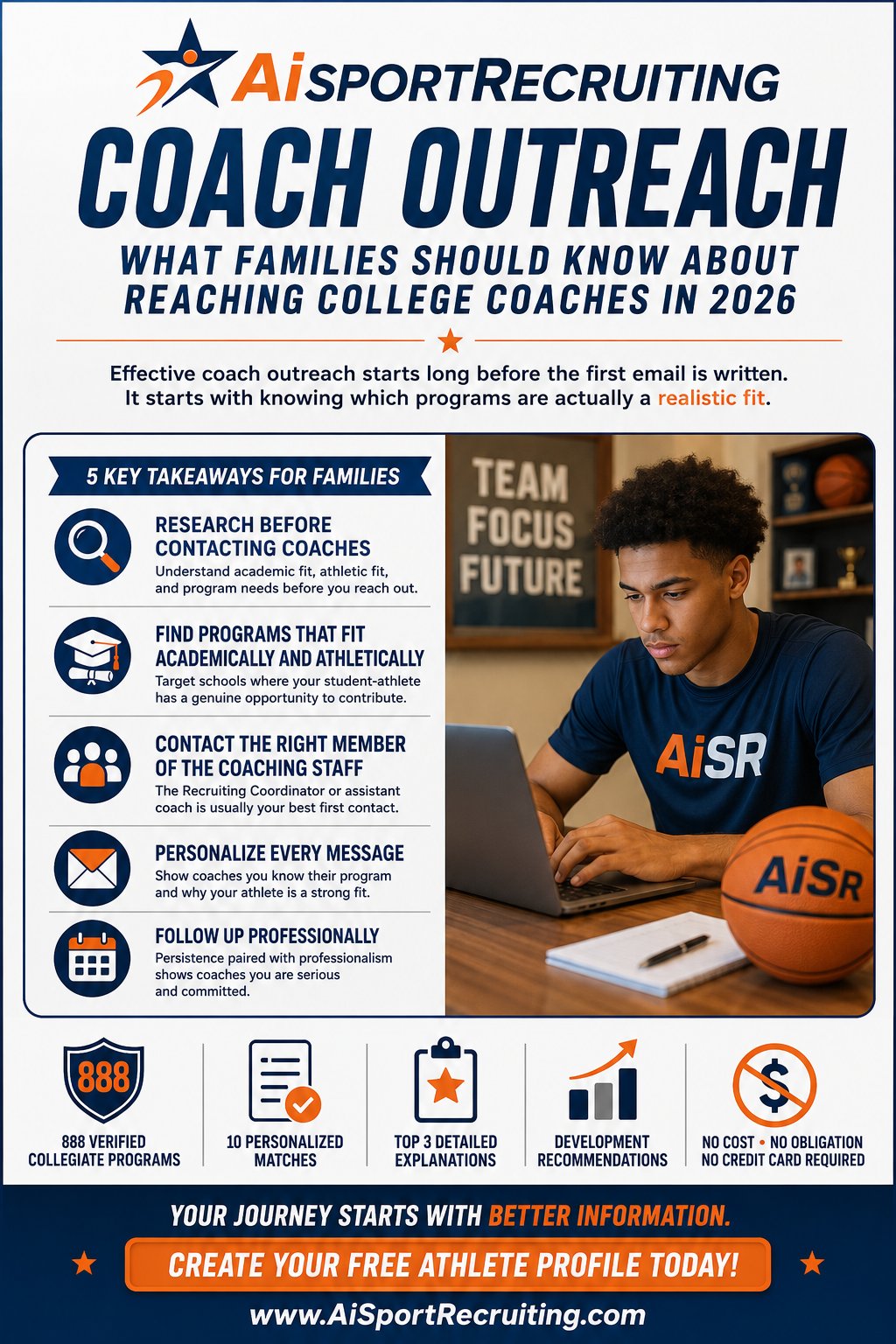
For student-athletes and their families the most time-consuming part of the college recruiting process is not identifying programs. It is reaching the right coaches at those programs with the right information at the right time — professionally, consistently, and at a scale that produces real results.
Most families who begin the recruiting process with genuine enthusiasm eventually encounter the same wall. Contacting twenty or thirty coaching staffs individually — researching each one, personalizing each message, tracking every response, following up appropriately — is a significant organizational undertaking that takes weeks of sustained effort before producing any meaningful results.
And that is before accounting for the reality that most initial outreach goes unanswered not because coaches are unresponsive but because the message reached the wrong person, arrived at the wrong time, or did not contain the information the coach needed to begin an evaluation.
A structured, systematic approach to coach outreach — one that ensures every introduction is professional, personalized, and directed at the right person at the right program — changes that experience entirely.
This guide covers how structured outreach works, what it produces for student-athletes and their families, and how AiSportRecruiting's Coach Outreach Agent approaches the introduction process on behalf of subscribers.
Get Your Free College Recruiting Match Report
Every athlete who creates a free profile on AiSportRecruiting receives:
✅ 10 personalized college program recommendations based on their academic and athletic profile
✅ Detailed explanations for the Top 3 recommended programs
✅ Personalized athlete development recommendations designed to strengthen future recruiting opportunities
✅ Recommendations spanning NCAA Division I, Division II, Division III, NAIA, and NJCAA
✅ No cost. No obligation. No credit card required.
Begin your free athlete profile today:
👉 www.AiSportRecruiting.com
Why Unstructured Outreach Produces Inconsistent Results
The most common approach families take to recruiting outreach is also the least effective one — sending individual emails to coaches one at a time, without a clear system for tracking responses, following up professionally, or ensuring consistent quality across every message sent.
This approach has several structural weaknesses that compound over time.
Inconsistent quality. When outreach is handled manually without a template or framework the quality varies from message to message. Some messages lead with academic credentials as they should. Others lead with athletic highlights without establishing eligibility. Some are professional and concise. Others are too long or too informal. That inconsistency reduces the overall effectiveness of the entire outreach campaign.
Poor tracking. Without a clear system for recording who was contacted, when the message was sent, what it contained, and what response was received families quickly lose track of where each program relationship stands. Programs fall through the gaps. Follow-up opportunities are missed. The organizational burden of managing outreach to twenty or thirty programs simultaneously becomes overwhelming.
Volume limitations. Manually researching and personalizing outreach to thirty programs while managing a full academic schedule, athletic commitments, and the rest of the recruiting process is genuinely difficult. The volume of outreach most families can sustain manually is significantly lower than what an organized, systematic approach can produce.
No accountability for follow-up. A single unanswered message is not rejection — it is an invitation to follow up professionally. But without a system tracking which messages have been sent and which have received responses families frequently fail to follow up at all — missing the relationship-building opportunities that consistent, professional follow-up creates.
For a complete guide to what effective follow-up looks like and when to send it read our Best Follow-Up Strategy After Contacting College Coaches guide.
What Structured Coach Outreach Actually Means
Structured coach outreach is not simply sending more emails. It is ensuring every coach introduction the family makes is professional, accurate, personalized, and directed at the right person at the right program — consistently, regardless of how many programs are being pursued simultaneously.
The components of structured outreach that matter most:
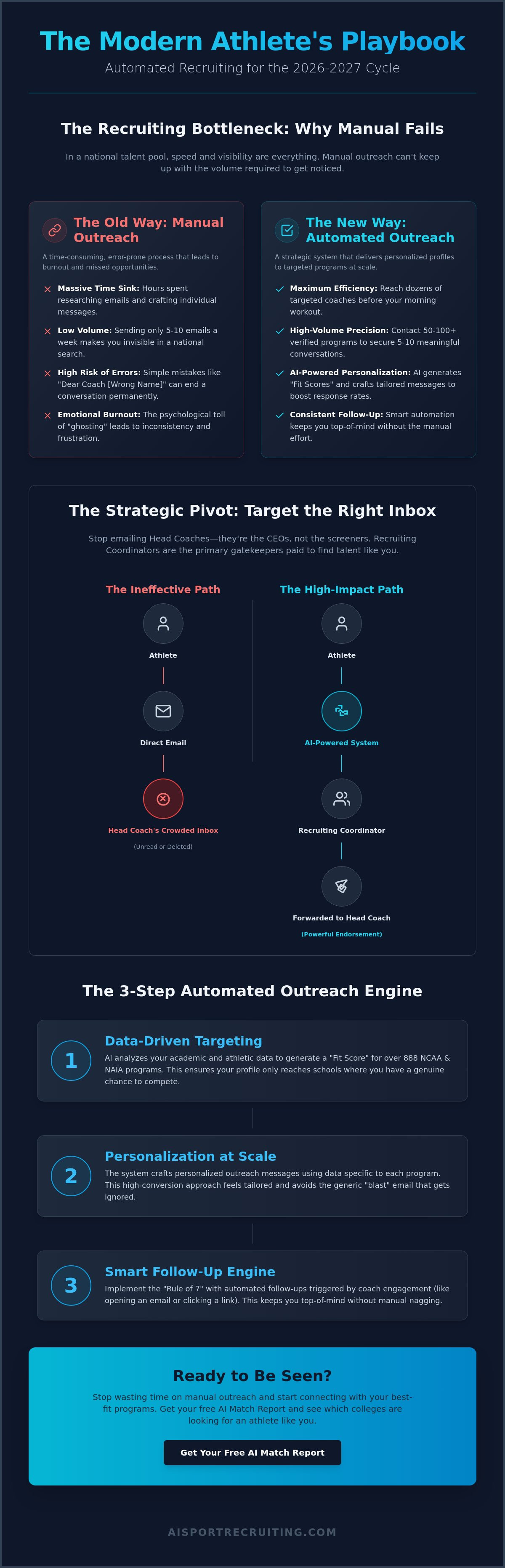
The right person at each program. At most Division I and Division II programs the head coach does not manage initial recruiting correspondence. The Recruiting Coordinator — the staff member specifically assigned to identifying and evaluating incoming talent — is the appropriate first contact. Structured outreach ensures every introduction reaches the right staff member at each program rather than a general inbox that may not reach the person making recruiting decisions. For a complete guide to identifying who to contact at each type of program read our Best Way to Contact College Coaches guide.
The right information in every message. An effective coach introduction includes graduation year, position, GPA, height, high school, state, and a direct link to highlight film — in that order, with academic credentials appearing first. Every introduction should also include a clear statement of why the program interests the athlete and a direct path for the coach to contact the family. Structured outreach ensures these elements appear consistently in every message rather than varying based on how much time and energy the family has available on the day the message is written.
Family contact routed directly to the family. When a coach responds to a recruiting introduction their reply should go directly to the athlete's family — not to a support inbox, not to a third party, and not to a system that filters responses before delivering them. Direct family contact is the foundation of authentic recruiting relationships.
A professional, consistent tone. Every message that goes out under a family's name reflects on the athlete's character and professionalism. Structured outreach ensures every introduction maintains the professional tone that college coaches expect from serious recruits and their families.
How AiSportRecruiting's Coach Outreach Agent Works
AiSportRecruiting's Coach Outreach Agent provides Standard subscribers with a structured, professional introduction service that handles the coach outreach process on behalf of the athlete and their family.
Here is exactly what the Coach Outreach Agent does:
Identifies the matched programs. After a family submits their athlete profile the platform compares the athlete's academic and athletic profile against 888 verified collegiate programs to identify the best fits. The outreach agent uses those match results as the foundation for determining which coaching staffs to contact.
Locates the verified coach contact. The platform's database includes verified coaching contact information across Football, Boys Basketball, and Girls Basketball programs. The agent identifies the appropriate contact at each program — the Recruiting Coordinator or head coach depending on the program's structure — rather than directing introductions to generic department inboxes.
Generates a professional introduction email. Each introduction email is built from the athlete's verified profile data — name, sport, position, graduation year, GPA, height, high school, and state — and populated into the governed Coach Introduction template that received unanimous three-way governance approval. The template leads with the athlete's information rather than the platform's marketing language. It describes AiSportRecruiting accurately as an introduction service rather than a guarantor of outcomes. It includes a clear disclaimer that recruiting and admission decisions remain solely with each institution.
Routes coach replies directly to the family. The reply-to field in every introduction email is set to the family's contact address. When a coach responds their reply goes directly to the family — not to a support inbox, not to the platform, and not to any intermediary. The conversation between the coach and the family begins immediately and directly.
What the Coach Introduction email looks like:
Subject: [Athlete Name] | [Position] | Class of [Year] | [High School] ([State])
The email opens with a professional introduction on behalf of the athlete and their family. It includes the complete athlete profile — sport, position, graduation year, GPA, height, high school, and state — in a clean, easy-to-scan format. It describes the platform as one that compares each student-athlete's academic and athletic profile against 888 verified collegiate programs to help families identify potential opportunities. It provides the family contact information clearly labeled as the direct reply path. It closes with the AiSportRecruiting disclaimer — serving as an introduction service only, with recruiting and admission decisions remaining solely with each institution — and the platform's signature: Talent Deserves Opportunity.
What the Coach Outreach Agent Does Not Currently Do
Honest communication about platform capabilities is a core AiSportRecruiting standard. The Coach Outreach Agent is live and verified for Football and Basketball introductions. There are additional capabilities that are part of the platform's development roadmap but are not yet in production.
Not yet live:
Coach behavior-triggered follow-up automation — sequences that automatically send follow-up messages based on whether a coach opened or clicked the initial introduction. This capability is in development and will be introduced when it completes the platform's quality validation process.
Live outreach dashboards showing individual coach engagement metrics — open rates, click rates, and response status at the individual coach level within the subscriber's account. This is planned for a future platform sprint.
AI-driven optimization of outreach sequencing based on coach engagement signals — a future capability that will allow the platform to refine outreach timing and messaging based on aggregated response data.
These features will be announced when they are confirmed live and have passed three-way governance review. Until then the platform's Coach Outreach Agent provides what it provides — professional, structured, family-first coach introductions — and nothing beyond that.
The Results Families Can Realistically Expect
Understanding what structured coach outreach produces — and what it does not guarantee — helps families use it most effectively.
What structured outreach produces:
Professional, verified introductions to coaching staffs at matched programs. Direct contact paths for coaches who want to respond. A more organized, consistent starting point for recruiting relationships than manual outreach typically provides.
What structured outreach does not guarantee:
Coach responses. Scholarship offers. Roster spots. Recruiting interest. No outreach approach — structured or otherwise — can guarantee how a coaching staff will respond. A coach with no current roster need at the athlete's position in their graduation year has no immediate reason to respond regardless of how professional the introduction is. A coach whose program does not match the athlete's academic profile cannot pursue the athlete regardless of athletic ability.
The goal of structured coach outreach is not to guarantee outcomes. It is to give every athlete the best possible professional introduction to the programs most likely to have genuine interest — and to do so consistently, at scale, with the professionalism that college coaches expect from serious recruits.
What happens after the introduction — the follow-up conversations, the campus visits, the relationship-building that determines recruiting outcomes — remains in the hands of the family. AiSportRecruiting provides the introduction. The family builds the relationship.
For guidance on how to build those relationships effectively after the initial introduction read our Best Follow-Up Strategy After Contacting College Coaches guide and our How to Stand Out to College Recruiters guide.
Who Benefits Most From Structured Coach Outreach
Structured coach outreach is most valuable for families who have a clear, verified picture of which programs represent realistic fits for their athlete — and who are ready to begin building relationships with those coaching staffs professionally and consistently.
Families who have not yet confirmed which programs represent realistic academic and athletic fits should begin with the free match report before activating outreach. Structured outreach directed at programs where the athlete is not a realistic fit produces silence regardless of how professional the introduction is. Fit first. Outreach second.
For families who are ready the combination of a data-driven match report and structured coach outreach provides the clearest, most organized path to genuine recruiting conversations that AiSportRecruiting can currently offer.
The platform currently supports Coach Outreach for student-athletes in three sports:
🏀 Boys Basketball
🏀 Girls Basketball
🏈 Football
The Junior Year Window and Outreach Timing
The most important timing consideration for coach outreach is the junior year recruiting window — when scholarship budgets are being allocated and coaching staffs are actively building their recruiting boards.
Families who initiate structured outreach early in junior year are competing for the full scholarship budget available for their athlete's class. Families who wait until senior year are frequently competing for whatever resources remain after earlier commitments have been made.
For a complete guide to the recruiting timeline and how to structure outreach across freshman, sophomore, junior, and senior year read our Junior Year College Recruiting guide and our Ultimate Junior Year College Recruiting Strategy.
How AiSportRecruiting Supports the Complete Recruiting Journey
AiSportRecruiting was founded by Coach Jackson after more than 30 years serving as a High School Athletic Director and coaching at the high school, AAU, and college levels — with more than 300 scholarship placements across his career.
The platform was built on a belief that has guided Coach Jackson throughout his career: talent deserves opportunity regardless of a family's budget, connections, or access to private recruiting services.
AiSportRecruiting provides two core capabilities for student-athletes in Boys Basketball, Girls Basketball, and Football:
The free match report — 10 personalized program recommendations, detailed Top 3 explanations, and athlete development guidance at no cost with no credit card required.
The Coach Outreach Agent — available to Standard subscribers at $24.99 per month — providing structured, professional coach introductions on behalf of the athlete and their family with replies routed directly to the family.
To understand the full platform and how both capabilities work together read our College Recruiting Platform for Student Athletes guide.
Additional sports are in development and will be introduced as they complete AiSportRecruiting's quality validation process.
The AiSportRecruiting Standard
Everything AiSportRecruiting publishes and every recommendation the platform produces is guided by one principle:
Families deserve recruiting information they can trust.
That means accuracy before assumptions. Evidence before opinion. Families before technology. Opportunity for every athlete across every level of college athletics. And transparency in every recommendation we provide.
AiSportRecruiting does not guarantee scholarships, roster positions, coach responses, or recruiting offers. The platform provides honest, evidence-based recruiting intelligence and structured coach introduction services designed to help families navigate the recruiting process with greater clarity and confidence.
That is the AiSportRecruiting Standard.
The college recruiting process rewards families who are organized, professional, and consistent. Structured coach outreach does not replace the relationships that determine recruiting outcomes — it creates the professional first impressions that make those relationships possible.
Every introduction is the beginning of a conversation. Every conversation is an opportunity. Every opportunity begins with a professional, personalized, family-first message that gives a college coach exactly what they need to decide whether to take a closer look.
That is what the AiSportRecruiting Coach Outreach Agent is designed to deliver.
Begin Your Recruiting Journey Today
Every recruiting journey begins with better information.
If you are ready to identify college programs that may align with your student-athlete's academic and athletic goals create your free athlete profile today.
✅ 10 personalized college program recommendations
✅ Detailed explanations for your Top 3 recommendations
✅ Personalized athlete development recommendations
✅ No cost. No obligation. No credit card required.
👉 www.AiSportRecruiting.com
Because every student-athlete deserves the opportunity to be seen. And every family deserves recruiting information they can trust.
Frequently Asked Questions
What is automated coach outreach for athletes?
Automated coach outreach refers to a structured, systematic process for introducing student-athletes to college coaches on their behalf. AiSportRecruiting's Coach Outreach Agent handles the professional introduction process for Standard subscribers — sending verified, personalized introductions to coaching staffs at matched programs with replies routed directly to the family.
Does AiSportRecruiting contact coaches on behalf of my athlete?
Yes — for Standard subscribers. The Coach Outreach Agent sends professional introduction emails to coaching staffs at programs identified as potential fits through the platform's matching process. Every introduction uses the governed Coach Introduction template, includes the athlete's complete profile information, and routes coach replies directly to the family.
Does the Coach Outreach Agent send follow-up emails automatically?
Not currently. The Coach Outreach Agent handles the initial professional introduction. Follow-up communication with coaches is the family's responsibility. Behavior-triggered follow-up automation is part of the platform's development roadmap and will be introduced when it completes the quality validation process. For guidance on effective follow-up read our Best Follow-Up Strategy After Contacting College Coaches guide.
Will coaches reply to the platform or to my family directly?
Coaches reply directly to the family. The reply-to field in every introduction email is set to the family's contact address. When a coach responds their reply goes directly to the family with no intermediary.
Does coach outreach guarantee responses or scholarship offers?
No. Coach outreach — structured or otherwise — cannot guarantee how a coaching staff will respond. A coach with no current roster need at the athlete's position has no immediate reason to respond regardless of how professional the introduction is. Structured outreach provides the best possible professional first impression — what happens after that depends on the coach's evaluation and the relationship the family builds.
Which sports does the Coach Outreach Agent currently support?
The Coach Outreach Agent currently supports Boys Basketball, Girls Basketball, and Football — the three sports where the platform's verified coach contact database is fully live.
How is the introduction email structured?
Each introduction email includes the athlete's name, sport, position, graduation year, GPA, height, high school, and state. It describes AiSportRecruiting as an introduction service that compares student-athlete profiles against 888 verified collegiate programs. It includes the family's direct contact information and a disclaimer that recruiting and admission decisions remain solely with each institution. It closes with Talent Deserves Opportunity — the platform's founding mission statement.
What is the Standard subscription?
The Standard subscription at $24.99 per month provides full platform access including the Coach Outreach Agent for structured coach introductions on behalf of the athlete and their family.
Who should use the Coach Outreach Agent?
Families who have a clear, verified picture of which programs represent realistic fits for their athlete and who are ready to begin building relationships with coaching staffs professionally. Families who have not yet confirmed program fit should start with the free match report first. For guidance on identifying fit read our Free College Recruiting Match Report guide.
What capabilities are coming in the future?
The platform's development roadmap includes coach behavior-triggered follow-up automation, live outreach analytics showing engagement metrics at the individual coach level, and AI-driven optimization of outreach sequencing. These features will be announced when they are confirmed live and have passed three-way governance review.


