For many families navigating the college recruiting process Division II is either the first choice they never considered or the last resort they turned to after Division I did not work out.
Both approaches miss what Division II actually is.
NCAA Division II is not a consolation prize and it is not a fallback. It is a deliberate, structured level of college athletics that offers genuine scholarship opportunities, high-level competition, and a student-athlete experience intentionally designed to balance athletic commitment with academic life, personal development, and career preparation.
Families who understand Division II — who evaluate it honestly against other options from the beginning of the recruiting process rather than arriving there by elimination — consistently make better decisions about where their athlete belongs than families who approach the division with assumptions built on name recognition and cultural familiarity with Division I.
This guide is designed to give families the complete, honest picture of what Division II offers, how the recruiting process works at this level, and how to pursue Division II opportunities strategically and effectively.
Before reaching out to any Division II program start by understanding where your athlete's profile aligns across the full collegiate landscape. Our Free College Recruiting Match Report provides 10 personalized program recommendations at no cost — so your outreach is directed at the right programs from the beginning.
Get Your Free College Recruiting Match Report
Every athlete who creates a free profile on AiSportRecruiting receives:
✅ 10 personalized college program recommendations based on their academic and athletic profile
✅ Detailed explanations for the Top 3 recommended programs
✅ Personalized athlete development recommendations designed to strengthen future recruiting opportunities
✅ Recommendations spanning NCAA Division I, Division II, Division III, NAIA, and NJCAA
✅ No cost. No obligation. No credit card required.
Begin your free athlete profile today:
👉 www.AiSportRecruiting.com
What NCAA Division II Actually Is
NCAA Division II is the middle tier of the three-division NCAA structure — sitting between the high-profile, high-resource environment of Division I and the non-scholarship academic focus of Division III.
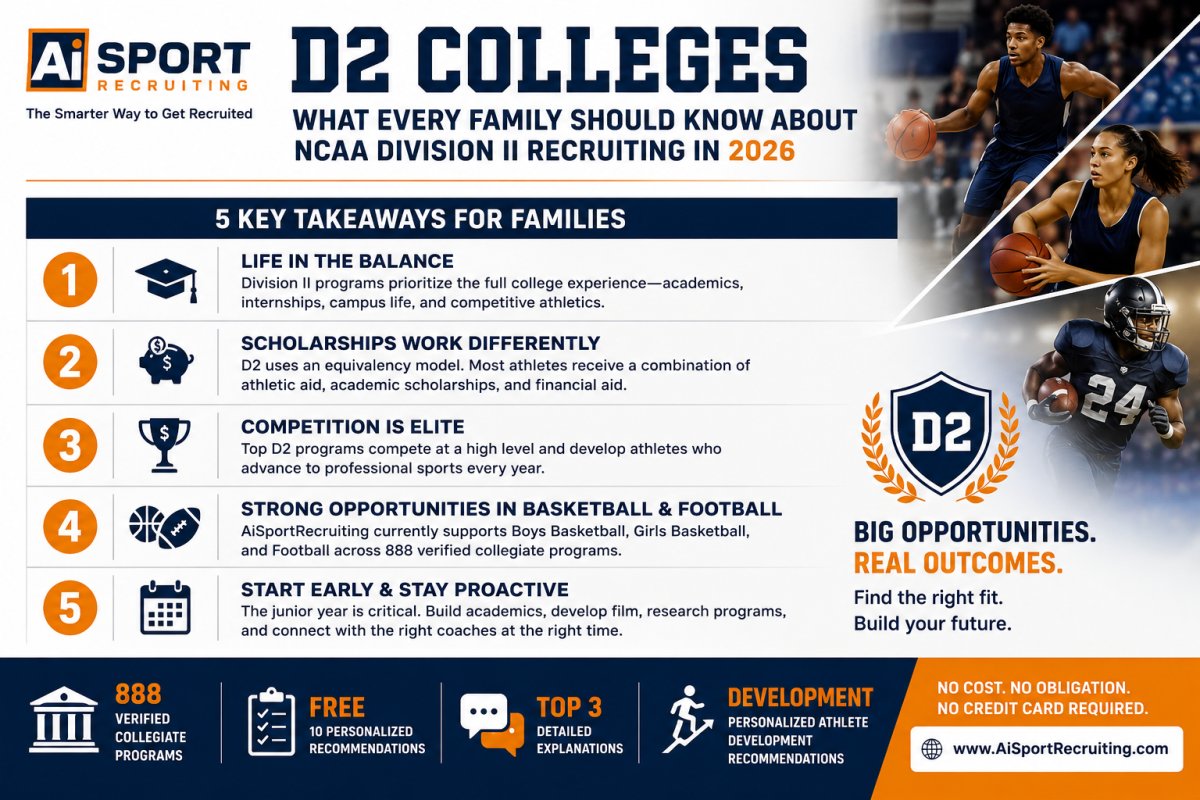
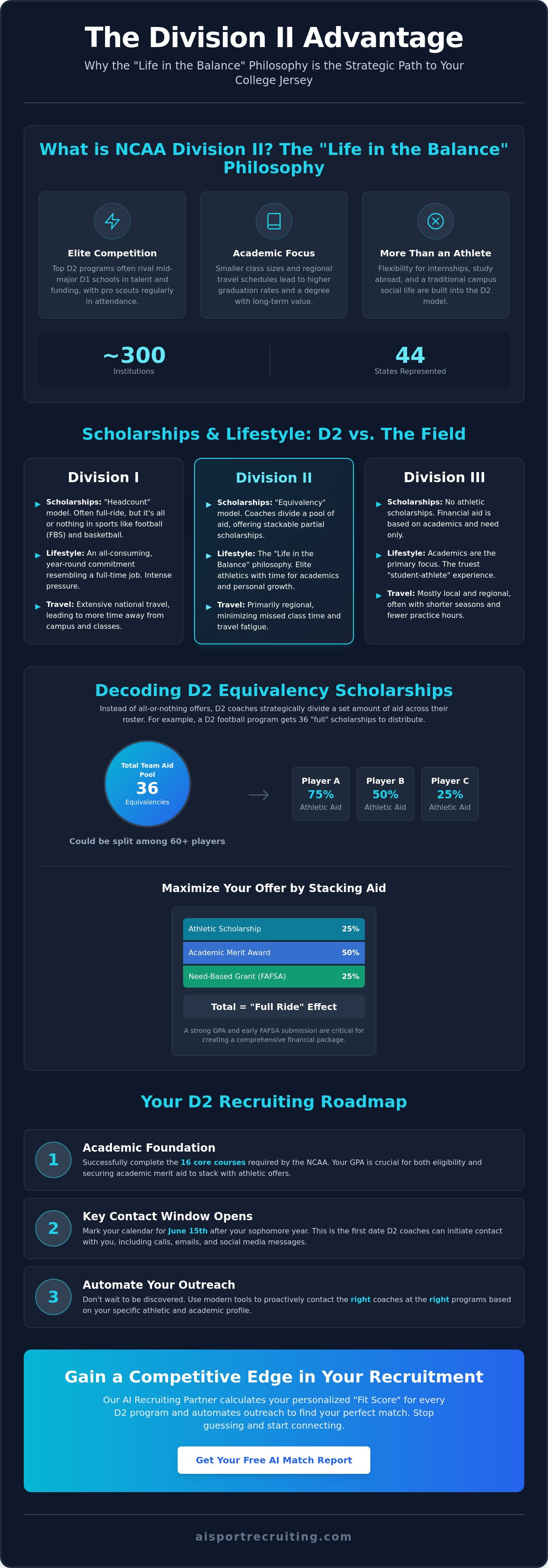
Division II programs operate under what the NCAA describes as a Life in the Balance philosophy — a structural commitment to ensuring that student-athletes have the time and flexibility to pursue the full college experience alongside competitive athletics. That means internship opportunities, study abroad programs, campus involvement, and a social life are all considered part of the Division II experience — not distractions from it.
This philosophy is not marketing language. It is built into the scheduling structures, travel requirements, and academic expectations of Division II programs. Most Division II conferences are regionally organized which means less time spent on long-distance travel and more time available for academic and personal development. Athletes compete seriously without the relentless year-round demands that characterize many Division I programs.
Division II is home to approximately 300 colleges and universities competing across more than 20 sports. That breadth and scale means the division encompasses an enormous range of institutional size, academic profile, campus environment, and athletic competitive level — far more diverse than the Division II label alone suggests.
The Division II Scholarship Model — How It Actually Works
Understanding how athletic scholarships work at the Division II level is essential for families evaluating this opportunity accurately.
Division I headcount sports — like football and basketball at the highest levels — offer scholarships that are either full or non-existent. A recruited athlete either receives a full scholarship covering tuition, fees, room, board, and books or does not receive one at all.
Division II operates on an equivalency model. Each program receives a set number of scholarship equivalencies — the equivalent of full scholarships — that coaches can divide among their roster however they choose. A Division II basketball program, for example, may have a set number of equivalencies available. A coach might use those equivalencies to provide partial athletic aid to more players rather than giving a smaller number of athletes a complete package.
What this means practically is that most Division II athletes receive a financial package that combines partial athletic aid with academic merit scholarships, need-based financial aid, and other forms of institutional support. The total package can effectively cover the full cost of attendance — but it requires families to be proactive about the academic side of the financial equation.
Strong academic credentials are a scholarship multiplier at Division II. A high-achieving student-athlete may qualify for academic merit scholarships and need-based grants that supplement the athletic aid a coach can offer — effectively reducing the total cost to the coach's athletic budget. This makes academically strong athletes more attractive recruiting targets at the Division II level regardless of where they fall on the pure athletic spectrum.
Submitting the FAFSA early and understanding how each institution's financial aid office works alongside the athletic department is essential for maximizing a Division II financial package.
How Families Should Evaluate Division II Opportunities
The most important shift in mindset families need to make when evaluating Division II is moving from prestige to fit.
The question is not whether Division II is as prestigious as Division I. The question is whether a specific Division II program provides the academic environment, the athletic competitive level, the coaching quality, the financial package, and the overall college experience that is right for this specific athlete at this specific stage of their life.
Evaluated on those terms Division II frequently wins — not despite being Division II but because Division II programs are designed around a different set of priorities than Division I.
Questions every family should ask when evaluating Division II programs:
Is this program a realistic academic fit? Every Division II institution has its own admission standards. Research the academic profile of each target program — GPA requirements, test score expectations, and any specific admission requirements — before investing time in recruiting outreach. An athlete whose academic credentials do not meet a program's admission standards cannot be recruited there regardless of athletic ability.
What does the full financial package look like? Athletic aid, academic merit scholarships, need-based grants, and institutional support should all be considered together rather than looking at the athletic scholarship in isolation. Request a complete financial aid estimate from each institution and compare the net cost of attendance — not the sticker price.
What is the competitive level of this program within Division II? The range of athletic competition within Division II is wide. Some programs compete at an elite level and produce professional athletes. Others are more development-oriented. Research each program's recent performance, coaching staff credentials, and competitive environment to understand where it falls within the Division II landscape.
Does this program's system fit my athlete's specific skill set? Athletic fit is about more than division level. A guard who thrives in an uptempo system may not be the right fit for a half-court program regardless of division. Research each program's style of play and confirm it matches what the athlete does best.
What is the campus environment and academic offering? The four-year college experience is about more than athletics. Programs that offer strong academic departments aligned with the athlete's academic interests, campus cultures that match the athlete's personality, and geographic environments the family finds appealing produce better long-term outcomes than programs chosen purely on athletic criteria.
What Division II Competition Actually Looks Like
One of the most persistent misconceptions about Division II athletics is that the competition level is significantly below Division I. For some programs at some levels that may be true — but for the top tier of Division II in sports like football and basketball the competition is genuinely high-level.
Elite Division II programs have produced professional athletes across multiple sports. Professional scouts evaluate talent at every NCAA level including Division II because the quality of development at top Division II programs is real and verifiable. The technical skill development, coaching quality, and competitive environment at elite Division II programs prepare athletes for life beyond college athletics in ways that go far beyond what statistics alone can measure.
For athletes whose realistic competitive profile aligns with the Division II level this represents an opportunity to be a meaningful contributor — often a starter or key rotation player — from the beginning of their college career. That playing time and development opportunity is something a roster spot at the bottom of a Division I program does not always provide.
The honest question for every family is not whether Division II is as athletically prestigious as Division I. The question is whether this athlete will develop more as a player, achieve more academically, and have a more fulfilling four-year experience at the Division II level where they are a genuine priority for the coaching staff — or at a Division I level where they may spend four years at the end of a deep roster.
Academic Preparation for Division II Recruiting
Academic preparation for Division II recruiting begins well before the recruiting process does.
NCAA Eligibility Center registration. Families targeting Division II programs should register with the NCAA Eligibility Center early — typically during freshman or sophomore year — to ensure the athlete's academic record is being tracked against Division II eligibility requirements from the beginning. Division II has specific core course requirements and a sliding scale GPA and test score standard that determines initial eligibility. Failing to meet those requirements eliminates Division II as an option regardless of athletic ability.
Core course completion. Division II requires completion of a minimum number of NCAA-approved core courses in English, mathematics, natural science, social science, and other areas. Research the specific core course requirements for Division II and confirm the athlete is on track to meet them before junior year — when recruiting conversations with coaches are most active.
GPA management. Junior year GPA is among the most closely scrutinized academic data points in the Division II recruiting process because it is the most recent complete academic record available when coaches are actively building their recruiting boards. Families should treat junior year academics as equally important to athletic performance. A declining junior year GPA raises concerns that can derail recruiting conversations even after initial interest has been established.
Standardized test preparation. Division II uses a sliding scale that balances GPA and test scores — a lower GPA can be offset by a stronger test score and vice versa within defined ranges. Understanding where an athlete stands on the Division II sliding scale and identifying whether improved test scores could expand their eligibility options is worth evaluating during sophomore or junior year.
For more on how academic standing affects recruiting options across every division level read our What College Coaches Actually Look For in a Student-Athlete guide.
Division II Recruiting Timeline
Understanding when Division II coaches can contact recruits — and when athletes should proactively reach out — is critical for families navigating this process.
June 15 following sophomore year is when Division II coaches can begin making direct phone contact and sending certain forms of electronic communication to prospects. This is the most important date in the Division II recruiting calendar for most athletes. Families should be prepared before that date arrives — not scrambling to prepare after the window opens.
Junior year is the most critical window. When scholarship budgets are being allocated and coaches are actively building recruiting boards athletes who engage with Division II programs during their junior year have access to the full scholarship budget for their class. Athletes who wait until senior year are frequently competing for whatever resources remain.
What families should have ready before the contact window opens:
Current highlight video that opens immediately without a login or download. Academic credentials confirmed — GPA, test scores, and NCAA Eligibility Center registration current. A researched list of target Division II programs where genuine academic and athletic fit has been confirmed. Understanding of each program's coaching staff and which staff member handles recruiting for the athlete's sport and position.
For a complete tactical framework covering the full junior year recruiting execution read our Junior Year College Recruiting guide and our Ultimate Junior Year College Recruiting Strategy.
Who to Contact and How
One of the most consistent mistakes families make when reaching out to Division II programs is directing all communication to the head coach.
Head coaches at Division II programs — particularly at competitive programs with active recruiting pipelines — receive significant volumes of unsolicited correspondence. They delegate the initial talent identification and evaluation process to Recruiting Coordinators and assistant coaches assigned to recruiting responsibilities.
At smaller Division II programs the head coach may manage recruiting personally. Research each program's specific staff structure before making first contact and direct the initial outreach to the appropriate person.
What an effective Division II initial outreach message includes:
Academic credentials upfront — graduation year, GPA, and test scores in the first sentence. Athletic information specific to the position — key statistics and recent performance highlights. A direct link to the highlight video that opens immediately. One specific reason the program interests the athlete — a playing style, an academic program, a coaching philosophy, or a campus environment. A specific, direct question — about roster availability, showcase attendance, or availability for a call.
For a complete guide to structuring effective recruiting outreach read our Best Way to Contact College Coaches guide.
Common Division II Recruiting Mistakes
Treating Division II as a last resort. Families who arrive at Division II recruiting after Division I outreach has not produced results are approaching the process from a position of disappointment rather than genuine evaluation. Programs at every level can tell when they are a backup option rather than a genuine choice. Approaching Division II as a primary target from the beginning — when it genuinely fits — produces better results and better relationships with coaching staffs.
Not researching academic fit before outreach. Contacting Division II programs without confirming the athlete meets the institution's academic admission standards wastes everyone's time and produces silence that discourages families from continuing the process. Academic fit should be confirmed before the first message is sent.
Leading with athletic highlights instead of academic credentials. Division II coaches evaluate academic eligibility before athletic ability. A message that opens with statistics before establishing GPA and graduation year signals that the family does not understand how the evaluation process works.
Focusing exclusively on scholarship amount. The athletic scholarship is one component of the total financial picture at a Division II institution. Academic merit scholarships, need-based grants, and institutional support can significantly change the net cost of attendance. Families who evaluate Division II solely on athletic aid amounts frequently miss the full financial picture.
Not following up professionally. A single unanswered message is not rejection. Professional, value-adding follow-up is expected and appropriate at every level of college recruiting. For a complete guide to effective follow-up read our Best Follow-Up Strategy After Contacting College Coaches guide.
Attending showcases at programs that are not realistic fits. Showcase and camp investment is only valuable when the programs attending represent genuine academic and athletic opportunities for the athlete. Research which programs will have coaches at each event before committing to the expense.
Questions Every Family Should Ask Division II Coaches
The recruiting process is a two-way evaluation. Families should ask specific, substantive questions of Division II coaching staffs to understand whether a specific program is genuinely right for their athlete.
What position need does my athlete address for your program in their graduation year? Understanding whether the program has a genuine roster need establishes whether the coach has a real reason to invest recruiting resources.
What does your scholarship and financial aid process look like for incoming recruits? Understanding how the program structures its financial packages — and what role academic merit aid plays alongside athletic aid — helps families evaluate the complete financial picture.
What does the academic support structure look like for student-athletes at your institution? Division II programs vary significantly in their academic support resources. Programs that invest seriously in academic support produce better graduation outcomes.
What is the program's typical practice and travel schedule? Understanding the time commitment required by the athletic program helps families evaluate whether it aligns with academic goals and personal priorities.
Where have recent athletes from your program gone after graduation? Post-graduation outcomes — both athletic and professional — reflect the quality of development and preparation a program provides over four years.
Division II Compared to Other Levels
Understanding how Division II compares to other levels of college athletics helps families make informed decisions about where an athlete genuinely belongs.
Division II vs Division I. Division I offers the highest profile of college athletics and in some sports the highest scholarship packages. It also demands the most athletic commitment and in many cases requires significant academic and personal sacrifices to meet the demands of high-level Division I programs. For athletes whose realistic competitive level aligns with Division II the more balanced Division II experience frequently produces better overall outcomes.
Division II vs Division III. Division III does not offer athletic scholarships but provides strong need-based and merit-based financial aid at many institutions. For athletes who are strong academic performers the total financial package at a selective Division III institution can rival or exceed a partial Division II athletic scholarship. Our NCAA Division III Recruiting guide covers what families should know about this comparison.
Division II vs NAIA. NAIA programs offer athletic scholarships and competitive athletics at four-year institutions with generally more accessible eligibility standards than NCAA Division II. For some athletes whose academic profile creates NCAA eligibility concerns NAIA programs may represent a more realistic four-year opportunity. Our NAIA College Recruiting guide and our How to Get Recruited by NAIA Programs guide cover what the NAIA specifically offers.
Division II vs NJCAA. NJCAA programs provide two-year athletic experiences that can serve as a bridge to four-year Division II programs. For athletes whose academic profile does not yet meet Division II standards or who need additional development time the NJCAA path can create Division II opportunities that were not accessible directly from high school. Our Junior College Recruiting guide covers when the junior college path makes strategic sense.
Division II for Basketball and Football Families
AiSportRecruiting currently supports student-athletes in Boys Basketball, Girls Basketball, and Football — the three sports where the platform's program data and matching capabilities are fully live.
For basketball families Division II basketball spans a wide range of conferences with distinct playing styles and competitive environments. Some conferences emphasize physical half-court basketball with high basketball IQ requirements. Others feature uptempo transition-heavy systems that reward athleticism and conditioning. Understanding which system fits an athlete's specific skill set — and identifying programs within those systems where a genuine need exists — is exactly the kind of matching AiSportRecruiting is designed to support.
For football families Division II football is one of the most underappreciated levels of college athletics from a talent and competition standpoint. Elite Division II football programs draw significant regional support, operate with strong facilities and coaching staffs, and have produced players who advanced to professional football. Division II football provides a genuine high-level competitive experience without the all-consuming demands that characterize the highest levels of Division I football.
How AiSportRecruiting Helps Families Navigate Division II
AiSportRecruiting was founded by Coach Jackson after more than 30 years serving as a High School Athletic Director and coaching at the high school, AAU, and college levels — with more than 300 scholarship placements across his career.
The platform was built on a belief that has guided Coach Jackson throughout his career: talent deserves opportunity regardless of a family's budget, connections, or access to private recruiting services.
AiSportRecruiting compares each student-athlete's academic and athletic profile against 888 verified collegiate programs across NCAA Division I, Division II, Division III, NAIA, and NJCAA. For families in Boys Basketball, Girls Basketball, and Football the platform returns 10 personalized program recommendations, detailed explanations for the Top 3 recommended schools, and personalized athlete development guidance — all at no cost and with no credit card required.
For families beginning to seriously consider Division II as a target level the platform provides a data-grounded starting point for understanding which specific Division II programs may represent a genuine fit — so that outreach is directed at the right programs from the beginning rather than the most familiar names.
For more on how the platform works and what it provides read our College Recruiting Platform for Student Athletes guide. For families considering whether private recruiting consulting is worth the investment read our College Recruiting Consultant Alternative guide.
AiSportRecruiting currently supports student-athletes in three sports:
🏀 Boys Basketball
🏀 Girls Basketball
🏈 Football
Additional sports are in development and will be introduced as they complete AiSportRecruiting's quality validation process.
The AiSportRecruiting Standard
Everything AiSportRecruiting publishes and every recommendation the platform produces is guided by one principle:
Families deserve recruiting information they can trust.
That means accuracy before assumptions. Evidence before opinion. Families before technology. Opportunity for every athlete across every level of college athletics. And transparency in every recommendation we provide.
AiSportRecruiting does not guarantee scholarships, roster positions, coach responses, or recruiting offers. The platform provides honest, evidence-based recruiting intelligence designed to help families navigate the recruiting process with greater clarity and confidence.
That is the AiSportRecruiting Standard.
Division II is not a stepping stone and it is not a second choice. It is a legitimate, well-designed level of college athletics that provides genuine scholarship opportunities, genuine competitive development, and a genuine four-year college experience built around the student-athlete rather than the athletic program.
The families who approach Division II with that understanding — who evaluate it honestly from the beginning, research programs carefully, and pursue the right programs with professional outreach — consistently find that Division II delivers exactly what they were looking for.
Fit before prestige. Evidence before assumptions. Opportunity for every athlete who has earned it.
Begin Your Recruiting Journey Today
Every recruiting journey begins with better information.
If you are ready to identify Division II programs — and programs across every level of college athletics — that may align with your student-athlete's academic and athletic goals create your free athlete profile today.
✅ 10 personalized college program recommendations
✅ Detailed explanations for your Top 3 recommendations
✅ Personalized athlete development recommendations
✅ No cost. No obligation. No credit card required.
👉 www.AiSportRecruiting.com
Because every student-athlete deserves the opportunity to be seen. And every family deserves recruiting information they can trust.
Frequently Asked Questions
What is NCAA Division II and how is it different from Division I?
NCAA Division II is the middle tier of the three-division NCAA structure. It operates under a Life in the Balance philosophy that emphasizes competitive athletics alongside a full college experience — internships, study abroad, campus involvement, and a balanced lifestyle. Division I programs typically operate with greater resources and more intensive year-round athletic demands. Division II programs offer high-level competition with more flexibility for student-athletes to pursue academic and personal development alongside their sport.
How do Division II scholarships work?
Division II uses an equivalency scholarship model rather than the headcount model found in some Division I sports. Coaches receive a set number of scholarship equivalencies they can divide among their roster. Most Division II athletes receive a financial package combining partial athletic aid with academic merit scholarships, need-based grants, and institutional aid. Strong academic credentials directly increase the total aid available because they qualify athletes for additional institutional support beyond the athletic component.
Does AiSportRecruiting include Division II programs?
Yes. AiSportRecruiting analyzes 888 verified collegiate programs including Division II programs across Boys Basketball, Girls Basketball, and Football. Athletes whose profile aligns with Division II programs will see those schools represented in their personalized match results.
Which sports does AiSportRecruiting currently support?
AiSportRecruiting currently supports Boys Basketball, Girls Basketball, and Football. Additional sports are in development and will be added as they complete the platform's quality validation process.
How competitive is Division II athletics?
Division II athletics is high-level and competitive across the division. Elite Division II programs have produced professional athletes and professional scouts evaluate talent at every NCAA level including Division II. The competition level varies by conference and program which is why understanding where a specific athlete's profile fits within the Division II landscape matters so much.
When should families start the Division II recruiting process?
As early as possible — but the most critical window is junior year when scholarship budgets are being allocated and coaches are actively building their recruiting boards. Families who begin preparation during freshman and sophomore year arrive at the junior year contact window ready to engage meaningfully. Read our Junior Year College Recruiting guide for a complete timeline.
Who should my athlete contact at a Division II program?
In most cases the Recruiting Coordinator or the assistant coach assigned to recruiting responsibilities is the most effective first contact. Research each program individually to identify the right person before reaching out. Our guide on The Best Way to Contact College Coaches covers exactly how to approach this.
Can Division II athletes transfer to Division I?
Yes. Division II athletes can transfer to Division I programs through the NCAA Transfer Portal if they meet eligibility requirements. This has become an increasingly common pathway for athletes who develop significantly at the Division II level and attract Division I interest.
Does AiSportRecruiting guarantee Division II scholarship offers?
No. AiSportRecruiting provides personalized program recommendations and athlete development guidance based on the information families submit. Recruiting outcomes depend on many factors including athletic performance, academic standing, a program's specific roster needs, and the relationships families build with coaching staffs.
Is Division II the right level for my athlete?
That depends on the athlete's specific academic and athletic profile, their goals for the college experience, and which programs represent a realistic fit. AiSportRecruiting was built to help families answer exactly that question with data-driven program recommendations rather than guesswork. Creating a free profile takes approximately two minutes and provides a personalized starting point for understanding where an athlete's current profile may align across every major level of college athletics.
What questions should I ask a Division II coach?
Ask about roster needs at the athlete's position in their graduation year, how the program structures its scholarship and financial aid packages, what academic support looks like for student-athletes, what the practice and travel schedule requires, and where recent program alumni have gone after graduation. Those five questions give families a complete picture of whether a specific Division II program is genuinely the right fit.


