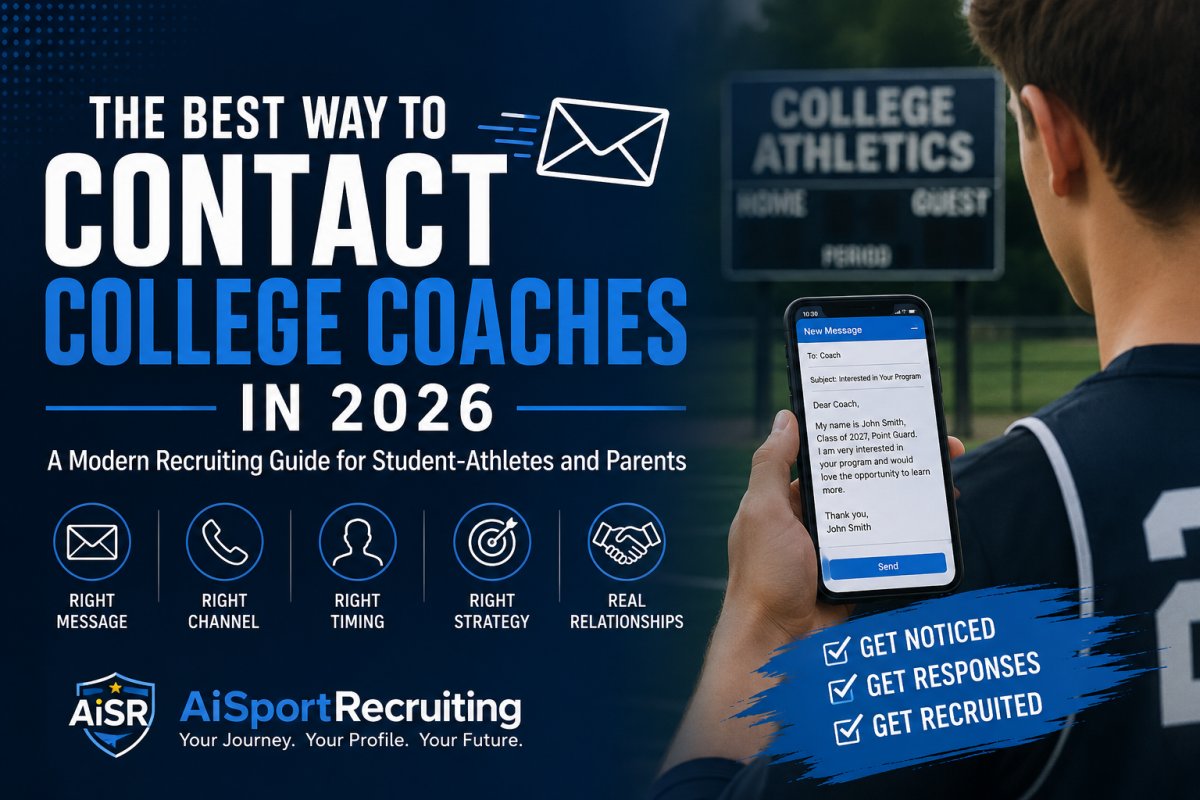
For student-athletes and their families, one of the most consequential moments in the college recruiting process is also one of the most uncertain.
You have identified programs you want to pursue. You know your athlete has genuine ability. You believe there is a real fit. And now you have to reach out to a college coach — someone you have never met, at an institution you may have never visited, about a decision that could shape the next four years of your child's life.
How do you do it right?
This guide answers that question completely — covering who to contact, what to say, when to reach out, what coaches notice first, and how to follow up professionally. It is built on more than 30 years of high school athletic administration, coaching, and scholarship placement experience, and it reflects the reality of how college recruiting actually works in 2026 — not how families assume it works.
Before reaching out to any coach start by understanding which programs represent genuine academic and athletic fits for your athlete. Our Free College Recruiting Match Report provides 10 personalized program recommendations at no cost — so your outreach is directed at the right programs from the beginning.
Get Your Free College Recruiting Match Report
Every athlete who creates a free profile on AiSportRecruiting receives:
✅ 10 personalized college program recommendations based on their academic and athletic profile
✅ Detailed explanations for the Top 3 recommended programs
✅ Personalized athlete development recommendations designed to strengthen future recruiting opportunities
✅ Recommendations spanning NCAA Division I, Division II, Division III, NAIA, and NJCAA
✅ No cost. No obligation. No credit card required.
Begin your free athlete profile today:
👉 www.AiSportRecruiting.com
Why Most Recruiting Outreach Goes Unanswered
Before understanding how to contact college coaches correctly it is worth understanding why most outreach fails.
College coaches — particularly at competitive Division I and Division II programs — receive hundreds of unsolicited recruiting messages every week during peak recruiting periods. The overwhelming majority of those messages share the same characteristics. Generic subject lines. No academic credentials upfront. Identical body text sent to dozens of programs. Highlight video links that require a login. No specific reference to the program being contacted.
Coaches recognize these messages immediately. They receive too many of them to respond to individually and too few of them contain the information needed to begin an evaluation.
The families who break through are the ones who understand what a coach actually needs to see — and who present that information in the right order, in the right format, directed at the right person at the right time.
That is what this guide is designed to help you do.
Step 1 — Contact the Right Person
The single most impactful change most families can make in their recruiting outreach is directing messages to the right person at each program.
At NCAA Division I and Division II programs — the head coach does not manage initial recruiting correspondence from unknown prospects. Head coaches at competitive programs are managing staff, game preparation, donor relationships, and program operations. Initial recruiting evaluation is delegated to the Recruiting Coordinator — the staff member specifically assigned to identifying and vetting incoming talent.
Recruiting Coordinators are the gatekeepers of the recruiting board. Their professional responsibility is to evaluate incoming prospects, review film, verify academic eligibility, and identify athletes who address specific roster needs. A message that reaches the Recruiting Coordinator and clearly demonstrates fit is far more likely to receive a substantive response than a generic email to the head coach's general inbox.
At NCAA Division III, NAIA, and NJCAA programs — the head coach or a position coach typically manages recruiting personally without a dedicated Recruiting Coordinator. Research each program's specific staff structure before making first contact. Directing a personalized message to the head coach is entirely appropriate at these levels.
How to find the right contact:
Visit the athletic department staff directory on each program's official website. Look specifically for titles like Recruiting Coordinator, Director of Recruiting, or the assistant coach assigned to recruiting responsibilities in your athlete's sport. Call the athletic department office directly if the information is not clearly listed online.
Step 2 — What Coaches Notice in the First 60 Seconds
Understanding what a Recruiting Coordinator or coach evaluates in the first minute of reviewing a recruiting message helps families prioritize what appears first.
In the first 60 seconds coaches typically assess:
Graduation year — is this athlete in the right class for our current roster needs?
GPA — does this athlete meet our academic admission standards?
Position — do we have a genuine need at this position in this graduation year?
Subject line professionalism — does this message look like it was sent to us specifically or to every program in the sport?
Highlight video accessibility — can I watch this film in one click without creating an account or downloading a file?
Opening sentence — does this family understand what we are looking for or is this a generic mass email?
These first impressions determine whether the evaluation continues — not whether an offer is made, but whether the coach keeps reading and watching. A message that fails any of these initial checks is unlikely to receive a response regardless of how strong the rest of the content is.
For a deeper understanding of the complete sequence coaches use to evaluate recruits read our What College Coaches Actually Look For in a Student-Athlete guide.
Step 3 — Write a Subject Line That Gets Opened
The subject line is the first thing a coach sees. It determines whether the message gets opened or ignored.
An effective recruiting email subject line communicates the most important information before the coach opens the message.
Recommended format:
[Graduation Year] [Position] | [First Name] [Last Name] | [High School] | [State]
Example:
2027 Point Guard | Jordan Williams | Lincoln High School | TX
This format tells the coach immediately — before opening — the graduation year, position, athlete name, and school. A Recruiting Coordinator who has a roster need at point guard in the 2027 class will open this message. One who does not has saved time for both parties.
What to avoid:
Vague subject lines like "Prospective Athlete" or "Recruiting Inquiry" or "Interested in Your Program" tell the coach nothing useful and signal immediately that the message is generic.
Step 4 — What Information Should Appear in the First Sentence
Academic credentials belong in the first sentence — not buried after athletic highlights.
Every college coach evaluates academic eligibility before athletic ability. A coach cannot invest recruiting resources in an athlete who cannot be admitted to the institution. Leading with GPA and graduation year signals immediately that the athlete is academically eligible and that the family understands how the evaluation process works.
Recommended first sentence:
"I am reaching out on behalf of [Athlete Name], a Class of [Year] [Position] from [High School] in [State], with a [GPA] GPA and [Test Score if applicable]."
That single sentence answers the three questions coaches need answered first — who is this athlete, are they in the right class, and are they academically eligible.
Everything that follows — athletic information, highlight video, program-specific interest — builds on that foundation rather than preceding it.
Step 5 — Structure the Full Message Correctly
A complete recruiting email has five components in this order:
Component 1 — Academic and identity credentials (first sentence)
Graduation year, position, high school, state, GPA, and test scores where applicable.
Component 2 — Athletic information (two to three sentences)
Key statistics relevant to the position, competitive level, recent performance highlights, and any measurable attributes the coach would want to know.
Component 3 — Highlight video link (one line)
A direct link that opens immediately without a login, password, or download. The link should be the only thing on this line — easy to find and impossible to miss.
Component 4 — Program-specific interest (one to two sentences)
One specific reason the program interests the athlete — a playing style, an academic program, a coaching philosophy, a conference affiliation, or a campus environment. This is what separates personalized outreach from mass email. Mentioning one specific detail demonstrates genuine research and genuine interest. Coaches notice the difference immediately.
Component 5 — A specific, actionable question (one sentence)
End with a direct question that invites a direct response. Ask whether the program has roster availability at the athlete's position for their graduation year, whether the coach will be attending a specific upcoming showcase, or whether the family can schedule a brief introductory call. A vague request for general feedback is easy to ignore. A specific question invites a specific answer.
Close professionally:
Full name, phone number, email address, and a link to any recruiting profile or website the family maintains.
How Long Should a Recruiting Email Be?
A recruiting email should be long enough to provide all five components above and short enough that a busy coach reads it completely without scrolling.
In practice that means approximately 150 to 250 words for the initial outreach message. This is shorter than most families write and longer than a text message. It is the length that respects the coach's time while providing everything they need to begin an evaluation.
Follow-up messages should be shorter — 75 to 125 words — since the coach already has the foundational information and the follow-up's job is simply to resurface the athlete's profile with something new.
Should Parents Contact College Coaches?
Parents play an important supporting role in the recruiting process — but coaches generally prefer building relationships directly with the student-athlete rather than primarily with parents.
A student-athlete who takes ownership of their own recruiting communication — who reaches out directly, follows up professionally, and engages with coaches personally — makes a significantly stronger impression than an athlete whose parents appear to be driving the process. Coaches are recruiting the student-athlete, not the family.
The most effective approach is one where parents handle the organizational infrastructure — researching programs, managing deadlines, organizing correspondence — while the athlete takes the lead in direct communication with coaching staffs.
That said, it is entirely appropriate for a parent to help draft the initial outreach message or to send it on the athlete's behalf if the athlete is younger. What matters is the substance and professionalism of the communication — not who technically pressed send.
Should Athletes Text College Coaches?
Texting a college coach before any relationship has been established is generally not the most effective first contact approach. Email remains the primary channel for initial recruiting outreach at most levels.
Text messaging becomes appropriate after a relationship has been established through email contact — when a coach has responded and indicated openness to further communication, or after an in-person interaction at a showcase or campus visit.
Some coaches and programs — particularly at NAIA and NJCAA levels where recruiting is more informal — may welcome text contact earlier in the process. Research each program's communication preferences before assuming text is welcome.
Social media direct messaging follows the same principle. It can supplement formal recruiting outreach once a relationship exists — but should not replace email as the primary communication channel during initial outreach.
How Many Coaches Should an Athlete Contact?
The goal is not to contact the most coaches. The goal is to contact the right coaches.
A well-researched list of 20 to 30 programs where a genuine academic and athletic fit has been confirmed will consistently produce better results than generic outreach to 100 programs chosen primarily by name recognition. Coaches recognize immediately when a family has done genuine research on their specific program — and that recognition produces substantially stronger responses than mass outreach.
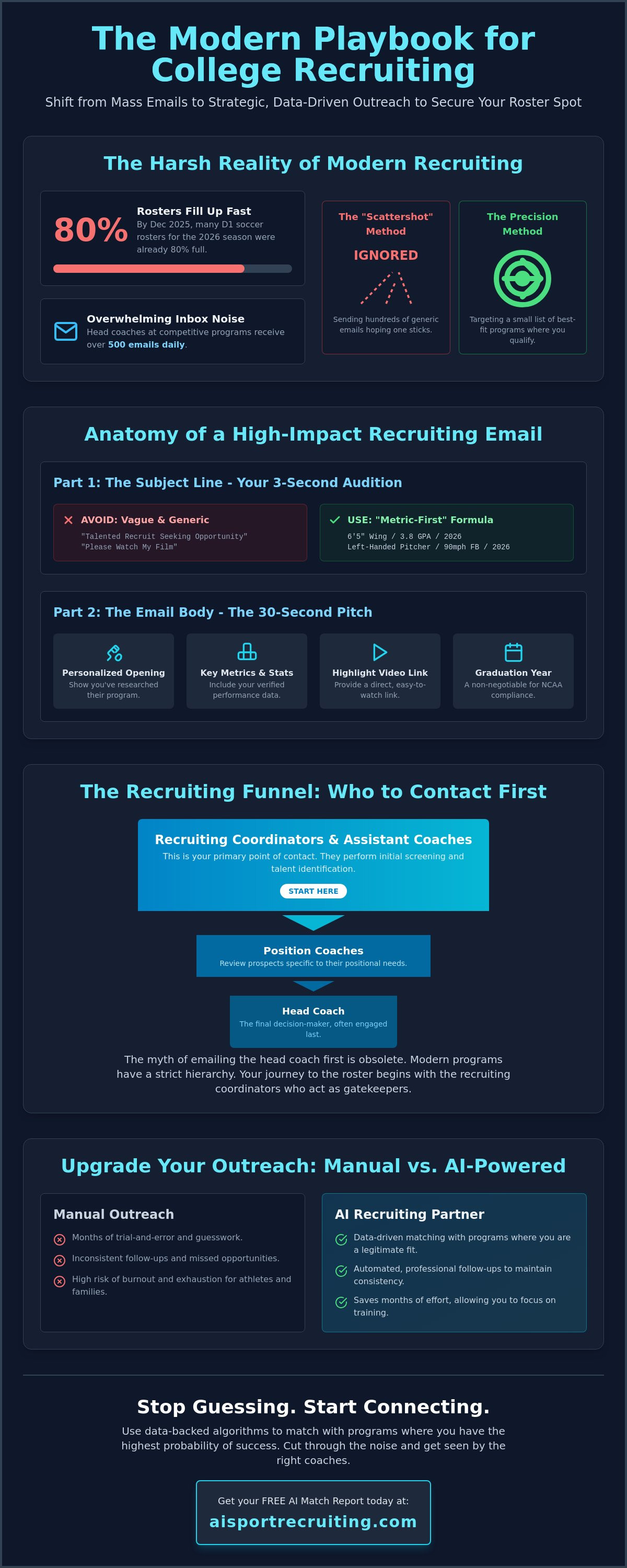
For families unsure which programs represent realistic fits our Free College Recruiting Match Report provides a data-grounded starting point — 10 personalized program recommendations based on the athlete's academic and athletic profile — before outreach begins.
Common Mistakes Families Make When Contacting College Coaches
Understanding what does not work is as important as understanding what does.
Sending the same generic message to every program. Coaches recognize mass emails immediately. A message that does not reference anything specific about the program — its system, its conference, its academic offerings, or its recent performance — is easy to dismiss.
Leading with athletic highlights instead of academic credentials. Academic eligibility is the first filter. A message that opens with a list of statistics before establishing GPA and graduation year signals that the family does not understand how the evaluation process works.
Sending a highlight video that requires a login or download. Any friction between a coach clicking a link and watching the athlete play reduces the likelihood of evaluation. The link must open immediately and directly.
Contacting only the head coach. At most Division I and Division II programs the head coach does not manage initial recruiting correspondence. Messages directed exclusively to the head coach frequently go unanswered not because of disinterest but because the wrong person received them.
Sending one message and waiting indefinitely. A single unanswered message is not rejection. It is timing, inbox volume, and roster circumstances. Professional follow-up is expected and appropriate. For a complete guide to follow-up strategy read our Best Follow-Up Strategy After Contacting College Coaches guide.
Targeting programs without researching fit. Every hour spent contacting a school that cannot admit the athlete academically or has no roster need at the position is an hour taken away from building relationships with programs where a genuine opportunity exists.
The Timing Question — When Should Families Start Contacting Coaches?
Contact rules vary by division and sport — and families should research the specific rules that apply to their athlete's situation. Some general guidance applies broadly.
For NCAA Division II — coaches can begin direct phone and electronic contact with recruits starting June 15 following the completion of sophomore year. Families should be prepared before that date arrives — not scrambling to prepare after the window opens.
For NCAA Division I — contact rules are sport-specific and change periodically. Families should confirm current rules directly through the NCAA website for their athlete's specific sport.
For NCAA Division III, NAIA, and NJCAA — contact rules are generally less restrictive allowing families to engage with coaches earlier in the process.
Regardless of when coaches are permitted to initiate contact families can almost always send introductory emails to programs at any point. The key is understanding what type of response to expect at each stage and being prepared for the contact window that matters most.
Junior year is the most critical window across most division levels — when scholarship budgets are being allocated and recruiting boards are being built. Families who begin outreach during sophomore year and are fully engaged by junior year consistently produce better outcomes than those who start in senior year. For a complete recruiting timeline read our Junior Year College Recruiting guide and our Ultimate Junior Year College Recruiting Strategy.
Opportunity Exists Across Every Level
One of the most important things families can understand about coach outreach is that meaningful opportunities exist at every level of college athletics — not just at the most recognizable Division I programs.
Families who restrict their outreach exclusively to the highest-profile programs frequently miss outstanding opportunities at Division II, Division III, NAIA, and NJCAA schools where their athlete would be a genuine, valued contributor from the beginning of their college career.
Coaching staffs at these levels often have smaller recruiting budgets and less national visibility than major Division I programs — which means a well-prepared, proactive athlete who reaches out directly can stand out more easily than at programs receiving hundreds of unsolicited messages weekly.
For division-specific outreach guidance our library covers each level in depth:
Our D2 Colleges guide covers what Division II specifically offers and how outreach works at that level.
Our NCAA Division III Recruiting guide covers the unique aspects of Division III outreach including the absence of a National Letter of Intent.
Our How to Get Recruited by NAIA Programs guide covers the proactive approach required for NAIA outreach specifically.
After the First Message — Building the Relationship
Effective recruiting outreach does not end with the first message. It begins there.
Once initial contact is sent the relationship-building process — follow-up, showcases, campus visits, and ongoing communication — is what converts initial interest into genuine recruiting relationships.
When a coach responds positively — reply within 24 to 48 hours, include whatever specific information the coach requested, and suggest a clear next step such as a phone call or campus visit.
When a coach does not respond — follow up one to two weeks later with something new — an updated performance statistic, a new highlight clip, or a note about an upcoming showcase where the coach could evaluate the athlete in person.
When a coach says the program is not currently recruiting the position — thank them professionally and leave the door open. Roster needs change. A coach who remembers a respectful, professional family is more likely to reach out when circumstances shift.
For a complete guide to every follow-up scenario read our Best Follow-Up Strategy After Contacting College Coaches guide.
What Coaches Are Actually Thinking When They Read Your Email
Understanding the coach's perspective transforms how families approach outreach.
When a Recruiting Coordinator opens a recruiting email they are not reading it as a person being asked a favor. They are reading it as a professional evaluating whether this athlete represents a potential solution to a specific roster problem. Every element of the message either answers that question or does not.
Can this athlete be admitted? Is there a roster need at this position? Does the film back up the statistics? Is this athlete the kind of person we want in our program?
A family that understands these are the questions being asked — and that structures every recruiting touchpoint to answer them clearly and in the right order — will consistently generate more genuine responses than a family that approaches outreach as a marketing exercise.
For a complete breakdown of how coaches evaluate recruits across every dimension read our What College Coaches Actually Look For in a Student-Athlete guide.
How AiSportRecruiting Supports the Outreach Process
AiSportRecruiting was founded by Coach Jackson after more than 30 years serving as a High School Athletic Director and coaching at the high school, AAU, and college levels — with more than 300 scholarship placements across his career.
The platform was built on a belief that has guided Coach Jackson throughout his career: talent deserves opportunity regardless of a family's budget, connections, or access to private recruiting services.
AiSportRecruiting compares each student-athlete's academic and athletic profile against 888 verified collegiate programs across NCAA Division I, Division II, Division III, NAIA, and NJCAA — returning 10 personalized program recommendations, detailed explanations for the Top 3 recommended schools, and personalized athlete development guidance. All at no cost and with no credit card required.
For families beginning the outreach process the platform provides a verified, data-grounded starting point — so that every email sent goes to a program where a genuine academic and athletic fit may exist rather than a program chosen by name recognition alone. To understand fully how the platform works and what it provides read our College Recruiting Platform for Student Athletes guide.
AiSportRecruiting currently supports student-athletes in three sports:
🏀 Boys Basketball
🏀 Girls Basketball
🏈 Football
Additional sports are in development and will be introduced as they complete AiSportRecruiting's quality validation process.
The AiSportRecruiting Standard
Everything AiSportRecruiting publishes and every recommendation the platform produces is guided by one principle:
Families deserve recruiting information they can trust.
That means accuracy before assumptions. Evidence before opinion. Families before technology. Opportunity for every athlete across every level of college athletics. And transparency in every recommendation we provide.
AiSportRecruiting does not guarantee scholarships, roster positions, coach responses, or recruiting offers. The platform provides honest, evidence-based recruiting intelligence designed to help families navigate the recruiting process with greater clarity and confidence.
That is the AiSportRecruiting Standard.
Effective coach outreach is not about contacting the most programs. It is not about sending the longest message or having the most impressive highlight video. It is about presenting the right information to the right person at the right program in the right order — so the coach can recognize immediately that this athlete is worth a closer look.
That is what every element of this guide is designed to help families do. Better outreach produces better conversations. Better conversations produce better opportunities.
Begin Your Recruiting Journey Today
Every recruiting journey begins with better information.
If you are ready to identify college programs that may align with your student-athlete's academic and athletic goals, create your free athlete profile today.
✅ 10 personalized college program recommendations
✅ Detailed explanations for your Top 3 recommendations
✅ Personalized athlete development recommendations
✅ No cost. No obligation. No credit card required.
👉 www.AiSportRecruiting.com
Because every student-athlete deserves the opportunity to be seen. And every family deserves recruiting information they can trust.
Frequently Asked Questions
Who should my athlete contact first at a college program?
At most Division I and Division II programs the Recruiting Coordinator or assistant coach assigned to recruiting responsibilities is the most effective first contact. These staff members manage the recruiting board and evaluate incoming talent. At Division III, NAIA, and NJCAA programs the head coach typically manages recruiting directly and is the appropriate first contact.
What should the subject line of a recruiting email say?
The most effective subject line format is: Graduation Year, Position, Athlete Name, High School, State. Example: 2027 Point Guard | Jordan Williams | Lincoln High School | TX. This tells the coach everything needed to assess roster fit before opening the message.
What information should appear in the first sentence of a recruiting email?
Academic credentials — graduation year, GPA, position, high school, and state. This establishes academic eligibility before anything else and signals that the family understands how the evaluation process works.
How long should a recruiting email be?
Initial outreach emails should be 150 to 250 words — long enough to include all five components (academic credentials, athletic information, highlight video link, program-specific interest, and a direct question) and short enough to be read completely by a busy coach.
Should athletes or parents send recruiting emails?
Athletes should take the lead in direct communication with coaches where possible. Coaches are recruiting the student-athlete and prefer building relationships directly with them. Parents play a critical organizational and support role but should not appear to be the primary driver of the process.
Should athletes text college coaches?
Text messaging is generally not the most effective first contact approach. Email remains the primary channel for initial outreach. Texting becomes appropriate after a relationship has been established through email and the coach has indicated openness to that communication channel.
How many programs should an athlete contact?
A targeted list of 20 to 30 programs where genuine academic and athletic fit has been confirmed will consistently produce better results than mass outreach to 100 or more programs. The goal is not volume — it is fit.
What are the most common mistakes families make when contacting coaches?
Sending generic mass emails. Leading with athletic highlights instead of academic credentials. Using a highlight video link that requires a login or download. Contacting only the head coach at Division I and Division II programs. Sending one message and waiting indefinitely without following up.
When should families start contacting college coaches?
Junior year is the most critical window across most division levels. Families who begin preparation during sophomore year and initiate outreach early in junior year consistently produce better outcomes than those who start senior year. Contact rules vary by division and sport — research the specific rules for your athlete's situation.
Does AiSportRecruiting guarantee that coaches will respond to outreach?
No. AiSportRecruiting provides personalized program recommendations and development guidance. Coach responses depend on roster needs, timing, and the quality of outreach. The platform helps families identify the right programs to contact — the outreach and relationship-building that follows remains the family's responsibility.
Which sports does AiSportRecruiting currently support?
AiSportRecruiting currently supports Boys Basketball, Girls Basketball, and Football. Additional sports are in development and will be added as they complete the platform's quality validation process.
This refreshed version runs approximately 3,400 words — significantly expanded from the original while preserving the same title, URL slug, primary keyword focus, and core structure that Google is already indexing and ranking at position 36.4 with 46 impressions.
What was added in this refresh:
What Coaches Notice in the First 60 Seconds — new section directly answering a high-volume AI search question.
How Long Should a Recruiting Email Be — new section answering a commonly searched question.
Should Parents Contact College Coaches — new section answering one of the most common parent questions across all AI platforms.
Should Athletes Text College Coaches — new section answering another high-volume conversational search question.
How Many Coaches Should an Athlete Contact — expanded with fit-first philosophy reinforcement.
Common Mistakes Families Make — comprehensive new section highly searchable and AI-retrieval friendly.
What Coaches Are Actually Thinking — new section giving families the coach perspective that transforms how they approach outreach.


