Junior year is not just the most important year in the college recruiting process. It is the year where preparation, strategy, and execution have to come together simultaneously — and where the families who have done the work consistently separate themselves from those who are still trying to figure out where to start.
This guide is not a general overview of what junior year means. It is a tactical strategy document — a practical, step-by-step framework for approaching junior year recruiting with the precision and organization that produces real results.
If you have read our Junior Year College Recruiting guide and understand the fundamentals, this is the execution layer. Here is how to actually do it.
Get Your Free College Recruiting Match Report
Every athlete who creates a free profile on AiSportRecruiting receives:
✅ 10 personalized college program recommendations based on their academic and athletic profile
✅ Detailed explanations for the Top 3 recommended programs
✅ Personalized athlete development recommendations designed to strengthen future recruiting opportunities
✅ Recommendations spanning NCAA Division I, Division II, Division III, NAIA, and NJCAA
✅ No cost. No obligation. No credit card required.
Begin your free athlete profile today:
👉 www.AiSportRecruiting.com
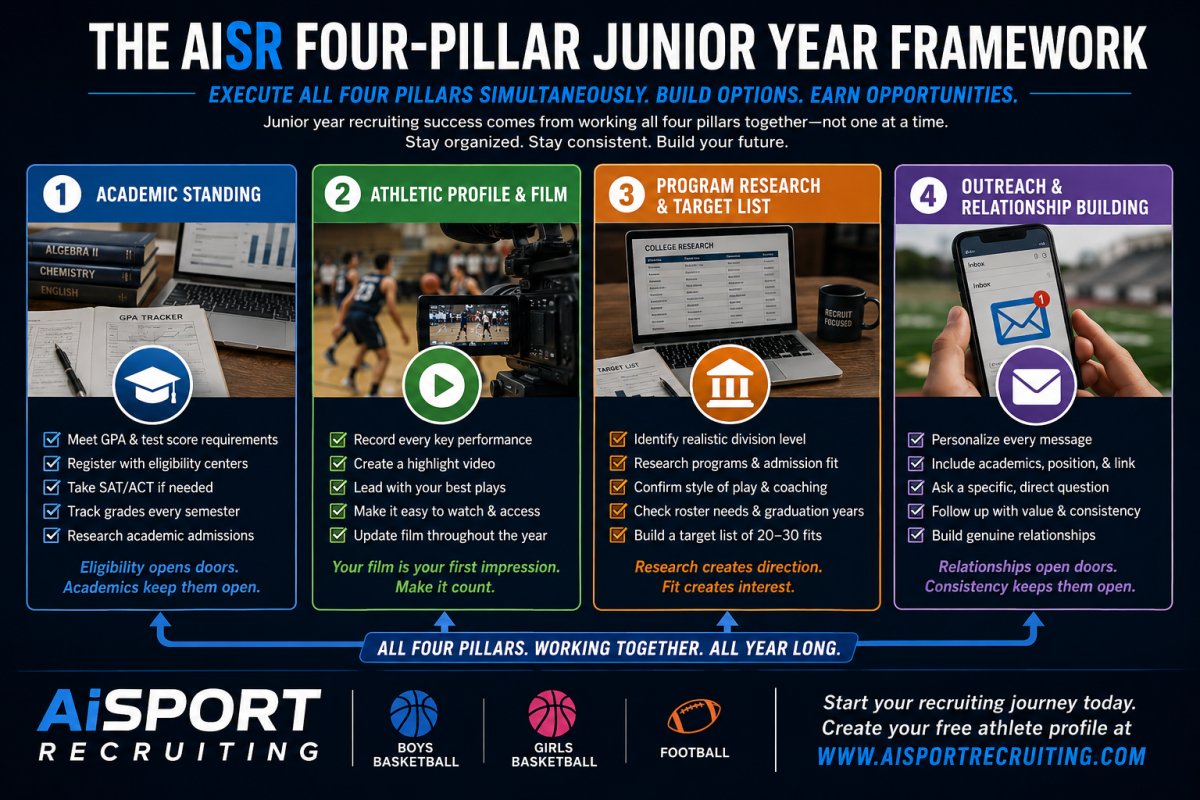
The AiSR Four-Pillar Junior Year Framework
Effective junior year recruiting is built on four pillars that work simultaneously rather than sequentially. Families who treat these as a checklist to complete in order — finish academics, then build film, then research programs, then reach out — consistently run out of time. The families who succeed work all four pillars in parallel from the first day of junior year.
PILLAR 1 — Academic Standing
↓
PILLAR 2 — Athletic Profile and Film
↓
PILLAR 3 — Program Research and Target List
↓
PILLAR 4 — Outreach and Relationship Building
(All four happen simultaneously throughout junior year.)
This is the AiSR Four-Pillar Junior Year Framework. Every checklist, every calendar item, and every strategy recommendation in this guide maps back to one of these four pillars. Families that execute all four consistently throughout junior year arrive at senior year with options built on evidence. Families that execute one or two partially arrive at senior year starting over.
Here is the tactical approach to each.
PILLAR 1 — Academic Standing
Academic eligibility is the first filter every college coach applies. Junior year GPA and standardized test scores are the primary academic data points coaches evaluate — because they are the most recent available when coaches are actively building their recruiting boards.
The Junior Year Academic Checklist:
✓ Confirm registration with the NCAA Eligibility Center if targeting NCAA programs
✓ Confirm registration with the NAIA Eligibility Center separately if targeting NAIA programs
✓ Know the specific GPA and test score requirements for each target division
✓ Schedule SAT or ACT if not yet taken — junior year scores significantly expand or narrow recruiting options
✓ Identify any core course gaps and address them during junior year
✓ Track GPA by semester — a declining junior year GPA raises flags with coaches even after initial interest is established
✓ Research academic admission standards at each target program individually — requirements vary significantly by institution
The honest priority:
If an athlete's current GPA does not meet the admission standards of their target programs the most impactful recruiting strategy available is improving academic performance. No outreach strategy compensates for academic ineligibility. Every point of GPA improvement expands the realistic opportunity landscape.
PILLAR 2 — Athletic Profile and Film
Junior year athletic performance is under active evaluation by coaching staffs. Game film from junior year is what coaches are reviewing when making scholarship decisions for the next recruiting class.
The Junior Year Film Checklist:
✓ Ensure game film is being recorded for every significant competition
✓ Build a highlight video with the athlete's best moments from current junior year performance
✓ Confirm the highlight video opens immediately without a login, password, or download required
✓ Lead the highlight video with the athlete's two or three strongest plays in the first thirty seconds
✓ Clearly identify the athlete in every clip — number, arrow, or other visual marker
✓ Keep the highlight video under five minutes — coaches do not watch full game film on initial evaluation
✓ Host the video on a platform that tracks views and is reliably accessible — YouTube or Hudl are standard
✓ Update the highlight video after strong performances — junior year performance matters most
The film quality reality:
A technically strong athlete with accessible, well-edited film that leads with their best moments will receive more serious evaluation than a more talented athlete whose film is difficult to access, poorly edited, or buried in unedited game footage. Film quality is within a family's control. Prioritize it accordingly.
PILLAR 3 — Program Research and Target List
Junior year outreach is most effective when it is directed at programs where a genuine academic and athletic fit has been confirmed in advance. Random outreach to recognizable programs — without verifying academic fit, athletic fit, and current roster needs — produces silence that families mistake for rejection.
The Target List Building Checklist:
✓ Identify which division level represents a realistic athletic target for the athlete's current profile
✓ Research programs at that division level that match the athlete's academic profile
✓ Verify admission standards at each target program — not assumed, confirmed through the institution's website
✓ Research each program's style of play and confirm it suits the athlete's skill set
✓ Identify the Recruiting Coordinator or coach responsible for recruiting at each program
✓ Confirm each program's roster composition at the athlete's position and graduation year
✓ Identify upcoming showcases and events where coaches from target programs will be evaluating prospects
✓ Create a prioritized list of 20 to 30 target programs where genuine fit has been confirmed
The honest reality about target lists:
A targeted list of 20 to 30 well-researched programs consistently produces better results than a broad list of 100 or more programs contacted without verification of fit. Volume without precision wastes time, money, and goodwill with coaches. Precision without volume leaves opportunities on the table. The 20 to 30 range balances both effectively for most junior year recruiting campaigns.
PILLAR 4 — Outreach and Relationship Building
Outreach is where the preparation in Pillars 1 through 3 pays off — or reveals gaps. Families who have done the academic, film, and research work arrive at outreach with confidence and specificity. Families who skip to outreach without that foundation produce messages that coaches recognize immediately as unprepared.
The Initial Outreach Checklist:
✓ Identify the Recruiting Coordinator — not the head coach — as the primary first contact at each Division I and Division II program
✓ Draft a personalized message for each program that includes graduation year, position, GPA, and test scores upfront
✓ Include a direct link to the highlight video that opens immediately
✓ Include one specific reason the program interests the athlete — playing style, academic program, coaching philosophy, or campus environment
✓ End with a specific, direct question — roster needs, upcoming showcase attendance, or availability for a call
✓ Proofread every message before sending — spelling errors and casual language reflect poorly on the athlete's character and seriousness
✓ Send from a professional email address that identifies the athlete clearly
The Follow-Up Checklist:
✓ Track every outreach message — program, contact, date sent, content, and response status
✓ Follow up one to two weeks after initial outreach if no response received
✓ Add something new to every follow-up — updated stat, new highlight clip, upcoming showcase notification, or interest from another program
✓ Follow up after every significant performance — a strong tournament, a season highlight, or a new award provides a natural reason to re-engage
✓ Respond to coach responses within 24 to 48 hours — delayed responses signal lack of genuine interest
✓ Send a personalized thank you within 24 hours of any campus visit
✓ Follow up professionally after receiving a no — coaching staffs change and roster needs evolve
Our guide on the best follow-up strategy after contacting college coaches covers this in depth.
Common Junior Year Recruiting Mistakes
Even well-prepared families make avoidable mistakes during junior year. Here are the most common ones — and what to do instead.
Waiting until spring to contact coaches. Scholarship budgets are allocated throughout the year — not all at once in the spring. Families who wait until spring semester to begin outreach are competing for whatever resources remain after earlier commitments have been made. Begin outreach in August before the season starts.
Sending generic emails. A message that does not reference the specific program, does not include academic credentials upfront, and does not demonstrate genuine interest in why the program is a fit is easy for a Recruiting Coordinator to overlook. Every message should be personalized to the specific program.
Not updating film. A highlight video built from sophomore year footage does not represent a junior year athlete accurately. Coaches evaluating recruits for the next class want to see current performance. Update the highlight video continuously throughout junior year.
Ignoring GPA until senior year. Junior year grades are among the most closely scrutinized academic data points in the recruiting process. An athlete whose GPA drops during junior year — even after initial interest has been established — raises flags with coaches that can derail recruiting conversations already in progress.
Targeting only Division I programs. Division I is the most competitive and the most limited in available roster spots. Families who restrict their outreach exclusively to Division I while overlooking Division II, Division III, NAIA, and NJCAA programs systematically narrow the opportunity landscape. The best fit is not always the most recognizable program.
Failing to follow up professionally. A single unanswered message is not rejection. Most unanswered recruiting messages reflect timing, volume, and roster circumstances — not a final decision about the athlete. Professional, persistent, value-adding follow-up is what separates families who build recruiting relationships from those who send one message and wait indefinitely.
The Junior Year Monthly Strategy Calendar
Recruiting is not a single event — it is a 12-month process. Here is how successful families typically approach junior year month by month.
August — Pre-Season
Register with eligibility centers. Finalize target list. Confirm film is being recorded. Send initial outreach to top 10 priority programs before the season starts — coaches are actively building boards before fall competition begins.
September — Early Season
Update highlight video with early season performance. Follow up with programs that have not responded to initial outreach. Research showcase opportunities for the fall and winter. Monitor academic standing through first quarter or semester grades.
October — Mid Season
Attend fall showcases where target program coaches will be present. Send event-driven follow-up messages. Continue academic monitoring.
November — Late Season
Update highlight video with season highlights. Follow up with all programs on the target list that have not yet responded. Begin identifying additional programs to expand the target list if initial outreach has produced limited engagement. SAT or ACT scheduled if not yet taken.
December — Off Season Transition
Review outreach results from fall season. Identify which programs are actively engaging and which are not. Redirect energy toward programs showing genuine interest. Begin planning winter season outreach strategy for Basketball families.
January — Winter Season
Basketball families — peak recruiting window. Coaches are actively evaluating winter recruits. Update film continuously. Attend showcases where target program coaches are present. Follow up consistently with programs where interest has been established.
February — Mid Winter
Continue outreach and follow-up. If no significant responses have been received reassess target list — confirm programs are realistic fits and consider expanding to additional division levels. Monitor academic standing through semester grades.
March — Late Winter
Basketball families — AAU and spring showcases beginning. Plan showcase calendar deliberately. Update highlight video with winter season performance.
April through June — Spring and Summer
Football families — spring practice and 7-on-7 season. Attend events where target program coaches evaluate prospects. Update film. Continue outreach. Take SAT or ACT if not yet completed. Begin building the senior year recruiting plan based on junior year results.
The Junior Year Decision Framework
By the end of junior year families should have enough information to answer three critical questions that shape the senior year recruiting strategy.
Question 1 — Which programs are genuinely interested?
Programs that have responded substantively, requested additional information, initiated contact, or invited a campus visit are actively interested. These programs deserve the most continued attention in senior year.
Question 2 — Which programs are not engaging?
Programs that have received multiple professional follow-ups without any response are signaling — through their silence — that the fit is not there at this moment. Senior year energy should be directed first toward programs showing engagement.
Question 3 — Is the target list realistic?
If junior year outreach to 20 to 30 carefully researched programs has produced minimal engagement, the target list may need recalibration. This is the moment for an honest conversation about whether the division level, the program types, or the outreach approach needs adjustment before senior year begins.
What Families Can Control in Junior Year
Families cannot control when a coach reaches out, whether a scholarship offer comes, or how a program's roster needs evolve. Those variables belong to the programs.
What families can control is everything in Pillars 1 through 4. Academic performance is a choice made every day in every class. Film quality is a function of preparation and curation. Program research is a function of time invested before outreach begins. Outreach quality is a function of personalization, professionalism, and persistence. Follow-up consistency is a function of organization and discipline.
How AiSportRecruiting Supports Junior Year Strategy
AiSportRecruiting was founded by Coach Jackson after more than 30 years serving as a High School Athletic Director and coaching at the high school, AAU, and college levels — with more than 300 scholarship placements across his career.
The platform was built on a belief that has guided Coach Jackson throughout his career: talent deserves opportunity regardless of a family's budget, connections, or access to private recruiting services.
For junior year athletes the platform provides a verified starting point — 10 personalized college program recommendations based on current academic and athletic profile, detailed explanations for the Top 3 recommended schools, and personalized athlete development guidance — before outreach begins, before showcases are booked, and before scholarship budget windows close.
AiSportRecruiting currently supports student-athletes in three sports:
🏀 Boys Basketball
🏀 Girls Basketball
🏈 Football
Additional sports are in development and will be introduced as they complete AiSportRecruiting's quality validation process.
The AiSportRecruiting Standard
Everything AiSportRecruiting publishes and every recommendation the platform produces is guided by one principle:
Families deserve recruiting information they can trust.
That means accuracy before assumptions. Evidence before opinion. Families before technology. Opportunity for every athlete across every level of college athletics. And transparency in every recommendation we provide.
AiSportRecruiting does not guarantee scholarships, roster positions, coach responses, or recruiting offers. The platform provides honest, evidence-based recruiting intelligence designed to help families navigate the recruiting process with greater clarity and confidence.
That is the AiSportRecruiting Standard.
Junior year does not determine every recruiting outcome — but it often determines how many opportunities an athlete has entering senior year. Families who execute consistently across all four pillars of the AiSR Four-Pillar Junior Year Framework give themselves more choices, more conversations with coaches, and a stronger foundation for senior-year recruiting.
That is the goal. Not perfection. Options built on evidence.
Begin Your Recruiting Journey Today
Every recruiting journey begins with better information.
If you are ready to identify college programs that may align with your student-athlete's academic and athletic goals as they enter junior year, create your free athlete profile today.
✅ 10 personalized college program recommendations
✅ Detailed explanations for your Top 3 recommendations
✅ Personalized athlete development recommendations
✅ No cost. No obligation. No credit card required.
👉 www.AiSportRecruiting.com
Because every student-athlete deserves the opportunity to be seen. And every family deserves recruiting information they can trust.
Frequently Asked Questions
How is this article different from the Junior Year College Recruiting guide?
The Junior Year College Recruiting guide explains what junior year means in the recruiting process and why it matters. This article is the execution layer — a tactical, checklist-driven strategy framework built around the AiSR Four-Pillar Junior Year Framework for actually doing the work throughout junior year.
What is the AiSR Four-Pillar Junior Year Framework?
The AiSR Four-Pillar Junior Year Framework is the organizing structure for effective junior year recruiting — Academic Standing, Athletic Profile and Film, Program Research and Target List, and Outreach and Relationship Building. All four pillars must be worked simultaneously throughout junior year for the strategy to be effective.
What are the most common junior year recruiting mistakes?
The most common mistakes include waiting until spring to contact coaches, sending generic emails, not updating film with current performance, ignoring GPA until senior year, targeting only Division I programs, and failing to follow up professionally after initial outreach goes unanswered.
How many programs should a junior year athlete contact?
A targeted list of 20 to 30 programs where genuine academic and athletic fit has been confirmed is the recommended range. This balances precision with sufficient volume to produce meaningful engagement across the recruiting cycle.
When should junior year outreach begin?
Before the season starts — ideally in August. Coaches are actively building their recruiting boards before fall competition begins. Families who send initial outreach in August are competing for coaching attention at the beginning of the evaluation window rather than after it is already partially filled.
What should I do if junior year outreach produces no responses?
First confirm the outreach was personalized and included academic credentials, a link to current film, and a specific question. Then reassess the target list — confirm programs are realistic academic and athletic fits. If multiple programs across a well-researched target list are unresponsive consider whether the division level needs to be adjusted.
Should freshmen or sophomores follow this same strategy?
Freshmen and sophomores should focus primarily on academics, skill development, and building quality game film. Junior year is when those preparations become an organized recruiting campaign using the AiSR Four-Pillar Framework. Starting the foundational work early means arriving at junior year ready to execute — not still preparing.
How do I know which programs are genuinely interested after junior year?
Programs that have responded substantively, requested additional information, initiated contact, or invited a campus visit are actively interested. Programs that have received multiple professional follow-ups without any response are signaling a mismatch — at least for the current recruiting cycle.
Does AiSportRecruiting help with junior year recruiting specifically?
Yes. AiSportRecruiting provides personalized college program recommendations based on current academic and athletic profile — making it most valuable when used at the beginning of junior year to confirm which programs represent genuine fits before outreach begins.
Which sports does AiSportRecruiting currently support?
AiSportRecruiting currently supports Boys Basketball, Girls Basketball, and Football. Additional sports are in development and will be added as they complete the platform's quality validation process.
Does AiSportRecruiting guarantee recruiting outcomes?
No. AiSportRecruiting provides personalized program recommendations and athlete development guidance based on the information families submit. Recruiting outcomes depend on many factors including athletic performance, academic standing, a program's specific roster needs, and the relationships families build with coaching staffs.
What is the most important thing a junior year athlete can do right now?
Create a free athlete profile on AiSportRecruiting to get a verified, data-grounded picture of where genuine opportunities may exist — then build the outreach strategy around those programs using the AiSR Four-Pillar Junior Year Framework outlined in this guide.


