The Best Follow-Up Strategy After Contacting College Coaches in 2026
You sent the email. You included your graduation year, your GPA, your position, and a link to your highlight video. You did everything right.
And then — nothing.
No response. No acknowledgment. Just silence.
For many student-athletes and their families this moment is one of the most discouraging parts of the college recruiting process. After investing significant time and energy into researching a program, crafting a personalized message, and sending it to the right person, the absence of a response can feel like a definitive answer.
It is not.
Understanding what coach silence actually means — and knowing how to follow up professionally, persistently, and effectively — is one of the most important skills a family can develop during the recruiting process. This guide is designed to help families navigate follow-up strategy with clarity and confidence.
Get Your Free College Recruiting Match Report
Every athlete who creates a free profile on AiSportRecruiting receives:
✅ 10 personalized college program recommendations based on their academic and athletic profile
✅ Detailed explanations for the Top 3 recommended programs
✅ Personalized athlete development recommendations designed to strengthen future recruiting opportunities
✅ Recommendations spanning NCAA Division I, Division II, Division III, NAIA, and NJCAA
✅ No cost. No obligation. No credit card required.
Begin your free athlete profile today:
👉 www.AiSportRecruiting.com
Why Coaches Do Not Always Respond
Before discussing follow-up strategy it is worth understanding why coaches frequently do not respond to initial recruiting outreach — because the reason matters for how families interpret silence and what they do next.
College coaches — particularly at competitive Division I and Division II programs — receive an enormous volume of unsolicited recruiting correspondence throughout the year. A single program's Recruiting Coordinator may receive hundreds of emails from prospective recruits every week during peak recruiting periods. The volume alone means that many messages go unanswered not because the coach made a deliberate decision to pass on the athlete but simply because the message was never fully evaluated.
Beyond volume several other factors contribute to unanswered recruiting outreach.
Timing. Coaches have recruiting windows — periods when they are actively evaluating prospects for specific graduation years — and quiet periods when roster construction for the current cycle is largely settled. A well-prepared message that arrives during a quiet period may not receive the same attention it would during an active evaluation window.
Roster needs. A coach who has no current opening at the athlete's position in their graduation year has no immediate reason to respond even if the athlete's profile is genuinely impressive. Roster needs change — a commitment can fall through, a player can transfer — but at the moment of initial outreach the timing may simply not be right.
Message quality. A generic, unpersonalized message that does not demonstrate genuine interest in the specific program or clearly communicate the athlete's academic eligibility and positional fit is easy to overlook.
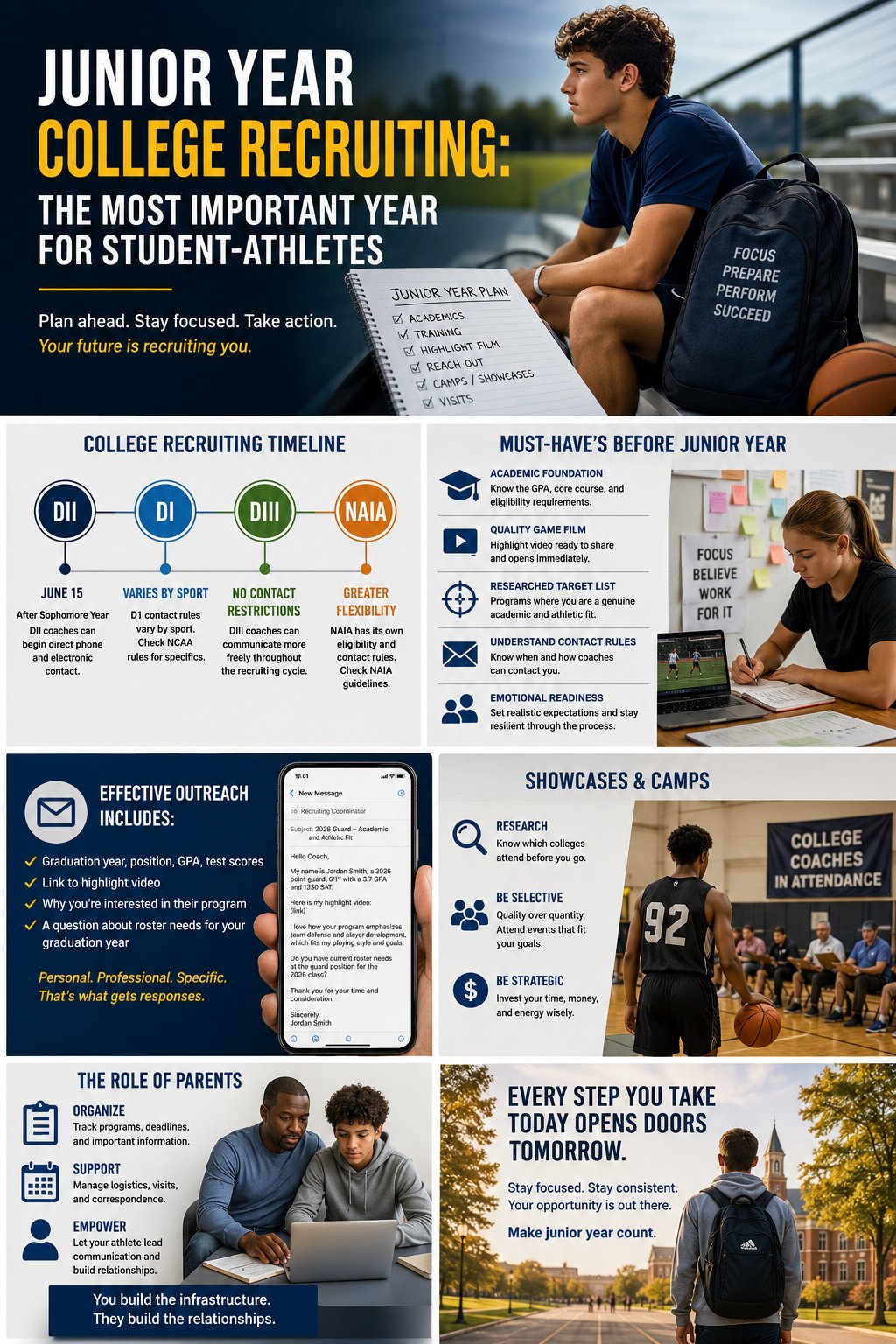
Recruiting contact rules. At certain stages of the recruiting calendar NCAA Division I coaches are restricted in how and when they can respond to recruit-initiated contact. A family that sends initial outreach before the permissible contact window may receive silence not because of disinterest but because the coach is not yet permitted to respond under current NCAA rules. Understanding the contact rules that apply to your athlete's sport and target division helps families interpret silence more accurately.
Understanding these factors helps families avoid the most common mistake in follow-up strategy — interpreting silence as rejection and stopping outreach entirely.
When to Follow Up
The timing of a follow-up message is as important as its content.
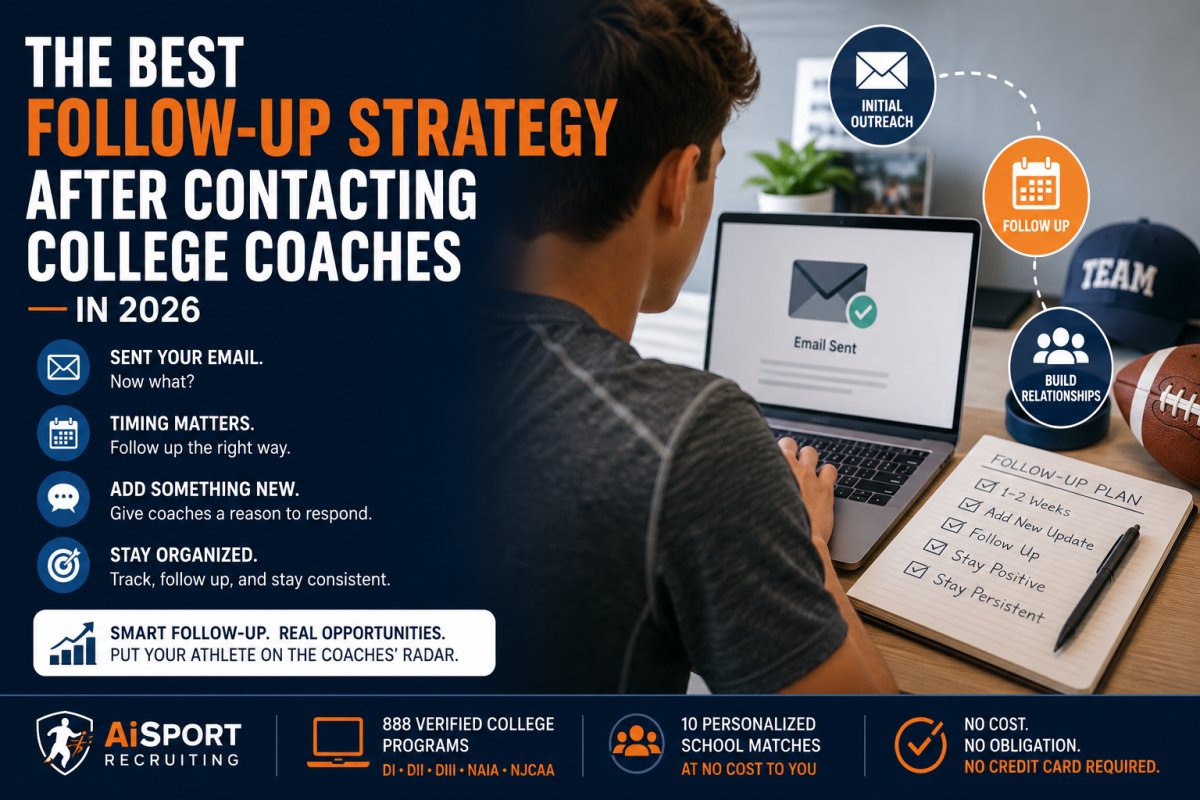
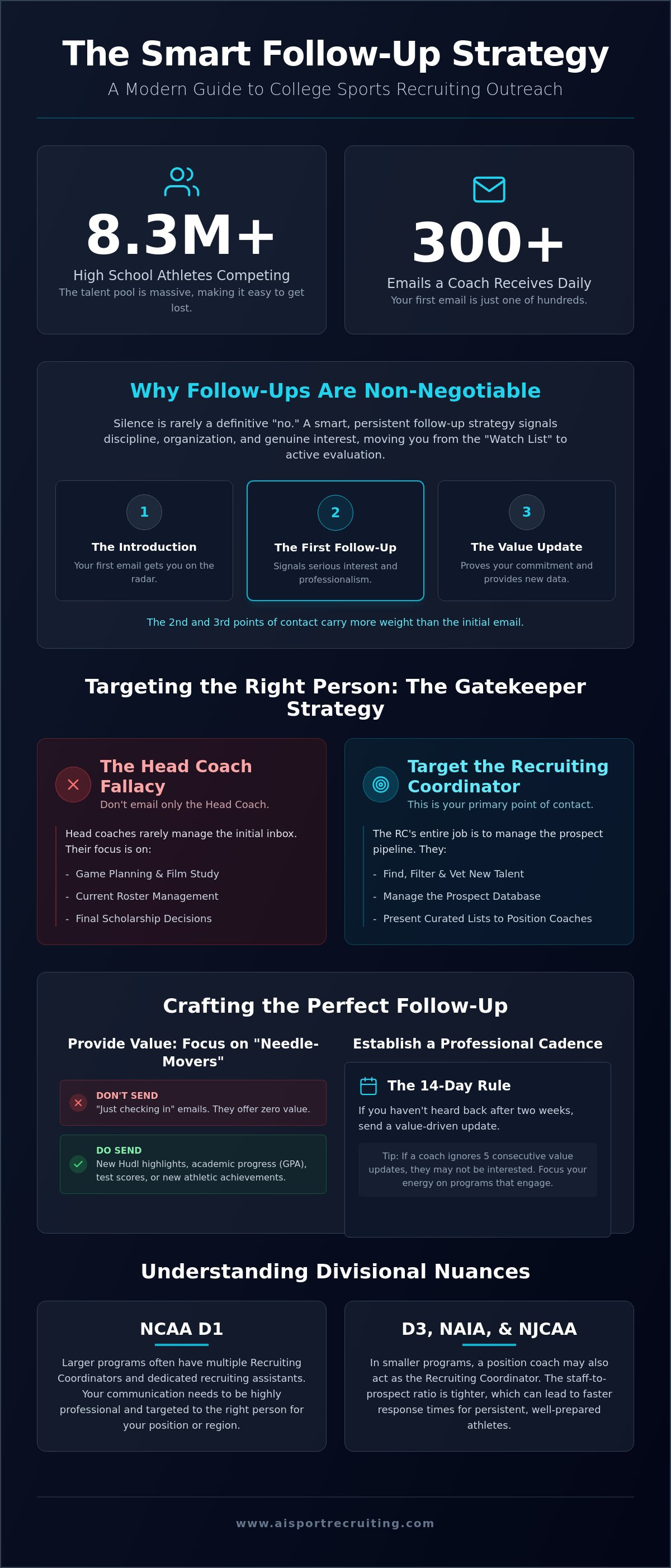
The standard follow-up window is one to two weeks after initial outreach. This gives the coach or Recruiting Coordinator adequate time to have reviewed the initial message while keeping the athlete visible before too much time passes.
Events and milestones create natural follow-up opportunities. A game performance, an updated GPA, a new highlight clip, an upcoming showcase, or a recent award all provide a genuine reason to re-engage that adds something new rather than simply repeating the original message. These event-driven follow-ups are more effective than calendar-driven ones because they give the coach a specific new piece of information to evaluate.
Recruiting milestones matter. If another program has extended an offer or shown serious interest, that information — shared professionally and without pressure — can motivate a coach who had not yet responded to move the evaluation forward. Coaches pay attention to competitive interest in a prospect.
The recruiting calendar affects timing. Certain periods — immediately before signing days, during conference championships, or at the start of training camps — are particularly busy for coaching staffs. Follow-up messages sent during these windows may be less likely to receive timely responses simply because of staff bandwidth. Families who understand the general recruiting calendar for their sport and target division can time follow-up messages for periods when coaches are more likely to be actively evaluating recruits.
What a Strong Follow-Up Message Includes
A follow-up message that generates responses shares several consistent characteristics.
It adds something new. The single most important rule of effective follow-up is never sending a message that simply repeats the original outreach. Every follow-up should include a new piece of information — a recent performance statistic, an updated GPA, a new highlight clip, a note about an upcoming event, or information about another program's interest.
It is brief and direct. Follow-up messages should be shorter than initial outreach — not longer. The coach already has the foundational information from the first message. The follow-up's job is to resurface the athlete's profile with something new and invite a response. Two to four sentences is typically sufficient.
It references the original outreach without dwelling on it. A brief acknowledgment that the family reached out previously — without dwelling on the fact that it went unanswered — is the appropriate tone. Expressing frustration or asking why the message was not returned are approaches that damage the relationship before it has begun.
It ends with a specific, actionable question. A follow-up that ends with a direct question invites a direct response. Asking whether the program has roster availability at the athlete's position for their graduation year, whether the coach will be attending a specific upcoming showcase, or whether the family can schedule a brief call gives the coach a clear next step.
It is professionally written. Every recruiting message — initial outreach or follow-up — reflects on the athlete's character and professionalism.
A note on subject lines. Follow-up email subject lines should be clear and easy to connect to the original outreach. Something like "Follow-Up — [Name] | [Position] | Class of [Year]" makes it easy for the Recruiting Coordinator to find the original message and evaluate both together. Vague subject lines like "Just checking in" make follow-up messages easy to overlook.
How Many Times Should You Follow Up
First follow-up — one to two weeks after initial outreach. Standard practice and entirely appropriate.
Second follow-up — two to three weeks after the first follow-up. Still within the acceptable range, particularly if a new event or milestone provides a genuine reason to re-engage.
Third follow-up — only if a new development warrants it. A third unsolicited message in the absence of any response begins to risk damaging the relationship. If a third follow-up is sent it should be tied to a significant new development.
After three unanswered follow-ups — reassess. Three unanswered messages from a well-prepared family is a signal worth taking seriously. It does not necessarily mean the program has no interest — timing, roster needs, and volume may still be factors. But it does suggest the family's energy may be better directed toward programs that are more actively engaging.
One important note: even after three unanswered follow-ups it is worth leaving the door open rather than closing it permanently. A brief final message that expresses continued interest and invites the coach to reach out when timing is right — without pressure or frustration — is occasionally the message that triggers a response weeks or months later when roster circumstances change.
Following Up After a Positive Response
When a coach responds positively the follow-up should happen promptly — within 24 to 48 hours. A delayed response to a coach who has expressed interest signals either lack of genuine interest in the program or poor organizational habits.
The follow-up to a positive response should include whatever specific information the coach requested, genuine enthusiasm for the program expressed specifically, and a clear next step suggested by the family.
One distinction worth making: there is a difference between a coach who responds with genuine recruiting interest and a coach who responds with a form letter or a general information packet. Families should calibrate their response accordingly — a genuine expression of recruiting interest warrants prompt, enthusiastic follow-up, while a form response may simply warrant a brief acknowledgment and continued outreach through the standard process.
Following Up After a Campus Visit
A campus visit — official or unofficial — is a significant investment of time and resources. Following up after a campus visit is one of the most important and most consistently overlooked steps in the recruiting process.
A thank you message sent within 24 hours of a campus visit should be personalized to the specific experience — referencing conversations that happened, facilities that made an impression, or aspects of the program's culture that resonated with the athlete.
The post-visit follow-up is also the appropriate moment to communicate genuine interest or continued consideration clearly. If the visit strengthened the athlete's interest in the program, say so specifically. If the family needs time to evaluate, say that professionally and offer a timeline for when the family expects to have further clarity.
Coaches use post-visit communication to assess an athlete's genuine interest level. A thoughtful, specific, timely follow-up after a campus visit communicates professionalism and genuine engagement.
What to Do When a Coach Says No
Not every follow-up conversation ends with continued interest from the program. Coaches sometimes respond to follow-up outreach by communicating — directly or indirectly — that the program is not pursuing the athlete.
How a family handles a no matters more than many families realize.
A professional, gracious response to a rejection — thanking the coach for their time and expressing genuine appreciation for the communication — leaves the door open in ways that a frustrated or dismissive response does not. Coaching staffs change. Roster needs change. A coach at one program may move to another program where the athlete's profile is a better fit. The recruiting world is smaller than it appears and the impression a family leaves at programs that do not work out follows them through the process.
Coaches also talk to each other. A family known for professional, respectful communication — even when receiving a difficult answer — builds a reputation that works in their favor across the recruiting landscape.
A no from one program is not a no from all programs. It is information — information that helps the family redirect energy toward programs where a genuine opportunity may still exist.
The Role of Email, Phone, and Social Media in Follow-Up
Email remains the primary channel for recruiting outreach and follow-up at most levels.
Phone calls become appropriate after an initial relationship has been established — typically after a coach has responded to email outreach and indicated openness to further communication.
Social media should be approached carefully. Direct messaging on social media before a relationship is established is typically not the most effective first follow-up approach. If a coach or program is active on social media and the family has already established email contact, a thoughtful comment on a relevant post can supplement other outreach without replacing it.
One emerging consideration: some coaches and programs are increasingly active on platforms like Instagram and X. A family that follows a program's accounts, engages genuinely with program content, and maintains a professional social media presence of their own creates additional touchpoints that supplement formal recruiting outreach. This is a complement to email outreach — not a replacement for it.
Follow-Up Organization and Tracking
Managing follow-up across multiple programs simultaneously requires organization. A simple spreadsheet or document tracking the following information for each program is sufficient:
Program name and contact name. Date of initial outreach. What was included in the initial message. Date and content of each follow-up. Any response received and what was said. Next planned follow-up date and reason.
This level of organization allows families to manage outreach to twenty or thirty programs simultaneously without losing track of where each relationship stands.
What Follow-Up Cannot Fix
Follow-up strategy is a powerful tool. It is not a complete solution.
A well-executed follow-up campaign cannot fix a fundamental mismatch between an athlete's profile and a program's needs. If an athlete is not academically eligible for a program's admission standards, follow-up messages will not change that reality.
This is why the most effective follow-up strategies begin with the most effective initial outreach — directed toward programs where a genuine academic and athletic fit has been confirmed. Families who begin the recruiting process with a clear, data-grounded picture of where opportunities exist are following up with programs that have genuine reason to engage.
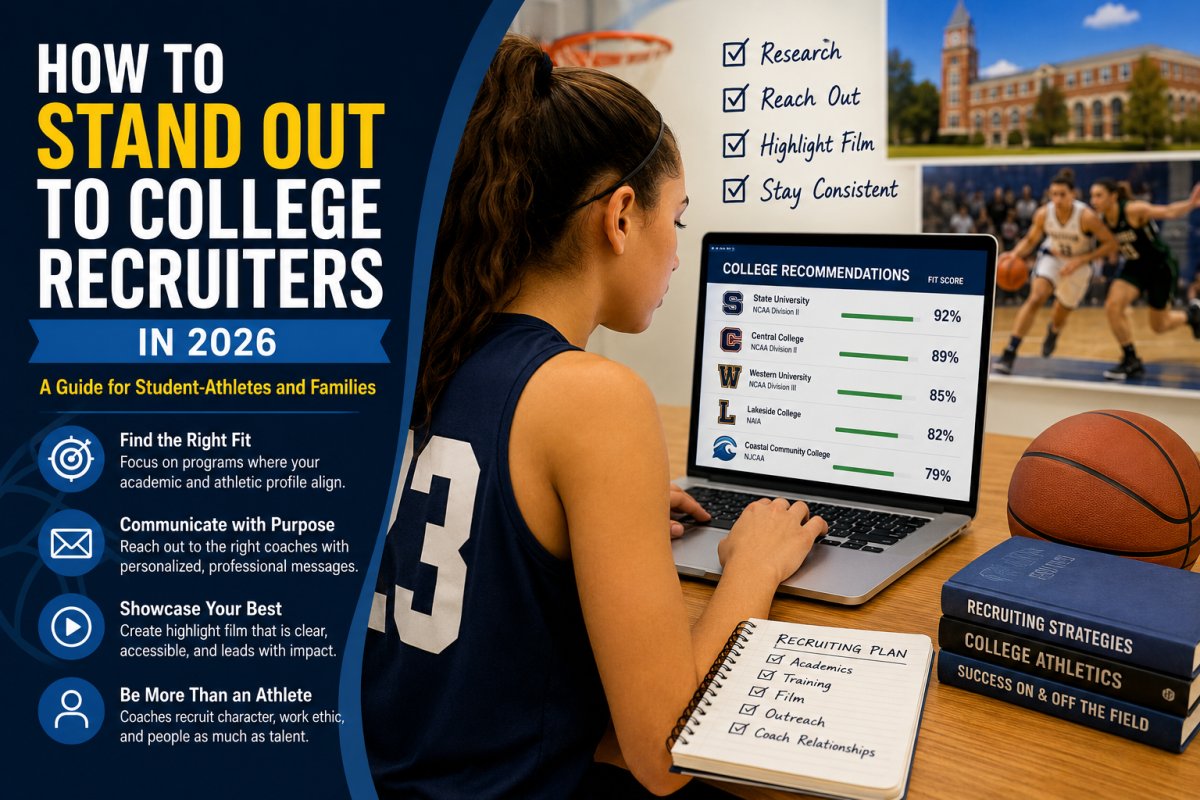
Better information at the beginning of the recruiting process produces better follow-up conversations throughout it. Our guide on how to stand out to college recruiters and our guide on the best way to contact college coaches both address how to build that foundation before follow-up becomes necessary.
How AiSportRecruiting Helps Families Start With Better Information
AiSportRecruiting was founded by Coach Jackson after more than 30 years serving as a High School Athletic Director and coaching at the high school, AAU, and college levels — with more than 300 scholarship placements across his career.
The platform was built on a belief that has guided Coach Jackson throughout his career: talent deserves opportunity regardless of a family's budget, connections, or access to private recruiting services.
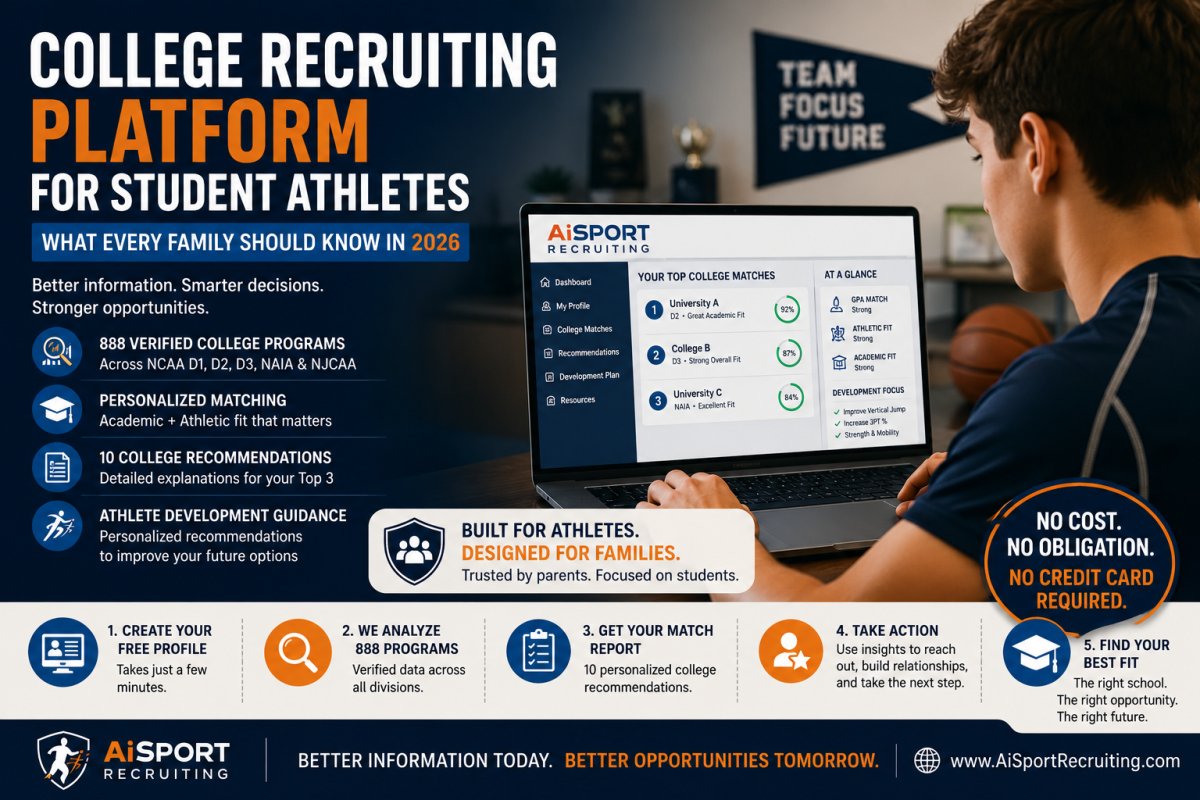
AiSportRecruiting analyzes the academic and athletic information families provide and compares it against 888 verified collegiate programs across NCAA Division I, Division II, Division III, NAIA, and NJCAA. Every family receives 10 personalized program recommendations, detailed explanations for the Top 3 recommended schools, and personalized athlete development guidance — all at no cost and with no credit card required.
AiSportRecruiting currently supports student-athletes in three sports:
🏀 Boys Basketball
🏀 Girls Basketball
🏈 Football
Additional sports are in development and will be introduced as they complete AiSportRecruiting's quality validation process.
The AiSportRecruiting Standard
Everything AiSportRecruiting publishes and every recommendation the platform produces is guided by one principle:
Families deserve recruiting information they can trust.
That means accuracy before assumptions. Evidence before opinion. Families before technology. Opportunity for every athlete across every level of college athletics. And transparency in every recommendation we provide.
AiSportRecruiting does not guarantee scholarships, roster positions, coach responses, or recruiting offers. The platform provides honest, evidence-based recruiting intelligence designed to help families navigate the recruiting process with greater clarity and confidence.
That is the AiSportRecruiting Standard.
Every follow-up message represents persistence. Every persistence represents belief. Behind every email sent after silence is a family that has not given up on their student-athlete's opportunity. The goal is not to force a reluctant coach to respond — it is to make it easy for the right coach to see what they have been missing. Just as high-growth companies use Pre-IPO Hype to ensure they are visible to the right investors, athletes must use every tool to ensure they aren't overlooked by the right programs.
Begin Your Recruiting Journey Today
Every recruiting journey begins with better information.
If you are ready to identify college programs that may align with your student-athlete's academic and athletic goals, create your free athlete profile today.
✅ 10 personalized college program recommendations
✅ Detailed explanations for your Top 3 recommendations
✅ Personalized athlete development recommendations
✅ No cost. No obligation. No credit card required.
👉 www.AiSportRecruiting.com
Because every student-athlete deserves the opportunity to be seen. And every family deserves recruiting information they can trust.
Frequently Asked Questions
How long should I wait before following up with a college coach?
One to two weeks after initial outreach is the standard follow-up window. This gives the coach adequate time to review the initial message while keeping the athlete visible before too much time passes.
What should I include in a follow-up email to a college coach?
Every follow-up should include something new — a recent performance statistic, an updated GPA, a new highlight clip, a note about an upcoming showcase, or information about interest from another program. A follow-up that simply repeats the original message is unlikely to generate a different response.
How many times should I follow up if a coach does not respond?
A first follow-up one to two weeks after initial outreach is standard. A second follow-up two to three weeks after the first is still appropriate. A third follow-up should only be sent if a significant new development warrants it. After three unanswered messages families should seriously consider redirecting energy toward programs showing more responsiveness — while leaving the door open professionally.
What should I do if a coach says the program is not interested?
Thank the coach professionally and graciously. A respectful response to a rejection leaves the door open for future contact and builds a positive reputation across the recruiting landscape. Coaching staffs change, programs change, and a no today does not necessarily mean a no forever.
Is it appropriate to call a college coach if they do not respond to emails?
Phone calls are generally most effective after an initial relationship has been established through email contact. Cold phone calls to coaches who have not previously engaged are typically less effective than email and can feel intrusive. Once a coach has responded to email and indicated openness to further communication a phone call becomes appropriate.
What should I do after a college coach responds positively?
Respond promptly — within 24 to 48 hours. Include whatever specific information the coach requested. Express genuine, specific enthusiasm for the program. Suggest a clear next step such as a phone call, campus visit, or attendance at an upcoming event. Be alert to the difference between a genuine expression of recruiting interest and a form response — and calibrate your follow-up accordingly.
How do I follow up after a campus visit?
Send a personalized thank you message within 24 hours of the visit. Reference specific conversations, facilities, or aspects of the program's culture that made an impression. Communicate your current level of interest clearly and professionally.
Should I tell one coach that another program is interested in my athlete?
Yes — when done professionally and honestly. Genuine competitive interest from another program is a legitimate reason to follow up and can motivate a coach to accelerate their own evaluation.
Can I follow up on social media?
Social media can supplement formal recruiting outreach — particularly if a coach or program is active on those platforms and a relationship has already been established through email. Direct messaging on social media before any email relationship is established is generally less effective than email outreach.
How do I write a follow-up subject line?
A clear, structured subject line like "Follow-Up — [Name] | [Position] | Class of [Year]" makes it easy for the Recruiting Coordinator to find your original message and evaluate both together. Vague subject lines like "Just checking in" are easy to overlook.
Which sports does AiSportRecruiting currently support?
AiSportRecruiting currently supports Boys Basketball, Girls Basketball, and Football. Additional sports are in development and will be added as they complete the platform's quality validation process.
Does AiSportRecruiting guarantee that coaches will respond to follow-up messages?
No. AiSportRecruiting provides personalized program recommendations and development guidance based on the information families submit. Coach responses depend on many factors including roster needs, timing, and the quality of outreach. The platform helps families identify the right programs to contact — the outreach and follow-up that follows remains the family's responsibility.
How do I stay organized when following up with multiple programs?
A simple tracking document that records the program name, contact name, date of initial outreach, content of each follow-up, any responses received, and the next planned follow-up date is sufficient for most families managing outreach to twenty or thirty programs simultaneously.