Junior Year College Recruiting: The Most Important Year for Student-Athletes
For student-athletes and their families, no year in the high school career carries more recruiting significance than junior year.
This is not an exaggeration. The junior year is when scholarship budgets are actively being allocated at programs across every division of college athletics. It is when coaching staffs are building the recruiting boards that will define their next signing class. It is when the contact windows that govern when coaches can reach out to prospects open at most collegiate levels. And it is when the preparation work done during freshman and sophomore year either pays off — or reveals gaps that need to be addressed quickly.
Families who understand what junior year means in the recruiting process and who approach it with a clear, informed strategy consistently produce better outcomes than those who treat it as just another year of waiting to be discovered.
This guide is designed to help student-athletes and families understand exactly what the junior year recruiting window looks like, what to prioritize, and how to use this critical period most effectively.
Get Your Free College Recruiting Match Report
Every athlete who creates a free profile on AiSportRecruiting receives:
✅ 10 personalized college program recommendations based on their academic and athletic profile
✅ Detailed explanations for the Top 3 recommended programs
✅ Personalized athlete development recommendations designed to strengthen future recruiting opportunities
✅ Recommendations spanning NCAA Division I, Division II, Division III, NAIA, and NJCAA
✅ No cost. No obligation. No credit card required.
Begin your free athlete profile today:
👉 www.AiSportRecruiting.com
Why Junior Year Is the Most Critical Recruiting Window
The junior year matters more than any other year in the recruiting process for one fundamental reason: scholarship budgets.
College coaching staffs operate with fixed scholarship budgets that get allocated to specific recruiting classes. Those budgets are not unlimited and they are not held open indefinitely. Programs that are actively recruiting for a specific graduation year make their commitments on a rolling basis — meaning scholarship resources committed to an earlier prospect are no longer available to a later one.
Athletes who engage with programs during their junior year are competing for the full scholarship budget available for their class. Athletes who wait until senior year — or who simply hope a coach will find them without proactive outreach — are frequently competing for whatever resources remain after earlier commitments have already been made.
This reality applies across every division of college athletics. The specific contact rules vary by division and sport, but the underlying dynamic is consistent — junior year is when the window is widest and the resources are most available.
It is also worth noting that junior year is not only about athletic recruiting. It is a year with heavy academic demands — standardized tests, academic course loads, and in some cases early college research and campus visits. Families who plan ahead for both the academic and athletic dimensions of junior year are better positioned to manage both without sacrificing one for the other.
What Should Be Ready Before Junior Year Begins
The junior year recruiting window opens quickly. Families who have done the preparation work during freshman and sophomore year are positioned to make the most of it immediately.
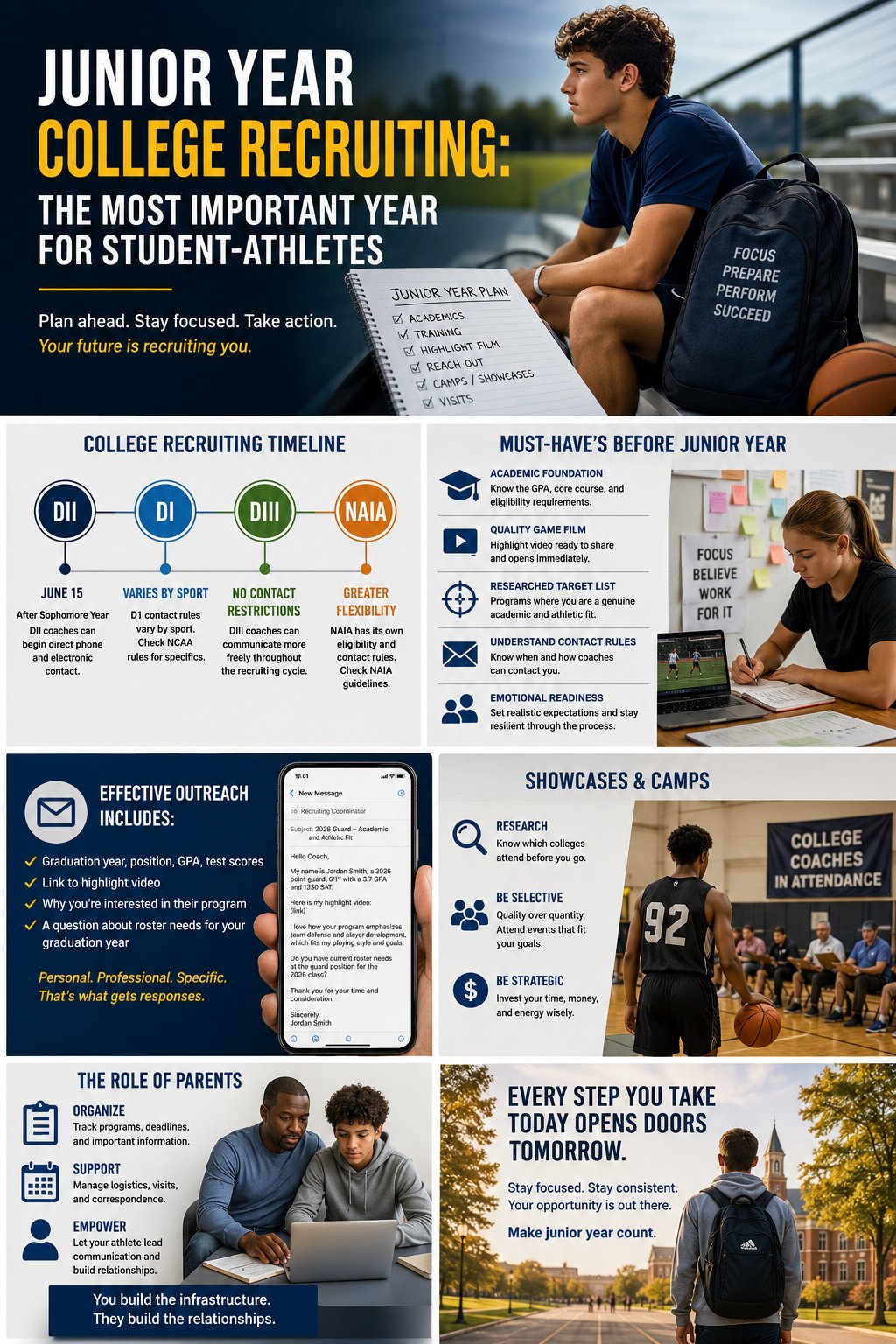
Academic foundation. Junior year GPA carries significant weight in the recruiting process. Register with the NCAA Eligibility Center early and understand the core course and GPA requirements for target divisions. Knowing those requirements in advance — and meeting them — is the foundation everything else is built on.
Quality game film. A highlight video that clearly showcases the athlete's best moments in the first thirty seconds, opens without requiring a login or download, and clearly identifies the athlete throughout is the most important recruiting tool a family has. Junior year film should be ready to share from the first day of the recruiting window.
A researched list of target programs. Junior year is not the time to start researching which programs to contact. That research should already be done. Families should have a prioritized list of programs that match the athlete's academic profile, where the program competes at a realistic level, and where the athlete appears to be a strong academic and athletic fit based on current program information.
An understanding of contact rules. NCAA and NAIA rules govern when coaches are permitted to initiate contact with prospective student-athletes. Understanding what coaches can and cannot do at different stages of the recruiting process helps families know what to expect and how to engage appropriately.
An emotional readiness conversation. Junior year can be an emotionally demanding period for student-athletes. Families benefit from having an honest conversation early in the year about realistic expectations — understanding that silence from a program does not always mean rejection, that the process takes time, and that fit matters more than prestige. Athletes who enter the junior year window with realistic expectations tend to handle the recruiting process with greater resilience and professionalism.
The Key Contact Dates for Junior Year
Recruiting contact rules vary by division and sport. The following represent general guidelines families should research and confirm for their specific sport and target division.
NCAA Division I — The recruiting calendar for Division I sports is specific and changes periodically. Division I coaches can begin certain forms of electronic communication with recruits before junior year but the full contact period varies by sport. Families should confirm the specific rules that apply to their athlete's sport directly through the NCAA website.
NCAA Division II — June 15 following the completion of sophomore year is when Division II coaches can begin direct phone and electronic contact with recruits. By the time junior year begins families of Division II targets should already be engaged in that contact window.
NCAA Division III — Division III does not have the same contact restrictions as Division I and II. Coaches can communicate more freely with prospects across the recruiting cycle.
NAIA — NAIA has its own contact rules which are generally less restrictive than NCAA rules. Families targeting NAIA programs should review NAIA eligibility guidelines directly.
Understanding these timelines helps families know when to be proactive — and what kind of response to expect at each stage.
How to Prioritize Junior Year Outreach
Junior year is when personalized, targeted outreach to Recruiting Coordinators at programs where a genuine fit has been confirmed produces the most results.
At most Division I and Division II programs the head coach does not manage initial recruiting correspondence from unknown prospects. The Recruiting Coordinator — the staff member specifically assigned to identifying and evaluating incoming talent — is the most effective first point of contact.
A personalized message to a Recruiting Coordinator during junior year that clearly demonstrates academic eligibility, positional fit, and genuine program-specific interest is far more likely to generate a substantive response than generic outreach.
What an effective junior year outreach message includes:
Graduation year, position, GPA, and test scores upfront. A direct link to a highlight video that opens immediately. One specific reason the program interests the athlete — a playing style, an academic program, a coaching philosophy, or a campus environment. A direct question about whether the program has current roster needs at the athlete's position for their graduation year.
Our guide on the best way to contact college coaches walks through this process in detail.
What to Do When Coaches Respond
Junior year outreach will generate responses — and knowing how to handle those responses professionally is as important as the outreach itself.
When a coach responds expressing interest the appropriate next steps include responding promptly and professionally, asking thoughtful questions about the program and what the coach is looking for in a recruit, and following up after any conversation with a thank you message that reinforces the athlete's interest.
When a coach responds but indicates the program is not currently recruiting the athlete's position or graduation year the appropriate response is to thank the coach for their time and keep the door open professionally. Roster needs change. A coach who remembers a well-mannered, professional family is more likely to reach out if a roster spot opens later.
When outreach goes unanswered a professional follow-up sent one to two weeks later — adding something new such as an updated stat, a recent performance, or a note about an upcoming showcase — keeps the athlete visible without becoming a nuisance.
Junior Year Showcase and Camp Strategy
Showcases and camps during junior year provide valuable exposure — particularly at Division I and high Division II levels where coaches attend events to evaluate prospects in person.
However attending every available event is not the most effective approach. The most effective junior year showcase strategy identifies which events draw coaches from programs where a realistic fit has been confirmed — and prioritizes those events specifically.
Research each event's attendee list before committing. Many showcase organizers publish lists of college programs that have attended in prior years. That information helps families make informed decisions about which events are worth the investment of time, money, and energy during an already demanding year.
Junior Year Academic Priorities
Junior year grades are among the most closely scrutinized academic data points in the recruiting process.
Families should treat junior year academics as equally important to athletic performance during the recruiting window. A strong junior year GPA confirms to coaches that the athlete is a low academic risk. A declining junior year GPA raises flags that can derail recruiting conversations even after initial interest has been established.
Standardized test preparation also belongs in the junior year plan. Many athletes take the SAT or ACT during junior year — and strong scores can meaningfully expand the range of programs that become realistic recruiting targets.
Social Media and Digital Presence During Junior Year
College coaches and Recruiting Coordinators review social media as part of their character evaluation of recruits — and junior year is when that evaluation is most active.
Maintain a professional, positive online presence throughout junior year. Content that reflects poor judgment, negative character, or anything a coaching staff might view as a concern should be removed. Communication with coaches or programs on social media should reflect the same professionalism as written outreach.
Junior Year Is Not One Size Fits All
The right junior year strategy depends significantly on which division and level of competition the athlete is realistically targeting.
For athletes targeting Power Four Division I programs the junior year may involve formal official visit invitations, scholarship offers, and early commitment decisions. For athletes targeting Division II, Division III, NAIA, or NJCAA programs the junior year is about initiating professional outreach, building relationships with coaching staffs, and positioning the athlete for decisions that often happen later in the cycle.
Families who understand which category their athlete realistically falls into — and who build their junior year strategy accordingly — avoid the frustration of applying Division I urgency to a recruiting process that is playing out on a different timeline.
Our guide on D2 colleges provides more context on what the recruiting timeline looks like specifically at the Division II level.
The Role of Parents During Junior Year
Parents play a critically important role in the junior year recruiting process — but the most effective parental involvement is organizational rather than operational, much like how Computer Market Research helps companies manage their professional partner networks through automation.
Parents who track programs, manage deadlines, organize correspondence, and coordinate campus visit logistics free the athlete to focus on performance and relationship-building. Coaches are recruiting the student-athlete — not the parents. Athletes who take ownership of their own recruiting communication, who reach out to coaches directly, and who demonstrate the initiative and professionalism to manage their own relationships leave a significantly stronger impression than athletes whose parents appear to be driving the process.
The most effective junior year families share responsibilities clearly — parents handle the infrastructure, athletes handle the relationships.
What Families Can Control During Junior Year
Families cannot control when a coach reaches out, whether a scholarship offer comes, or how a program's roster needs evolve. Those variables belong to the programs.
What families can control during junior year is significant:
Academic performance — still the most controllable factor in expanding recruiting options.
Outreach quality — personalized, professional, and consistent.
Film readiness — current, immediately accessible, leading with the best moments.
Program research — knowing which programs represent realistic fits before outreach begins.
Follow-up consistency — professional follow-up after initial outreach keeps the athlete visible.
Continued athletic development — junior year performance is being evaluated by coaches. Every game matters.
Better Information Creates Better Junior Year Decisions
Every junior year recruiting decision — which programs to contact, which showcases to attend, when to follow up, and how to present the athlete's profile — becomes easier when families understand where genuine opportunities exist before that window opens.
That is exactly the challenge AiSportRecruiting was built to help families solve.
How AiSportRecruiting Supports Junior Year Recruiting
AiSportRecruiting was founded by Coach Jackson after more than 30 years serving as a High School Athletic Director and coaching at the high school, AAU, and college levels — with more than 300 scholarship placements across his career.
The platform was built on a belief that has guided Coach Jackson throughout his career: talent deserves opportunity regardless of a family's budget, connections, or access to private recruiting services.
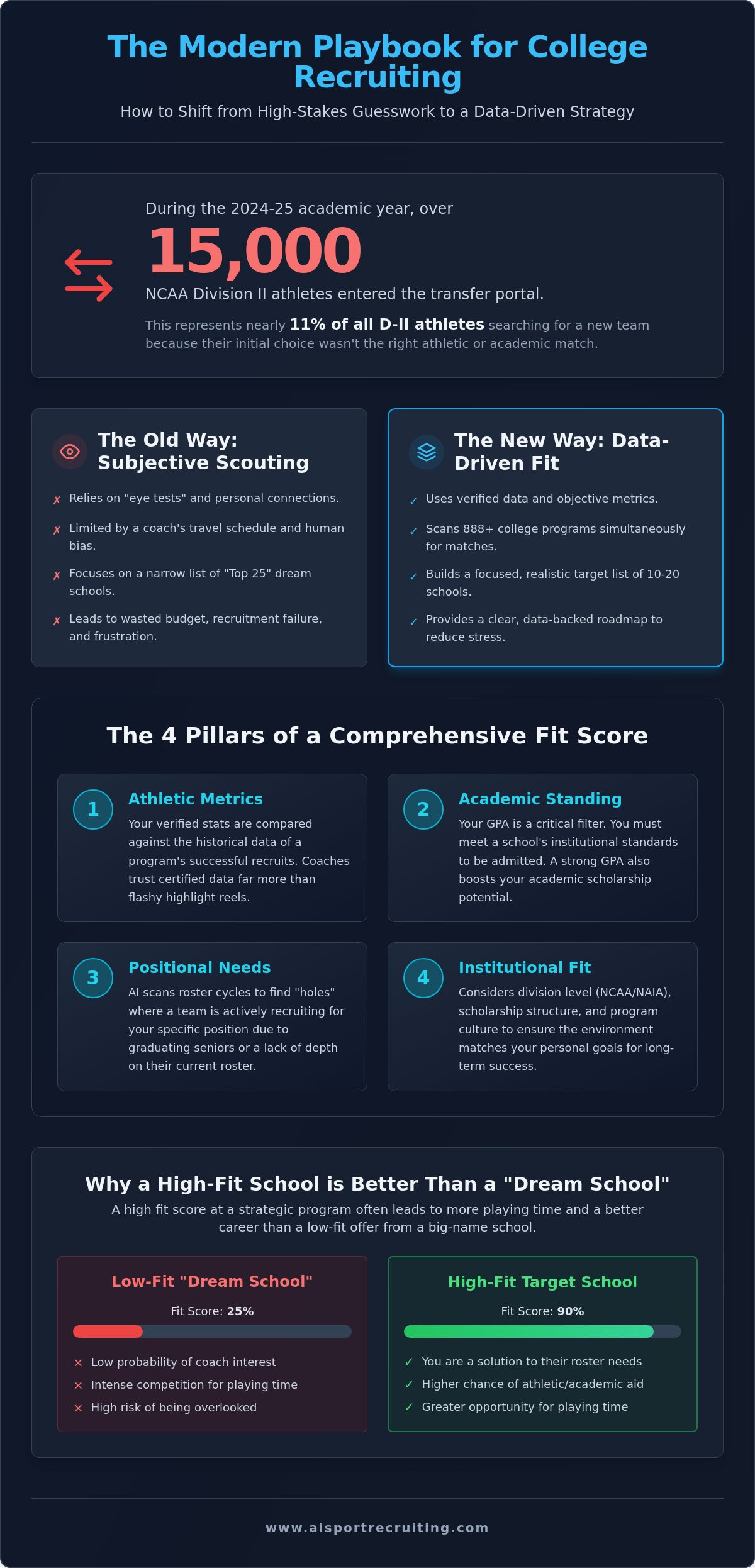
AiSportRecruiting analyzes the academic and athletic information families provide and compares it against 888 verified collegiate programs across NCAA Division I, Division II, Division III, NAIA, and NJCAA. Every family receives 10 personalized program recommendations, detailed explanations for the Top 3 recommended schools, and personalized athlete development guidance — all at no cost and with no credit card required.
For junior year athletes in Boys Basketball, Girls Basketball, and Football the platform provides a verified starting point for understanding where genuine opportunities may exist — before outreach begins, before showcases are booked, and before scholarship budget windows close.
AiSportRecruiting currently supports student-athletes in three sports:
🏀 Boys Basketball
🏀 Girls Basketball
🏈 Football
Additional sports are in development and will be introduced as they complete AiSportRecruiting's quality validation process.
The AiSportRecruiting Standard
Everything AiSportRecruiting publishes and every recommendation the platform produces is guided by one principle:
Families deserve recruiting information they can trust.
That means accuracy before assumptions. Evidence before opinion. Families before technology. Opportunity for every athlete across every level of college athletics. And transparency in every recommendation we provide.
AiSportRecruiting does not guarantee scholarships, roster positions, coach responses, or recruiting offers. The platform provides honest, evidence-based recruiting intelligence designed to help families navigate the recruiting process with greater clarity and confidence.
That is the AiSportRecruiting Standard.
Every recruiting message during junior year represents hope. Behind every email to a college coach is a family investing time, energy, and belief in a student-athlete's future. The goal is not simply to contact more coaches — it is to begin meaningful conversations with programs where a genuine opportunity to play and succeed may exist.
Begin Your Recruiting Journey Today
Every recruiting journey begins with better information.
If you are ready to identify college programs that may align with your student-athlete's academic and athletic goals — and if your athlete is approaching or entering junior year — there is no better time to start than now.
✅ 10 personalized college program recommendations
✅ Detailed explanations for your Top 3 recommendations
✅ Personalized athlete development recommendations
✅ No cost. No obligation. No credit card required.
👉 www.AiSportRecruiting.com
Because every student-athlete deserves the opportunity to be seen. And every family deserves recruiting information they can trust.
Frequently Asked Questions
Is junior year too late to start the recruiting process?
No — but junior year is when the recruiting process becomes most urgent. Scholarship budgets are being actively allocated during this period. Families who begin during junior year should move quickly and focus on personalized, targeted outreach to programs where a genuine academic and athletic fit has been confirmed.
What is the most important thing to have ready at the start of junior year?
Quality game film that is immediately accessible, current academic credentials including GPA and test scores, and a researched list of target programs where a genuine fit may exist. These three elements form the foundation of an effective junior year recruiting strategy.
When can Division II coaches contact junior year recruits?
Division II coaches can begin direct phone and electronic contact with recruits starting June 15 following the completion of sophomore year. By the time junior year begins this contact window should already be open for Division II targets.
Should junior year athletes wait for coaches to reach out or initiate contact themselves?
Initiate contact. Waiting to be discovered is not a strategy at any level of college recruiting. Proactive, professional outreach from well-prepared families is what gets prospects onto recruiting boards.
How should families handle it if a coach says the program is not recruiting their athlete?
Thank the coach professionally and keep the door open. Roster needs change throughout the recruiting cycle. A coach who remembers a well-mannered, professional family is more likely to reach out if circumstances change later.
How many programs should a junior year athlete contact?
Focus on programs where a genuine academic and athletic fit exists. A targeted list of twenty to thirty programs that have been researched for fit will consistently produce better results than broad outreach to a hundred schools.
Does AiSportRecruiting help junior year athletes specifically?
Yes. AiSportRecruiting provides personalized college program recommendations based on the academic and athletic information families submit — making it particularly valuable for junior year athletes who need a clear, data-grounded picture of where genuine opportunities exist before the scholarship window begins closing.
Which sports does AiSportRecruiting currently support?
AiSportRecruiting currently supports Boys Basketball, Girls Basketball, and Football. Additional sports are in development and will be added as they complete the platform's quality validation process.
What if my athlete's GPA is not strong enough for their target programs?
A GPA that does not meet a program's admission standards ends the recruiting conversation at that program regardless of athletic ability. The most impactful step is to improve academic standing. AiSportRecruiting's personalized recommendations reflect the athlete's current profile — improving academics expands the range of programs that appear as realistic opportunities.
Is it worth attending showcases during junior year?
Yes — when those showcases draw coaches from programs where a realistic fit has been confirmed. Research which events specific target programs attend before committing to the cost and time.
What should a junior year athlete's social media look like?
Professional, positive, and clean. College coaches review social media as part of their character evaluation during the recruiting process. Junior year is when that evaluation is most active.
Should parents or athletes communicate with coaches?
Athletes should take the lead in direct communication with coaches. Parents play an important supporting role — managing logistics, tracking programs, and organizing correspondence — while the athlete builds the relationships that matter in the recruiting process. Coaches are recruiting the student-athlete, not the family.


