Girls Basketball College Recruiting Platform: What Every Family Should Know in 2026
For many families, the hardest part of the college recruiting process isn't finding colleges — it's knowing which colleges are realistically looking for an athlete with their daughter's specific combination of academics, athletic ability, and long-term goals.
Confidence begins with clarity.
The question families ask most often is a simple one: where does my athlete realistically fit? It sounds straightforward but turns out to be one of the hardest things to answer with confidence. There are hundreds of college basketball programs across every major division of college athletics. Each program has different academic standards, different roster needs, different scholarship structures, and different competitive expectations. Understanding where a specific athlete's profile genuinely aligns with what a coaching staff is building — before the first email is ever written — is the foundation of an effective recruiting strategy.
This guide is designed to help girls basketball families understand how the recruiting process actually works in 2026, what college coaches are evaluating, and how AiSportRecruiting helps families approach that process with better information from the start.
Get Your Free College Recruiting Match Report
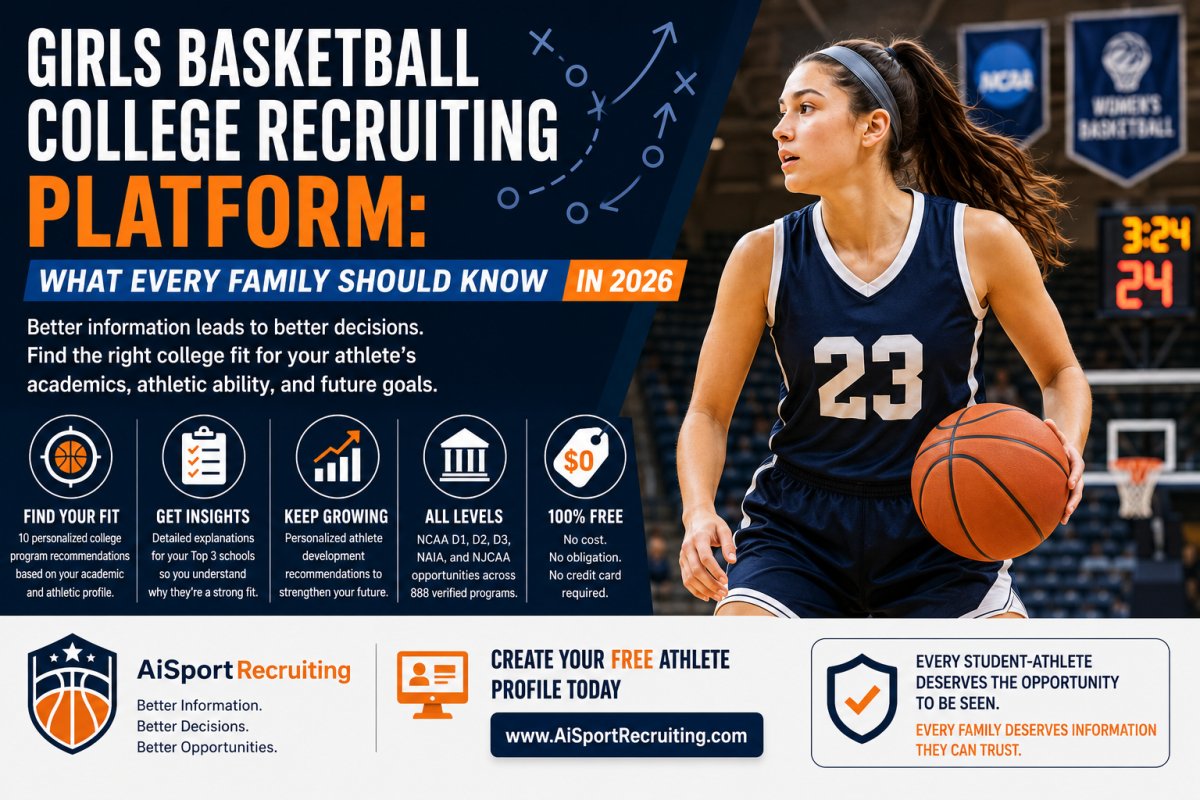
Every athlete who creates a free profile on AiSportRecruiting receives:
✅ 10 personalized college program recommendations based on their academic and athletic profile
✅ Detailed explanations for the Top 3 recommended programs, helping families understand why those schools may be a strong fit
✅ Personalized athlete development recommendations designed to strengthen future recruiting opportunities
✅ Recommendations spanning NCAA Division I, Division II, Division III, NAIA, and NJCAA
✅ No cost. No obligation. No credit card required.
Families who are unsure where to begin can start with our Free College Recruiting Match Report, which provides personalized college recommendations before outreach begins.
Begin your free athlete profile today:
👉 www.AiSportRecruiting.com
Girls Basketball Opportunities Continue to Grow
Women's college basketball continues to experience increased national attention, higher attendance, expanded media coverage, and greater investment across many collegiate programs. While competition remains strong, the number of meaningful opportunities across NCAA Division I, Division II, Division III, NAIA, and NJCAA has never been broader.
Families who understand this wider landscape often discover opportunities they may not have considered at the beginning of the recruiting process. The question is not simply whether an opportunity exists — it is where the right opportunity exists for a specific athlete's academic and athletic profile.
Why the Recruiting Process Feels Overwhelming
The college recruiting process for girls basketball families has become increasingly competitive at every level of college athletics.
Families often spend months researching programs, sending highlight reels to coaching staffs, and attending showcases without a clear picture of which programs represent realistic opportunities for their athlete. The challenge is rarely effort — families invest enormous energy into the recruiting process. The challenge is information.
Without a verified, data-grounded picture of where an athlete's specific academic and athletic profile aligns with what programs are building, families are essentially guessing. That guesswork is expensive. Attending camps and showcases at programs where the athlete is not a realistic fit wastes both time and money. Sending generic outreach to coaches who have no current roster need at the athlete's position produces silence that families often mistake for rejection. And focusing exclusively on the most recognizable Division I programs while overlooking outstanding opportunities at Division II, Division III, NAIA, and NJCAA levels means many athletes never discover the programs where they would thrive most.
Better information changes all of this.
Academic Eligibility Is One of the Earliest and Most Important Factors
Academic eligibility is one of the earliest and most important factors coaches evaluate because athletes must first be eligible for admission before recruiting can move forward.
A coaching staff cannot offer a roster spot or scholarship to an athlete who cannot be admitted to the institution. If an athlete's GPA or standardized test scores do not meet a program's admission standards, the athletic conversation stops regardless of how impressive the film is.
This means families should lead every recruiting conversation with academic information. Graduation year, GPA, and test scores should be front and center in every initial outreach message and athlete profile. An athlete who demonstrates academic eligibility and academic preparedness from the first contact is a lower-risk investment for a coach managing a limited scholarship budget — and coaches notice that professionalism immediately.
Families should also research each program's academic standards before reaching out. Academic requirements vary significantly by institution and by division. Understanding those standards before outreach begins prevents families from investing time in programs where admission is not a realistic possibility regardless of athletic fit.
Girls Basketball Recruiting Is Not One Size Fits All
There is no single path that works for every athlete.
Not every player develops at the same pace. Some demonstrate clear Division I caliber ability as sophomores. Others develop significantly during their junior or senior year. Some athletes are a better academic and cultural fit at a Division III institution. Others find that an NAIA program provides exactly the competitive environment and scholarship support they were looking for. Some benefit from a junior college experience before transferring to a four-year program.
Fit matters more than prestige. An athlete who earns meaningful playing time and genuine development at a Division II or NAIA program is in a fundamentally better position than an athlete who sits on a Division I roster for four years without contributing.
Families who approach girls basketball recruiting with an open mind about level and division — and who use verified data to guide that exploration rather than name recognition alone — consistently find better outcomes. Our guide on D2 colleges covers what Division II specifically offers basketball families in more detail.
Understanding Where Opportunity Exists Across Every Level
Many girls basketball families begin the recruiting process focused primarily on Division I programs — the conferences with the most national media coverage, the most recognizable school names, and the most cultural visibility.
Division I women's basketball is extraordinarily competitive. Roster spots are limited and the pool of athletes pursuing them is national in scope.
What many families do not fully appreciate until they are deep into the process is the breadth of genuine opportunity that exists across other divisions.
NCAA Division II offers athletic scholarships, competitive basketball, and strong academic environments. Division II women's basketball programs develop players who go on to compete professionally and provide a genuine high-level collegiate experience. The equivalency scholarship model at Division II means coaches can distribute aid across a larger roster — creating more scholarship availability than many families initially expect.
NCAA Division III does not offer athletic scholarships but provides need-based and merit-based financial aid that in many cases results in a more favorable overall financial package than a partial Division I scholarship after accounting for cost of attendance. Division III women's basketball is highly competitive and allows athletes to pursue rigorous academics alongside serious athletic competition.
NAIA offers athletic scholarships and a strong competitive environment. Many NAIA women's basketball programs have excellent histories of athletic achievement and provide opportunities for athletes whose profile may not align with Division I or Division II recruiting standards but who are fully capable of competing at a high level.
NJCAA provides two-year collegiate basketball experiences that serve as a genuine bridge to four-year programs. For some athletes the NJCAA path creates four-year opportunities that would not have been accessible directly from high school.
AiSportRecruiting analyzes 888 verified programs across all of these levels. Families who limit their search to Division I are narrowing their visibility to one portion of a landscape where their athlete may have a significantly better opportunity at another level.
A Typical Girls Basketball Recruiting Timeline
Understanding the general recruiting timeline helps families know when to prepare, when to act, and what to expect at each stage.
Freshman Year
Build the academic foundation. Understand NCAA eligibility requirements and register with the NCAA Eligibility Center. Begin developing quality game film. Start researching programs at every division level to understand what the landscape looks like.
Sophomore Year
Continue academic development and film building. At Division II the first contact window opens June 15 after sophomore year — coaches can begin direct phone and electronic contact with recruits at that point. Families should be prepared before that date arrives. Begin creating a targeted list of programs based on academic and athletic fit.
Junior Year
The most critical year. Scholarship budgets are being allocated and coaching staffs are actively building recruiting boards. Athletes who engage with programs during junior year have access to the full scholarship budget. Begin personalized outreach to Recruiting Coordinators at target programs. Attend showcases and camps at programs where a realistic fit has been confirmed through research.
Senior Year
Official visits, finalizing financial packages, and decisions. Families who have done the preparation work in earlier years arrive at senior year with genuine options. Athletes who begin the process in senior year are frequently competing for whatever resources remain after earlier commitments have been made.
What College Coaches Actually Evaluate
College basketball coaches evaluate incoming prospects across multiple dimensions simultaneously.
Positional fit and roster needs. A coach is building a specific roster for specific seasons ahead. Understanding what positions a program currently needs in a particular graduation year and communicating specifically why the athlete addresses that need makes outreach targeted and relevant.
Academic standing. Academic eligibility comes first. Leading with academic credentials communicates that the athlete is a complete prospect.
Game film that is immediately accessible. A highlight video must open without requiring a login, password, or download. The athlete's best plays must appear within the first thirty seconds. Coaches evaluating dozens of prospects cannot search through a full game film for the standout moments.
Position-specific performance. For guards coaches evaluate decision-making, ball handling under pressure, shooting percentages, and the ability to create for teammates and themselves. For forwards and post players they evaluate footwork, rebounding, post presence, and versatility. Understanding the specific metrics that matter at your athlete's position helps families present the most relevant information.
Character and coachability. Coaches recruit people as much as players. They consistently evaluate qualities that go beyond basketball ability — leadership on and off the court, communication with coaches and teammates, body language during difficult moments, consistent effort in practice, coachability when receiving instruction, and the ability to be a positive presence in a program's culture.
These qualities are often evaluated during games, practices, and conversations. References from high school and club coaches who can speak authentically to an athlete's character and work ethic add a layer of credibility that statistics alone cannot provide. A coach who trusts that a recruit will be a positive contributor to program culture will invest more recruiting resources in that athlete than in a more talented player whose character is uncertain.
Who to Contact and Why It Matters
Many girls basketball families instinctively direct their first recruiting message to the head coach. The head coach is the most visible figure and the person who ultimately makes scholarship decisions.
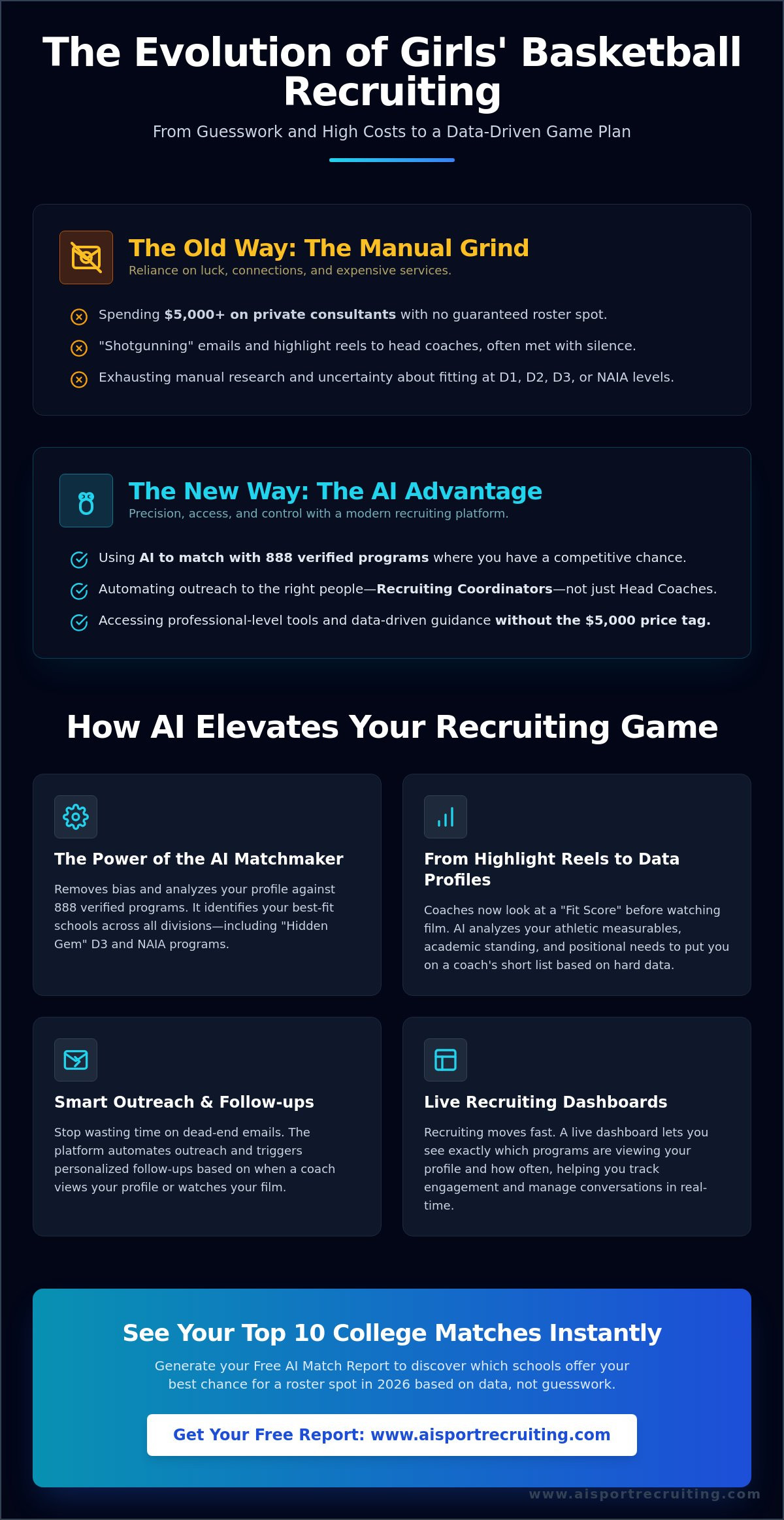
But in most college basketball programs — particularly at Division I and Division II levels — the head coach does not manage the initial wave of recruiting correspondence from unknown prospects. That responsibility belongs to the Recruiting Coordinator or an assistant coach specifically assigned to recruiting duties.
These staff members are the gatekeepers of the recruiting board. Their professional responsibility is to evaluate incoming prospects, review film, verify academic eligibility, and identify athletes who address specific roster needs. A message directed to the Recruiting Coordinator that clearly communicates academic eligibility, positional fit, and genuine interest in the program is far more likely to receive a substantive response than a generic email to the head coach's general inbox.
At smaller programs — particularly at Division III, NAIA, and NJCAA levels — the head coach or an assistant may handle recruiting personally. Research each program's staff structure individually before making first contact. Our guide on the best way to contact college coaches walks through this process in detail.
Girls Basketball Recruiting Checklist
Before contacting any college program, make sure you have the following ready:
✓ Graduation year
✓ GPA and test scores
✓ Position
✓ Height
✓ Key performance statistics
✓ Highlight film — immediately accessible without a login or download
✓ Contact information
✓ List of target programs researched for academic and athletic fit
✓ NCAA Eligibility Center registration if applicable
Working through this checklist before reaching out significantly increases the professionalism and effectiveness of every message that follows.
What Makes Coach Outreach Effective
Families who approach outreach strategically rather than as a volume exercise consistently see better engagement from coaching staffs.
Personalization matters more than volume. A thoughtful, program-specific message sent to twenty well-researched programs will consistently outperform the same generic message sent to one hundred schools. Coaches recognize mass emails immediately.
Messages should be concise and easy to act on. A message that clearly states graduation year, position, key stats, academic credentials, and a direct link to a highlight video is far more likely to receive a response than a lengthy biography.
Follow up professionally. A single unanswered message rarely reflects a coach's final assessment. A professional follow-up sent one to two weeks after initial outreach — adding something new like an updated stat, a recent performance, or a note about an upcoming showcase — keeps the athlete visible without becoming a nuisance.
Coaches recruit people as much as players. Consistent, respectful, professional communication throughout the recruiting cycle demonstrates exactly the character qualities coaching staffs value in a recruit.
Five Common Girls Basketball Recruiting Mistakes
Targeting only Division I programs while overlooking genuine opportunities at Division II, Division III, NAIA, and NJCAA.
Sending the same generic message to every program rather than personalizing outreach to each coaching staff.
Leading with athletic highlights without including academic credentials upfront.
Sending a highlight video that requires a login, download, or extensive searching to find the athlete's best moments.
Giving up after one unanswered message rather than following up professionally.
What Families Can Control
Families cannot control scholarship availability, roster openings, or how quickly coaches respond. Those variables belong to the programs.
What families can control is significant:
Academic performance — the single most controllable factor in expanding recruiting options.
Communication — professional, personalized, and consistent.
Preparation — having everything ready before outreach begins.
Organization — tracking programs, deadlines, and correspondence systematically.
Professionalism — every interaction with a coaching staff reflects on the athlete's character.
Continued athletic development — the match report reflects where an athlete stands today. Continued improvement opens new opportunities over time.
Focusing energy on what can be controlled consistently produces better recruiting outcomes than fixating on variables outside the family's influence.
A Note on Showcases and AAU Basketball
Showcases and AAU basketball provide valuable exposure — particularly at Division I and high Division II levels where coaches attend events to evaluate prospects in person.
However attending every available showcase is rarely the most effective strategy. Showcase costs, travel expenses, and time away from academics add up quickly. Researching which events align with realistic recruiting opportunities and which programs send staff to those events specifically provides a significantly better return on the family's investment of time and money. Understanding the 'profit margin' of your recruiting efforts—balancing the costs of travel and fees against the likelihood of a scholarship—is a mindset used by successful business owners who use SalonIQ to manage their operational efficiency and ensure every investment delivers value.
Not playing on a nationally recognized AAU team does not eliminate recruiting opportunities. At Division III, NAIA, and NJCAA levels coaches rely more heavily on direct outreach and film than on showcase attendance because their recruiting travel budgets are more limited. Film, academic credentials, communication, and fit still matter tremendously regardless of AAU team affiliation or prestige. Families whose athlete plays at a less prominent AAU program can build an effective recruiting strategy through direct, professional outreach to programs where a genuine fit exists.
Once Families Understand Where Genuine Opportunities Exist
Once families understand where genuine opportunities may exist, the challenge becomes organizing hundreds of pieces of information into one clear recruiting strategy. Knowing which schools deserve attention — and why — is often more valuable than simply having a longer list of schools.
That is exactly the challenge AiSportRecruiting was built to help families solve.
How AiSportRecruiting Supports Girls Basketball Families
AiSportRecruiting was founded by Coach Jackson after more than 30 years serving as a High School Athletic Director and coaching at the high school, AAU, and college levels — with more than 300 scholarship placements across his career.
The platform was built on a belief that has guided Coach Jackson throughout his career: talent deserves opportunity regardless of a family's budget, connections, or access to private recruiting services.
AiSportRecruiting analyzes the academic and athletic information families provide and compares it against 888 verified collegiate programs across NCAA Division I, Division II, Division III, NAIA, and NJCAA. For girls basketball families the platform returns 10 personalized program recommendations, detailed explanations for the Top 3 recommended schools, and personalized athlete development guidance — all at no cost and with no credit card required.
Girls Basketball is currently supported on the AiSportRecruiting platform, allowing eligible athletes to receive personalized college program recommendations based on the platform's current matching capabilities.
AiSportRecruiting currently supports student-athletes in three sports:
🏀 Boys Basketball
🏀 Girls Basketball
🏈 Football
Additional sports are in development and will be introduced as they complete AiSportRecruiting's quality validation process.
The AiSportRecruiting Standard
Everything AiSportRecruiting publishes and every recommendation the platform produces is guided by one principle:
Families deserve recruiting information they can trust.
That means accuracy before assumptions. Evidence before opinion. Families before technology. Opportunity for every athlete across every level of college athletics. And transparency in every recommendation we provide.
AiSportRecruiting does not guarantee scholarships, roster positions, coach responses, or recruiting offers. The platform provides honest, evidence-based recruiting intelligence designed to help families navigate the recruiting process with greater clarity and confidence.
That is the AiSportRecruiting Standard.
Every college roster begins with a conversation. Every conversation begins with a family deciding to take the first step. Better information leads to better decisions, and better decisions create better opportunities.
Every recruiting message represents hope. Behind every email to a college coach is a family investing time, energy, and belief in a student-athlete's future. The goal is not simply to contact more coaches — it is to begin meaningful conversations with programs where a genuine opportunity to play and succeed may exist.
Begin Your Recruiting Journey Today
Every recruiting journey begins with better information.
If you are ready to identify college basketball programs that may align with your student-athlete's academic and athletic goals, create your free athlete profile today.
✅ 10 personalized college program recommendations
✅ Detailed explanations for your Top 3 recommendations
✅ Personalized athlete development recommendations
✅ No cost. No obligation. No credit card required.
👉 www.AiSportRecruiting.com
Because every student-athlete deserves the opportunity to be seen. And every family deserves recruiting information they can trust.
Frequently Asked Questions
Is a girls basketball recruiting platform worth it for Division III athletes?
Yes. Division III coaches often have smaller recruiting budgets and fewer resources for national travel. A well-prepared, proactive athlete who reaches out directly with verified academic and athletic information can stand out more easily at the Division III level than at programs receiving hundreds of unsolicited messages weekly. Division III women's basketball provides a genuine competitive and academic experience and should be taken seriously as a primary target for many athletes.
Can my daughter get recruited if she does not play for a top-tier AAU program?
Yes. While top-tier AAU programs provide exposure at the Division I level, families can build effective recruiting strategies through direct professional outreach to programs where a genuine fit exists — particularly at Division II, Division III, NAIA, and NJCAA levels where coaches rely more heavily on direct outreach and film than on showcase attendance. Film, academics, communication, and fit still matter tremendously regardless of AAU affiliation.
How does AiSportRecruiting differ from a traditional recruiting consultant?
Traditional recruiting consultants offer personal guidance and industry relationships that can be genuinely valuable. AiSportRecruiting provides data-driven program recommendations across 888 verified programs at no cost — giving families a verified starting point for understanding where opportunities may exist. The platform is designed to complement rather than replace the guidance families receive from coaches, advisors, and recruiting professionals.
Does AiSportRecruiting support Girls Basketball?
Yes. Girls Basketball is currently supported on the AiSportRecruiting platform with verified program data and matching capabilities across 888 collegiate programs spanning NCAA Division I, Division II, Division III, NAIA, and NJCAA.
When should a girls basketball family start the recruiting process?
As early as possible. The most important recruiting window at most levels of college basketball is the junior year when scholarship budgets are being allocated and coaching staffs are actively building their recruiting boards. However preparation — academic foundation, film development, and program research — should begin freshman or sophomore year.
Who should my daughter contact first at a college program?
In most cases the Recruiting Coordinator or the assistant coach assigned to recruiting responsibilities is the most effective first point of contact. These staff members manage the recruiting board and evaluate incoming talent. Research each program individually to identify the right person before reaching out.
Should parents or athletes communicate with coaches?
Parents often help organize the recruiting process, but coaches generally prefer building relationships directly with the student-athlete while parents provide support behind the scenes. A student-athlete who communicates directly and professionally with a coaching staff makes a strong impression throughout the entire recruiting cycle.
How many programs should a girls basketball family contact?
Focus on programs where a genuine academic and athletic fit exists rather than maximizing volume. A well-researched list of twenty to thirty programs where the athlete's profile aligns with what the coaching staff is building will consistently produce better results than generic outreach to a hundred schools.
Does AiSportRecruiting guarantee girls basketball scholarship offers?
No. AiSportRecruiting provides personalized program recommendations and athlete development guidance based on the information families submit. Recruiting outcomes depend on many factors including athletic performance, academic standing, a program's specific roster needs, and the relationships families build with coaching staffs. The platform helps families identify the right programs to pursue — the outreach and relationship-building that follows is the family's responsibility.
Which sports does AiSportRecruiting currently support?
AiSportRecruiting currently supports Boys Basketball, Girls Basketball, and Football. Additional sports are in development and will be added as they complete the platform's quality validation process.
What information does a girls basketball recruiting profile need to include?
At minimum a profile should include graduation year, position, height, key performance statistics, GPA, and a link to a highlight video that opens immediately without a login or download. Academic information should be presented alongside athletic information — not as an afterthought.
Are showcases worth attending for girls basketball recruiting?
Showcases can provide valuable exposure — particularly at Division I and high Division II levels. However attending every available showcase is rarely the most effective strategy. Researching which events align with realistic recruiting opportunities and which programs send staff to those events specifically provides a better return on both time and cost.


