For student-athletes and their families navigating the college recruiting process the question that comes up most often is not where to find college programs. It is how to know which programs are actually worth pursuing.
There are 888 verified collegiate programs across NCAA Division I, Division II, Division III, NAIA, and NJCAA. Each has different academic standards, different athletic expectations, different scholarship structures, and different roster needs that change from year to year. Trying to identify where a specific athlete genuinely fits across that landscape — without professional guidance or data-driven intelligence — is one of the most challenging tasks families face in the entire recruiting process.
A college recruiting platform built around verified program data and personalized academic and athletic matching changes that dynamic. Instead of guessing families begin with a clear, evidence-based picture of where genuine opportunities may exist — before the first email is written, before the first showcase fee is paid, and before the first scholarship budget window closes.
This guide is designed to help families understand what a data-driven college recruiting platform actually does, what to look for when evaluating recruiting resources, and how AiSportRecruiting approaches the recruiting process differently.
Get Your Free College Recruiting Match Report
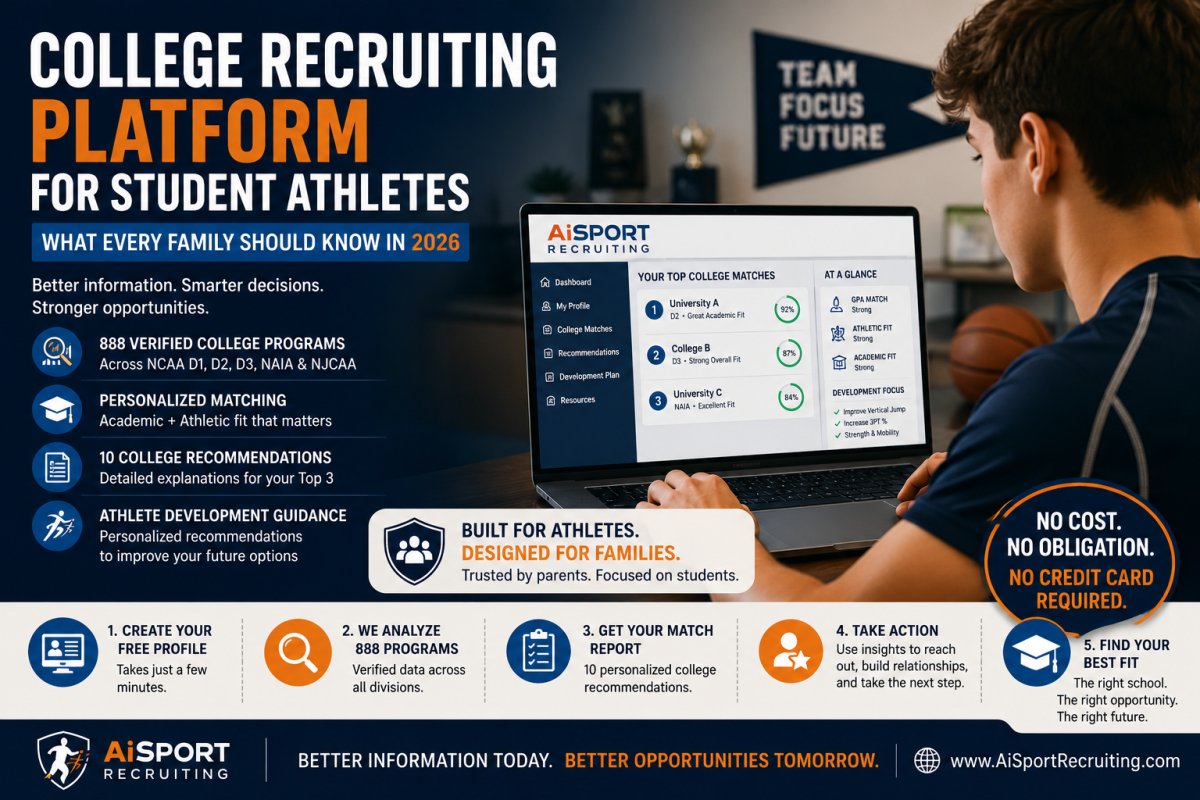
Every athlete who creates a free profile on AiSportRecruiting receives:
✅ 10 personalized college program recommendations based on their academic and athletic profile
✅ Detailed explanations for the Top 3 recommended programs
✅ Personalized athlete development recommendations designed to strengthen future recruiting opportunities
✅ Recommendations spanning NCAA Division I, Division II, Division III, NAIA, and NJCAA
✅ No cost. No obligation. No credit card required.
Begin your free athlete profile today:
👉 www.AiSportRecruiting.com
The Problem With How Most Families Approach College Recruiting
Most families begin the college recruiting process the same way — with a list of schools they recognize and a hope that persistence will eventually produce results.
They research programs manually. They send the same outreach message to dozens of coaches. They attend showcases and camps without a clear sense of whether the programs in the room represent realistic opportunities for their athlete. They invest significant time, energy, and money into a process that produces inconsistent results because it is built on guesswork rather than verified data.
The challenge is not effort. Families invest enormous effort into the recruiting process. The challenge is information — specifically the absence of a reliable, verified picture of where an athlete's specific academic and athletic profile aligns with what college programs are actually building.
Without that picture families end up contacting programs where the athlete is not a realistic fit — producing the silence and frustration that characterizes so many families' recruiting experiences. And they overlook programs where the athlete would be a genuine, valued contributor — programs that never appeared on the family's radar because they were not among the names being searched.
It is also worth naming something families rarely hear directly: many student-athletes who stop pursuing college athletics do so not because they lack ability but because they never received accurate information about where opportunities existed for their specific profile. A recruiting platform that provides honest, verified matching across the full collegiate landscape helps families make that decision based on facts rather than assumptions.
Better information is where the recruiting process should begin.
For more on why outreach goes unanswered and what coaches are actually evaluating when they receive recruiting messages read our What College Coaches Actually Look For in a Student-Athlete guide.
What a College Recruiting Platform Should Actually Do
The most useful college recruiting platforms share a core function — they help families understand where genuine opportunities exist before outreach begins.
Verified program data. A recruiting platform is only as useful as the accuracy of the program information it draws from. Outdated contact information, incorrect division listings, or unverified program data produce recommendations that lead families toward dead ends rather than genuine opportunities.
Academic and athletic matching. Every collegiate program has academic admission standards that must be met before athletic ability is evaluated. A platform that matches athletes to programs without accounting for academic fit produces recommendations that look good on a list but represent unrealistic opportunities in practice.
Division-wide coverage. Meaningful opportunities exist across NCAA Division I, Division II, Division III, NAIA, and NJCAA. A platform that only covers Division I — or that deprioritizes other divisions — systematically narrows the opportunity landscape for athletes whose best fit may be at another level.
Honest, transparent recommendations. Recruiting platforms that guarantee outcomes, promise scholarship offers, or overstate their capabilities damage families' trust and produce expectations that the recruiting process cannot fulfill. Honest platforms describe what they do accurately and leave the relationship-building and outreach that determines outcomes to the families who use them.
Actionable guidance beyond the match list. A list of programs is a starting point — not a complete recruiting strategy. The most useful platforms provide context that helps families understand why specific programs appear in their results and what they can do to strengthen their recruiting profile going forward.
For a complete framework for evaluating any recruiting platform or service read our How to Choose the Right College Recruiting Platform guide.
How AiSportRecruiting Is Different
AiSportRecruiting was built specifically to address the information gap that causes so many student-athletes and their families to navigate the recruiting process without a clear picture of where genuine opportunities exist.
The platform analyzes the academic and athletic information families submit and compares it against 888 verified collegiate programs across NCAA Division I, Division II, Division III, NAIA, and NJCAA. Every family receives 10 personalized program recommendations, detailed explanations for the Top 3 recommended schools, and personalized athlete development guidance — all at no cost and with no credit card required.
The 888 programs in the platform database are verified. Program information — division, conference, academic profile, and coaching contact data — has been confirmed accurate rather than scraped from unverified sources. The database is maintained and updated to reflect staff changes, program changes, and other developments that affect accuracy.
The matching process accounts for both academic and athletic fit. Recommendations reflect the athlete's academic profile alongside their athletic credentials. A program that is a strong athletic fit but where the athlete's academic credentials do not meet admission standards will not appear as a top recommendation. Academic fit is the first filter — exactly as it is for college coaches.
Coverage spans every major division. AiSportRecruiting analyzes programs across NCAA Division I, Division II, Division III, NAIA, and NJCAA — ensuring families see the full landscape of where genuine opportunities may exist.
The platform is honest about what it does and does not do. AiSportRecruiting provides recruiting intelligence — personalized program recommendations and athlete development guidance — based on verified data. It does not contact coaches on behalf of athletes. It does not guarantee scholarship offers or recruiting outcomes. It provides the best available information to help families make more informed decisions and leaves the outreach and relationship-building that determine outcomes in the hands of the families who use it.
What Families Receive — And What They Do Not
What every family receives:
10 personalized college program recommendations based on the academic and athletic information submitted — not generic suggestions based on sport and graduation year but recommendations that reflect the specific combination of academic credentials, athletic profile, and program data that produces the most relevant matches for that individual athlete.
Detailed explanations for the Top 3 recommended programs — giving families language and context for the outreach conversations that follow. Understanding why specific programs appear in the results gives families the specificity that separates effective recruiting outreach from mass email campaigns.
Personalized athlete development recommendations identifying specific areas where continued academic or athletic development could expand the athlete's recruiting options.
What AiSportRecruiting does not provide:
Guaranteed scholarship offers. No recruiting platform can guarantee a scholarship offer — that decision belongs to coaching staffs based on roster needs, budget availability, and many factors outside any platform's control.
Automated outreach to coaches on the athlete's behalf. Recruiting relationships are built by families through direct, professional communication with coaching staffs. AiSportRecruiting helps families understand which programs to pursue — the outreach and relationship-building that follows is the family's responsibility.
Assurance of admission. Being matched to a program on AiSportRecruiting does not guarantee admission. Coaches can advocate for recruits in the admission process but cannot guarantee admission outcomes.
One note worth adding for families who have previously used other recruiting services: some platforms in this space make claims about their technology, their coach networks, or their outcomes that are difficult to verify or substantiate. Families benefit from asking specific questions of any recruiting service they consider — what data does it draw from, how is that data verified, what does the platform actually do on the family's behalf, and what outcomes can it honestly guarantee. The honest answer to that last question for any recruiting platform should be: none. Outcomes depend on the athlete, the family's outreach, the program's roster needs, and many factors no platform controls.
What Happens After Receiving the Match Report
The match report is the beginning of the recruiting process — not the end of it. Understanding what to do after receiving it helps families convert intelligence into action.
Research each recommended program individually. The Top 10 recommendations provide a verified, data-grounded starting point. Families should research each program individually — understanding the coaching staff, the system, the academic environment, the campus culture, and the financial aid landscape — before reaching out. Personalized, informed outreach consistently outperforms generic outreach to a list of names.
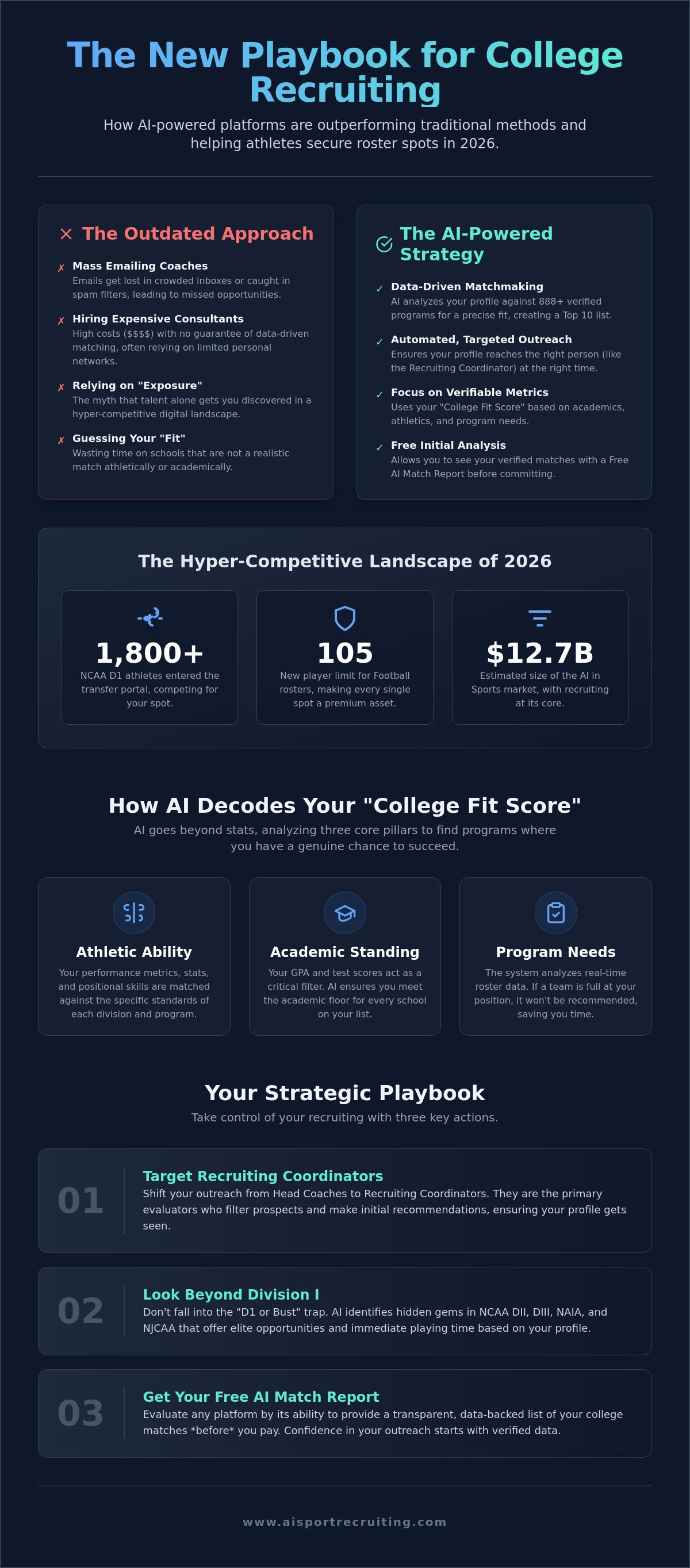
Use the Top 3 explanations in your outreach. The detailed explanations for the Top 3 programs give families specific language for their first messages to coaches. A recruiting message that demonstrates specific knowledge of why a program is a fit immediately differentiates itself from mass outreach.
Act on the development recommendations. The athlete development recommendations identify the most impactful areas to focus on before the next recruiting window opens. Acting on those recommendations produces measurably better outcomes than waiting.
Follow up professionally and consistently. A single email to a coach rarely produces immediate results. Professional, persistent follow-up — adding something new with each contact — is what builds the recruiting relationships that matter.
For complete guidance on what to do after identifying your target programs read our Best Way to Contact College Coaches guide and our Best Follow-Up Strategy After Contacting College Coaches guide.
The Full Landscape of College Athletic Opportunity
One of the most important things a recruiting platform provides is visibility across the full collegiate landscape — not just the most recognizable programs.
Many families begin recruiting with attention fixed on Division I. That is understandable — Division I receives the most media coverage and cultural recognition. But Division I is also the most competitive level with the fewest available roster spots.
Outstanding educational and athletic experiences exist at every level. Families who restrict their search to Division I programs systematically overlook opportunities that may represent a significantly better overall fit.
Our library covers each division level in depth:
The D2 Colleges guide covers what Division II specifically offers families including the equivalency scholarship model and the recruiting timeline.
The NCAA Division III Recruiting guide covers the financial aid landscape and unique recruiting process at Division III.
The NAIA College Recruiting guide and How to Get Recruited by NAIA Programs guide cover what the NAIA offers and how to pursue those opportunities.
The Junior College Recruiting guide covers when the two-year NJCAA path makes strategic sense as a bridge to four-year programs.
Who AiSportRecruiting Was Built For
AiSportRecruiting was founded by Coach Jackson after more than 30 years serving as a High School Athletic Director and coaching at the high school, AAU, and college levels — with more than 300 scholarship placements across his career.
Throughout those years one pattern became impossible to ignore. Talented student-athletes were being overlooked — not because they lacked ability but because they lacked information, guidance, and exposure. Families who could afford private recruiting consultants had access to tools and intelligence that most families never saw. Families who could not were left to navigate one of the most consequential processes in their child's life entirely on their own.
AiSportRecruiting was built to change that — to give every family access to the same quality of recruiting intelligence that was previously available only to those with access to expensive private consulting services. At no cost. With no credit card required. And with no promise of outcomes that the recruiting process cannot guarantee.
AiSportRecruiting currently supports student-athletes in three sports:
🏀 Boys Basketball
🏀 Girls Basketball
🏈 Football
Additional sports are in development and will be introduced as they complete AiSportRecruiting's quality validation process.
How to Use AiSportRecruiting Most Effectively
A recruiting platform is a tool. Like any tool it is most effective when used as part of a broader, well-organized recruiting strategy.
Start with accurate information. The quality of AiSportRecruiting's recommendations depends on the accuracy of the information families provide. Academic credentials should reflect current standing not aspirational targets. Athletic information should reflect current demonstrated ability rather than projected development.
Use the recommendations as a starting point. The 10 program recommendations are a verified, data-grounded starting point for recruiting research — not a final answer. Research each recommended program individually before reaching out.
Take the development recommendations seriously. Families who act on the personalized athlete development recommendations consistently see better recruiting outcomes over time.
Continue updating the profile. Keeping profile information current ensures the recommendations continue to reflect the athlete's actual standing as they develop throughout high school.
Use the platform early in the process. Families who create a profile early and use the recommendations to guide their initial outreach are in a significantly stronger position than families who turn to a recruiting platform after months of unfocused outreach. For more on when to start and how to structure the full recruiting timeline read our Junior Year College Recruiting guide and our Ultimate Junior Year College Recruiting Strategy.
A Note on Cost and Accessibility
One of the most consistent inequities in college athletic recruiting is the role that financial resources play in determining which families receive professional guidance.
Private recruiting consultants charge thousands of dollars for the kind of program-by-program analysis that AiSportRecruiting provides for free. Families who can afford those services have a meaningful advantage. Families who cannot navigate the same complex, high-stakes process without the same foundation of information.
AiSportRecruiting was designed specifically to eliminate that inequity. The platform is free. The match report is free. The development guidance is free. No credit card is required to get started. That is a deliberate design choice that reflects the platform's founding belief: talent deserves opportunity regardless of a family's financial resources.
For more on how AiSportRecruiting compares to traditional consulting services read our College Recruiting Consultant Alternative guide.
The AiSportRecruiting Standard
Everything AiSportRecruiting publishes and every recommendation the platform produces is guided by one principle:
Families deserve recruiting information they can trust.
That means accuracy before assumptions. Evidence before opinion. Families before technology. Opportunity for every athlete across every level of college athletics. And transparency in every recommendation we provide.
AiSportRecruiting does not guarantee scholarships, roster positions, coach responses, or recruiting offers. The platform provides honest, evidence-based recruiting intelligence designed to help families navigate the recruiting process with greater clarity and confidence.
That is the AiSportRecruiting Standard.
Every family navigating the college recruiting process deserves access to accurate, verified information about where genuine opportunities exist for their student-athlete. The recruiting process is consequential — academically, athletically, and financially. Families who begin it with better information make better decisions throughout it.
Begin Your Recruiting Journey Today
Every recruiting journey begins with better information.
If you are ready to identify college programs that may align with your student-athlete's academic and athletic goals create your free athlete profile today.
✅ 10 personalized college program recommendations
✅ Detailed explanations for your Top 3 recommendations
✅ Personalized athlete development recommendations
✅ No cost. No obligation. No credit card required.
👉 www.AiSportRecruiting.com
Because every student-athlete deserves the opportunity to be seen. And every family deserves recruiting information they can trust.
Frequently Asked Questions
What is a college recruiting platform?
A college recruiting platform is a tool that helps student-athletes and their families identify college programs that may align with their academic and athletic profile. The most useful platforms draw from verified program data and account for both academic and athletic fit when generating recommendations — rather than producing generic lists based on sport and graduation year alone.
How is AiSportRecruiting different from private recruiting consultants?
Private recruiting consultants offer personal guidance and industry relationships that can be genuinely valuable. AiSportRecruiting provides data-driven program recommendations across 888 verified programs at no cost — giving families a verified starting point for understanding where opportunities may exist. The platform is designed to complement rather than replace the guidance families receive from coaches, advisors, and recruiting professionals. For more on that comparison read our College Recruiting Consultant Alternative guide.
Is AiSportRecruiting free?
Yes. Every athlete who creates a profile receives 10 personalized college program recommendations, detailed explanations for the Top 3 recommended programs, and personalized athlete development recommendations — all at no cost with no credit card required and no financial commitment to get started.
How many programs does AiSportRecruiting analyze?
AiSportRecruiting analyzes 888 verified collegiate programs across NCAA Division I, Division II, Division III, NAIA, and NJCAA.
Which sports does AiSportRecruiting currently support?
AiSportRecruiting currently supports Boys Basketball, Girls Basketball, and Football. Additional sports are in development and will be added as they complete the platform's quality validation process.
Does AiSportRecruiting contact coaches on behalf of athletes?
No. AiSportRecruiting provides personalized program recommendations and development guidance. The outreach and relationship-building that determines recruiting outcomes remains the responsibility of the student-athlete and their family. Our Best Way to Contact College Coaches guide walks through how to approach that outreach effectively.
Does AiSportRecruiting guarantee scholarship offers?
No. AiSportRecruiting provides honest data-driven recruiting intelligence. Scholarship offers depend on many factors including athletic performance, academic standing, a program's specific roster needs, and the relationships families build with coaching staffs. The platform helps families identify the right programs to pursue — outcomes depend on many variables outside the platform's control.
How accurate is the program data in AiSportRecruiting?
The platform's 888 verified collegiate programs have been confirmed for accuracy across division, conference, academic profile, and coaching contact data. The database is maintained and updated to reflect changes over time. Families should still confirm specific details directly with individual programs as part of their own research process.
What should I ask any recruiting platform before using it?
Ask what data the platform draws from and how it is verified. Ask what the platform actually does on the family's behalf. Ask what outcomes it can honestly guarantee. Ask whether there are costs beyond the initial signup. For a complete framework for evaluating any recruiting service read our How to Choose the Right College Recruiting Platform guide.
What information does my athlete need to provide?
At minimum a profile should include graduation year, sport, position, height, GPA, and test scores where available. The platform uses that information to generate personalized recommendations tailored to the athlete's specific academic and athletic profile.
Can parents use AiSportRecruiting on behalf of their student-athlete?
Yes. Parents and guardians frequently use AiSportRecruiting alongside their athlete to help navigate the recruiting process. The platform is designed to be accessible and actionable for the entire family.
What should I do after receiving my match report?
Research each recommended program individually. Use the Top 3 explanations as the foundation for personalized outreach messages. Act on the athlete development recommendations. Follow up professionally and consistently. Our Best Follow-Up Strategy guide and our How to Stand Out to College Recruiters guide cover exactly what to do next.
My athlete stopped pursuing college sports because they thought no opportunities existed. Is it too late?
It may not be. Many athletes and families conclude that college athletic opportunities do not exist for them based on incomplete information — focusing only on Division I programs or only on the schools they already recognize. Creating a free profile on AiSportRecruiting is a low-commitment way to understand what opportunities may still exist across the full landscape of college athletics before making a final decision.


