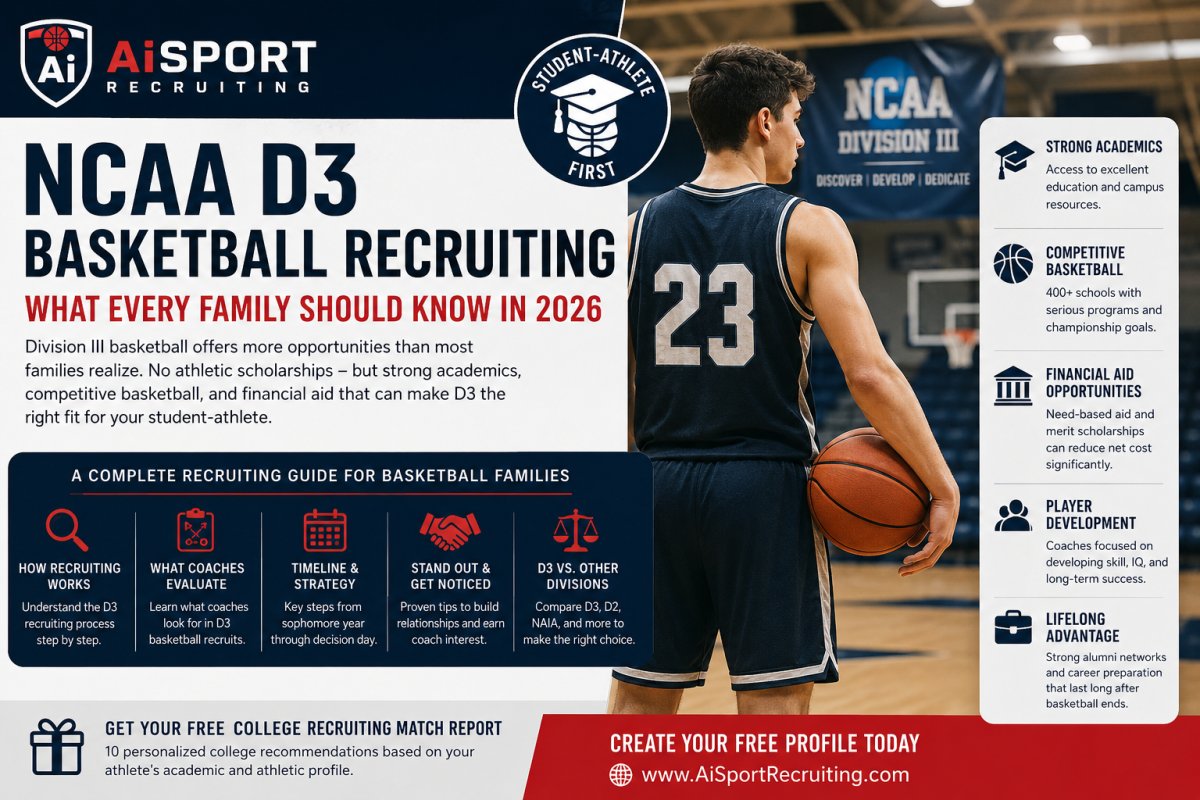
NCAA D3 Basketball Recruiting: What Every Family Should Know in 2026
For basketball families who have heard that Division III does not offer athletic scholarships and stopped researching there — this guide is worth reading before that decision becomes final.
Division III basketball is one of the most misunderstood levels of college athletics. The absence of athletic scholarships creates an immediate assumption that Division III is either unaffordable or uncompetitive. Neither assumption is accurate — and both cause families to overlook genuine opportunities that may represent a better overall fit for their student-athlete than programs at other levels.
This guide is specifically for basketball families — Boys Basketball and Girls Basketball — who want to understand what Division III actually offers, how Division III basketball recruiting works, and how to evaluate whether D3 basketball may be the right destination for their athlete.
If you are still building your overall recruiting foundation start with our Free College Recruiting Match Report guide and our broader NCAA Division III Recruiting guide before diving into basketball specifically.
Get Your Free College Recruiting Match Report
Every athlete who creates a free profile on AiSportRecruiting receives:
✅ 10 personalized college program recommendations based on their academic and athletic profile
✅ Detailed explanations for the Top 3 recommended programs
✅ Personalized athlete development recommendations designed to strengthen future recruiting opportunities
✅ Recommendations spanning NCAA Division I, Division II, Division III, NAIA, and NJCAA
✅ No cost. No obligation. No credit card required.
Begin your free athlete profile today:
👉 www.AiSportRecruiting.com
What Division III Basketball Actually Is
NCAA Division III basketball operates under the same "student-athlete first" philosophy that governs all Division III athletics — but within the specific context of one of the most competitive and historically rich levels of college basketball in the country.
More than 400 colleges and universities field Division III basketball programs. That makes Division III the largest single tier of college basketball by number of institutions. The range of program quality, competitive level, campus environment, and academic profile within those 400-plus schools is wide — meaning Division III is not a monolithic experience but a diverse landscape of genuine opportunities for basketball players at a variety of competitive levels.
The most important thing families need to understand about Division III basketball is that the absence of athletic scholarships does not mean the absence of financial support or competitive opportunity. It means the financial support comes through different channels — and for many families those channels produce outcomes that are as favorable or more favorable than athletic scholarship packages at other divisions.
The Financial Reality of Division III Basketball
The conversation about Division III basketball almost always starts with scholarships — or the lack of them. NCAA rules prohibit Division III programs from awarding financial aid based on athletic ability. That is accurate and worth understanding clearly.
What families frequently discover when they actually engage with Division III institutions is that the financial picture is more nuanced than that single fact suggests.
Many Division III colleges are private institutions with significant endowments and robust institutional financial aid programs. Need-based financial aid at these institutions can be substantial — covering a meaningful portion or in some cases the full cost of attendance for families who qualify. Academic merit scholarships at selective Division III institutions reward students with strong academic records with aid packages that are entirely independent of athletic participation.
The practical result for many families is that the total financial aid package at a selective Division III institution — combining need-based aid, merit scholarships, and institutional grants — produces a net cost of attendance that is comparable to or lower than what a partial athletic scholarship at a Division I or Division II program would provide after accounting for the typically higher sticker price at those institutions.
This comparison is worth making honestly with real numbers from each institution rather than assumptions. Not every Division III institution has the financial resources to produce a competitive aid package for every family. Some do. Some do not. The only way to know is to apply, receive financial aid offers, and compare them directly against offers at other division levels.
The honest guidance: do not dismiss Division III on financial grounds without first requesting actual financial aid estimates from the specific institutions your family is considering. The number on the page may surprise you.
Division III Basketball Competition — What Families Need to Know
The second most common misconception about Division III basketball is that the competition is not serious. For families whose athlete has trained and competed at a high level that assumption can make Division III feel like a step backward.
It is not — at least not universally.
Division III basketball includes programs that take the sport seriously, develop players at a high technical level, and compete in genuinely competitive conference and national championship environments. The Division III national championship — the NCAA Tournament at the Division III level — draws elite programs from across the country competing for a national title. Coaching staffs at top Division III programs are experienced, credentialed, and invested in player development.
The honest characterization of Division III basketball competition is that it is wide-ranging. The top programs in competitive Division III conferences are genuinely elite at their level. Programs at the lower end of the Division III competitive spectrum offer a different experience. Families should research individual programs rather than drawing conclusions about all of Division III based on the reputation of any single program or conference.
For athletes whose realistic competitive level aligns with Division III basketball — athletes who will be meaningful contributors, see playing time, and develop within a well-coached system — Division III often produces better long-term outcomes than sitting at the end of a Division I or Division II bench for four years without contributing meaningfully.
The question is not whether Division III is competitive. The question is whether specific Division III programs represent a genuine athletic and academic fit for a specific athlete's profile.
How Division III Basketball Recruiting Works
Division III basketball recruiting operates differently from Division I and Division II in several ways that basketball families should understand before beginning the process.
No National Letter of Intent. Division III programs do not use the National Letter of Intent — the formal binding commitment document that governs Division I and some Division II recruiting. Commitments to Division III programs are made through the institution's standard admission and enrollment process. This means a verbal commitment to a Division III basketball program is not binding in the same legal sense as a signed NLI at other divisions. Families should get clarity from each coaching staff about what a verbal commitment means in practice at their specific program before making final decisions.
Fewer contact restrictions. Division III recruiting rules allow coaches more flexibility in communicating with prospective student-athletes throughout the recruiting calendar than Division I rules permit. This means families can often begin building relationships with Division III coaches earlier and more directly than with Division I programs. That earlier engagement is an advantage — not a sign of lower interest from the program.
Admission is the first hurdle. Because Division III programs cannot offer athletic scholarships, athletes must be admitted through the standard academic admission process. A Division III coach can advocate for a recruit in the admission process — and coaching advocacy at selective institutions carries real weight — but the coach cannot guarantee admission. Academic credentials must meet the institution's standards. At selective Division III institutions those standards can be rigorous.
Recruiting timelines vary. Some Division III basketball programs recruit on timelines similar to Division I — making offers and receiving verbal commitments as early as sophomore or junior year. Others fill roster spots later in the cycle as the pool of available recruits evolves. Families should research the specific recruiting timeline for each target program individually rather than assuming a standard schedule.
The head coach is often the primary contact. Division III coaching staffs are typically smaller than those at Division I or Division II programs. In many cases the head coach manages recruiting directly rather than delegating to a dedicated Recruiting Coordinator. This creates genuine relationship-building opportunities that larger programs do not offer — a family that builds a direct relationship with a Division III head coach during the recruiting process is in a fundamentally different position than a family that communicates exclusively with a Recruiting Coordinator at a larger program.
For a complete guide on who to contact and how to structure your outreach read our Best Way to Contact College Coaches guide.
What Division III Basketball Coaches Evaluate
Understanding what Division III basketball coaches look for when evaluating recruits helps families present their athlete's profile most effectively.
Academic profile first. At academically selective Division III institutions the academic evaluation happens before the athletic evaluation. A recruit whose GPA and test scores do not meet the institution's admission standards cannot be pursued regardless of basketball ability. Families should know the academic admission standards at each target Division III program before investing significant time in recruiting outreach to that program.
Basketball skill and positional fit. Division III basketball coaches evaluate skill, basketball IQ, and positional fit within their specific system. Guards are evaluated on decision-making, ball handling, shooting efficiency, and the ability to create for themselves and teammates. Post players are evaluated on footwork, rebounding, positioning, and versatility. Understanding what a specific program's system requires — and demonstrating clearly how the athlete fits that system — makes outreach more targeted and more likely to generate engagement.
Film quality and accessibility. A highlight video that opens immediately without a login or download, leads with the athlete's best plays in the first thirty seconds, and clearly identifies the athlete throughout is essential. Division III coaches have the same film evaluation process as coaches at other levels — and the same limited time to evaluate dozens of prospects. Quality and accessibility are not optional.
Character and coachability. Division III programs invest significant institutional resources in their student-athletes — not athletic scholarship money, but coaching time, facilities access, and program investment. Coaches at Division III programs want high confidence that the athletes they recruit will be positive contributors to the program culture over four years. References from high school and club coaches, social media presence, and the professionalism of recruiting communication all factor into that evaluation.
The Division III Basketball Recruiting Timeline
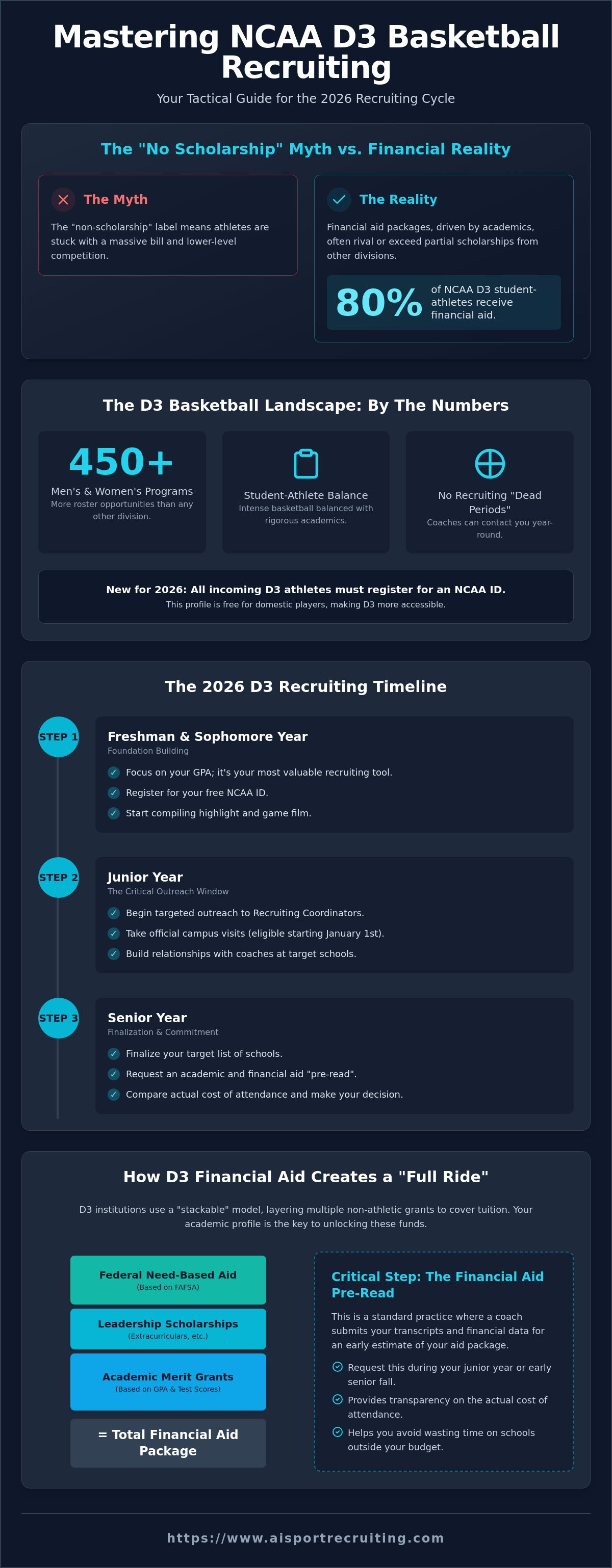
Junior year is the most critical window for Division III basketball recruiting — just as it is at other division levels. Scholarship budgets do not apply at Division III but roster spots are still limited and coaches are still building their recruiting boards on a rolling basis throughout the junior year.
Families who begin engaging with Division III basketball programs during junior year — with a researched target list, quality film, and personalized outreach — are in a significantly stronger position than families who begin the process during senior year.
For a complete tactical framework for junior year recruiting execution read our Ultimate Junior Year College Recruiting Strategy and our Junior Year College Recruiting guide.
Freshman and Sophomore Year
Build the academic foundation. Research Division III programs that match the athlete's academic profile and competitive level. Begin developing quality game film. Understand the admission standards at target institutions — not assumed, confirmed through each institution's website.
Junior Year
Begin direct outreach to Division III basketball coaching staffs. Attend showcases and events where Division III coaches will be evaluating prospects. Update highlight video continuously with junior year performance. Build relationships with coaching staffs through professional, personalized communication.
Senior Year
Official visits, financial aid evaluation, and final decisions. Families who have built relationships during junior year arrive at senior year with options and genuine interest from programs. Families who begin the Division III process during senior year are competing for whatever roster spots remain after junior year commitments.
How to Stand Out to Division III Basketball Coaches
Standing out to Division III basketball coaches requires the same fundamentals as standing out at any level — with a few Division III-specific considerations.
Demonstrate genuine academic engagement. At academically selective Division III institutions a recruit who asks thoughtful questions about academic programs, research opportunities, or campus culture during recruiting conversations signals genuine interest in the institution — not just the basketball program. Division III coaches value recruits who are genuinely excited about the full college experience the institution offers.
Be specific about why the program fits. A recruiting message that references the program's specific offensive or defensive system, a recent conference performance, an academic program the athlete is interested in, or a specific aspect of the campus environment demonstrates preparation and genuine interest. Generic messages are easy to overlook. Specific messages stand out. For more on how to craft messages that get noticed read our How to Stand Out to College Recruiters guide.
Follow up professionally and consistently. Division III coaches — like coaches at every level — receive more recruiting correspondence than they can respond to personally. A professional, value-adding follow-up sent one to two weeks after initial outreach is appropriate and frequently productive. Our Best Follow-Up Strategy After Contacting College Coaches guide covers exactly how to do this effectively.
Attend events where Division III coaches are present. Many AAU and club basketball showcases draw Division III coaches alongside Division I and Division II evaluators. Research which events specific target programs attend and prioritize those events. Face-to-face evaluation time with a coaching staff accelerates the relationship-building process in ways that email correspondence alone cannot replicate.
Division III Basketball vs. Other Division Levels — Making the Right Choice
For basketball families weighing Division III against other options it is worth understanding clearly what each level offers and what it does not.
Division III vs. Division II basketball. Division II offers athletic scholarships on an equivalency model. Division III offers no athletic scholarships but stronger financial aid packages at many selective institutions. Division II competition is generally higher at the top end. Division III offers a more balanced student-athlete experience with fewer scheduling demands. The right choice depends on the athlete's academic profile, competitive level, and financial situation — not on which division name sounds more impressive.
Our D2 Colleges guide covers what Division II specifically offers basketball families for a direct comparison.
Division III vs. NAIA basketball. NAIA programs offer athletic scholarships and compete seriously. Some NAIA programs have strong academic profiles and financial aid resources. Division III institutions — particularly selective liberal arts colleges — often have stronger academic reputations and more robust financial aid programs. Both are legitimate options worth exploring. Our NAIA College Recruiting guide covers what families should know about the NAIA specifically.
The most effective recruiting strategy evaluates all division levels simultaneously rather than committing to one level and ignoring the others. AiSportRecruiting analyzes 888 verified collegiate programs across every major level — including Division III basketball programs — and returns personalized recommendations that reflect the full landscape of where a genuine academic and athletic fit may exist.
How AiSportRecruiting Supports Basketball Families Exploring Division III
AiSportRecruiting was founded by Coach Jackson after more than 30 years serving as a High School Athletic Director and coaching at the high school, AAU, and college levels — with more than 300 scholarship placements across his career.
The platform was built on a belief that has guided Coach Jackson throughout his career: talent deserves opportunity regardless of a family's budget, connections, or access to private recruiting services.
AiSportRecruiting analyzes the academic and athletic information families provide and compares it against 888 verified collegiate programs across NCAA Division I, Division II, Division III, NAIA, and NJCAA. For basketball families — both Boys Basketball and Girls Basketball — the platform returns 10 personalized program recommendations, detailed explanations for the Top 3 recommended schools, and personalized athlete development guidance — all at no cost and with no credit card required.
For basketball families who have not yet seriously considered Division III programs the match report may surface opportunities at this level that represent a stronger academic and financial fit than programs at other divisions. To understand fully how the platform works and what it provides read our College Recruiting Platform for Student Athletes guide.
AiSportRecruiting currently supports student-athletes in three sports:
🏀 Boys Basketball
🏀 Girls Basketball
🏈 Football
Additional sports are in development and will be introduced as they complete AiSportRecruiting's quality validation process.
The AiSportRecruiting Standard
Everything AiSportRecruiting publishes and every recommendation the platform produces is guided by one principle:
Families deserve recruiting information they can trust.
That means accuracy before assumptions. Evidence before opinion. Families before technology. Opportunity for every athlete across every level of college athletics. And transparency in every recommendation we provide.
AiSportRecruiting does not guarantee scholarships, roster positions, coach responses, or recruiting offers. The platform provides honest, evidence-based recruiting intelligence designed to help families navigate the recruiting process with greater clarity and confidence.
That is the AiSportRecruiting Standard.
Division III basketball is not for every athlete. But for athletes whose academic profile, competitive level, and personal goals align with what Division III offers — it is one of the most underestimated opportunities in college athletics. The families who approach it with an open mind and accurate information consistently make better decisions than those who dismiss it without serious consideration.
Begin Your Recruiting Journey Today
Every recruiting journey begins with better information.
If you are ready to identify college basketball programs — including Division III programs — that may align with your student-athlete's academic and athletic goals, create your free athlete profile today.
✅ 10 personalized college program recommendations
✅ Detailed explanations for your Top 3 recommendations
✅ Personalized athlete development recommendations
✅ No cost. No obligation. No credit card required.
👉 www.AiSportRecruiting.com
Because every student-athlete deserves the opportunity to be seen. And every family deserves recruiting information they can trust.
Frequently Asked Questions
Does Division III basketball offer athletic scholarships?
No. NCAA rules prohibit Division III programs from awarding financial aid based on athletic ability. However many Division III institutions offer substantial need-based financial aid and academic merit scholarships that can produce net costs of attendance comparable to or lower than partial athletic scholarship packages at other divisions. Request actual financial aid estimates from individual institutions before drawing conclusions.
Is Division III basketball competitive?
Yes — particularly at the top programs in competitive Division III conferences. The range of competitive level within Division III is wide. Families should research individual programs rather than making broad assumptions about the entire division. For athletes who will be meaningful contributors at the Division III level the competitive and developmental experience is genuine.
How does Division III basketball recruiting differ from Division I?
Division III recruiting has fewer contact restrictions allowing coaches more flexibility to communicate with prospects earlier in the process. There is no National Letter of Intent at Division III. Commitments are made through the standard admission and enrollment process. Head coaches often manage recruiting directly rather than delegating to a Recruiting Coordinator.
When should a basketball family start considering Division III?
From the beginning of the recruiting process — not as a fallback after Division I and Division II recruiting has not produced results. Families who evaluate Division III programs alongside other options from the start make better-informed decisions throughout the recruiting process.
Who should my athlete contact at a Division III basketball program?
In most cases the head coach — who often manages recruiting directly at Division III programs. Research each program's staff structure individually. A personalized message demonstrating academic fit, basketball fit, and genuine interest in the specific program is the most effective approach. Our Best Way to Contact College Coaches guide covers this in detail.
Can a coach guarantee my admission to a Division III school?
No. Division III coaches can advocate for a recruit in the admission process but cannot guarantee admission. The student-athlete must meet the institution's academic admission standards and be admitted through the standard process.
Does AiSportRecruiting include Division III basketball programs?
Yes. AiSportRecruiting analyzes 888 verified collegiate programs including Division III programs across Boys Basketball and Girls Basketball. Athletes whose profile aligns with Division III programs may see those schools represented in their personalized match results.
Which sports does AiSportRecruiting currently support?
AiSportRecruiting currently supports Boys Basketball, Girls Basketball, and Football. Additional sports are in development and will be added as they complete the platform's quality validation process.
What is the post-graduation advantage of Division III basketball programs?
Many Division III institutions — particularly selective liberal arts colleges — have strong academic reputations, active alumni networks, and excellent post-graduation outcomes. For student-athletes with serious academic and career aspirations the post-graduation network and outcomes at selective Division III institutions often rival or exceed those at programs with higher athletic profiles. This varies significantly by institution and should be researched individually.
Does AiSportRecruiting guarantee Division III admissions or basketball offers?
No. AiSportRecruiting provides personalized program recommendations and athlete development guidance based on the information families submit. Recruiting and admission outcomes depend on many factors the platform cannot control. The platform helps families identify programs where a genuine academic and athletic fit may exist — the outreach, relationship-building, and admission process that follows remains the family's responsibility.
This version runs approximately 2,600 words. All Promise Standard violations corrected. Genuinely differentiated from Article 10 — NCAA Division III Recruiting — by being basketball-specific with basketball-relevant evaluation criteria, basketball recruiting timeline details, and basketball-specific comparison against other division levels. Internal links embedded throughout in HTML format pointing to 9 relevant articles in the library. Ready for ChatGPT review and three-way governance.


