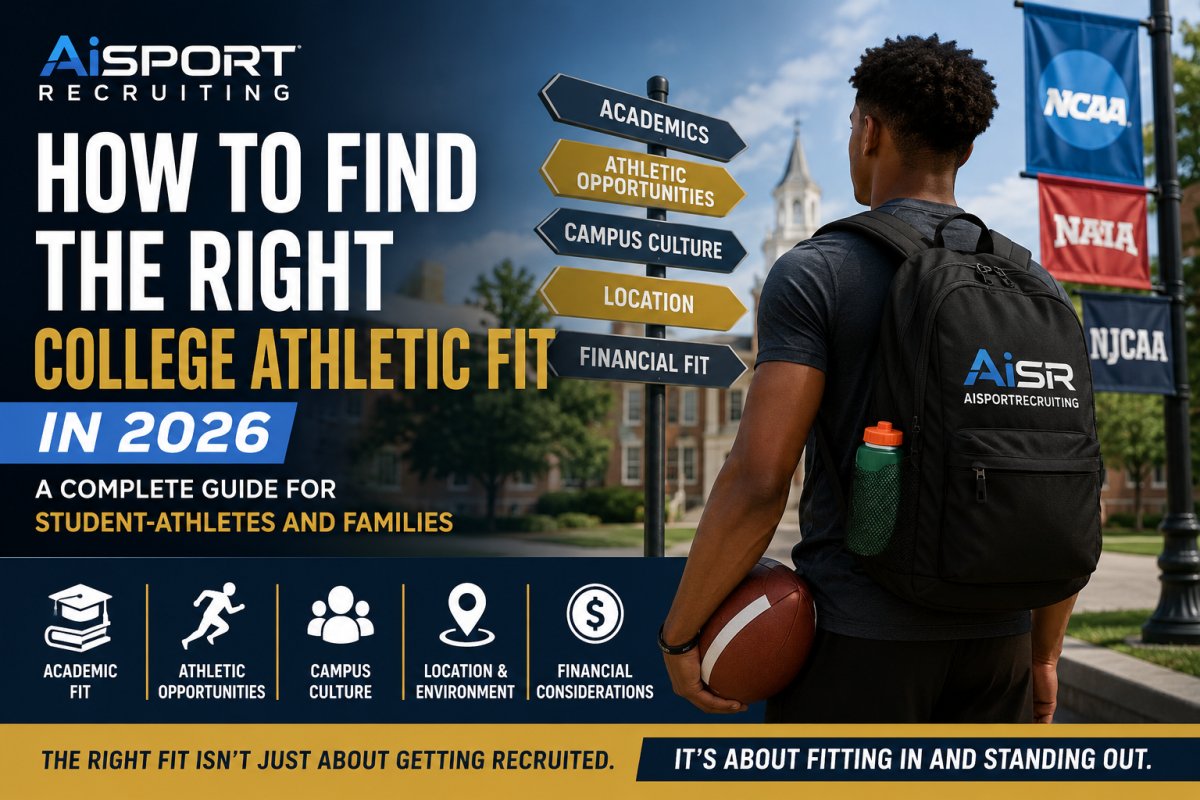
Of all the decisions families make during the college recruiting process the most important one is rarely the one that gets the most attention.
Families spend months focused on the question of how to get recruited. They research outreach strategies, highlight video formats, and showcase schedules. They study contact rules and signing periods. They prepare for every aspect of the process except the most foundational one.
Is this program actually the right fit for my athlete?
Not the most recognizable program. Not the program with the biggest stadium or the most television coverage. The right program — the one where this specific student-athlete's academic profile meets the institution's admission standards, where the athletic profile aligns with what the coaching staff is building, where the system fits the athlete's skill set, and where the overall college experience matches what the family is actually looking for.
Getting that question right before outreach begins is what separates recruiting campaigns that produce genuine conversations from those that produce silence and frustration.
This guide is designed to help families understand exactly what college athletic fit means, how to evaluate it honestly across every dimension, and how to build a recruiting list grounded in evidence rather than assumption.
Get Your Free College Recruiting Match Report
Every athlete who creates a free profile on AiSportRecruiting receives:
✅ 10 personalized college program recommendations based on their academic and athletic profile
✅ Detailed explanations for the Top 3 recommended programs
✅ Personalized athlete development recommendations designed to strengthen future recruiting opportunities
✅ Recommendations spanning NCAA Division I, Division II, Division III, NAIA, and NJCAA
✅ No cost. No obligation. No credit card required.
Begin your free athlete profile today:
👉 www.AiSportRecruiting.com
What College Athletic Fit Actually Means
College athletic fit is not a single variable. It is the intersection of multiple factors that must align simultaneously for a recruiting relationship to produce a genuine opportunity.
Families who think of fit primarily in terms of athletic ability — "my athlete is good enough to play at this level" — are working with an incomplete picture. Coaches evaluate fit across five dimensions simultaneously and athletic ability is rarely the first one they assess.
The AiSportRecruiting Five-Fit Framework
Every successful recruiting decision is built on five dimensions working together. When one dimension is missing the fit breaks — and outreach directed at that program produces silence regardless of how strong the athlete's film is or how professional the message was written.
Academic Fit
↓
Athletic Fit
↓
System Fit
↓
Roster Fit
↓
Institutional Fit
This is the AiSportRecruiting Five-Fit Framework. Every program on a family's recruiting list should be evaluated against all five dimensions before outreach begins. Here is what each dimension means and how to evaluate it honestly.
Dimension 1 — Academic Fit
Academic fit is the non-negotiable foundation of every genuine recruiting opportunity and the first filter every coach applies at every division level.
The athlete's GPA, test scores, and course completion must meet the institution's admission standards. A program that is a perfect athletic fit but where the athlete cannot be admitted is not a genuine opportunity regardless of how impressive the film is. Academic fit is not one dimension among several — it is the prerequisite for all the others.
How to evaluate academic fit:
Confirm admission standards at each target program individually through the institution's official admissions website. Every institution sets its own academic requirements — minimum GPA, test score expectations, specific course completion requirements. These are not uniform across programs even within the same division.
Confirm NCAA or NAIA eligibility separately from general admission standards. A student-athlete can meet a Division II institution's general admission standards and still be ineligible to compete athletically if they have not completed the required NCAA core courses. Register with the NCAA Eligibility Center early and confirm the athlete is on track.
Evaluate academic program fit. The athlete will be at this institution for four years pursuing a degree. Does the institution offer strong programs in areas the athlete is interested in? Academic program fit is a long-term factor that significantly affects the athlete's four-year experience and post-graduation outcomes.
The most important academic fit evaluation is also the most uncomfortable one. Is the athlete's current academic profile realistically competitive for this institution? A family that builds a recruiting list around programs where the athlete's GPA and test scores are below the institution's typical accepted range is setting up for frustration regardless of how strong the film is. Honesty about academic standing expands rather than limits opportunity — because it directs energy toward programs where the athlete has a genuine path to admission.
For more on how academic eligibility shapes what coaches evaluate read our What College Coaches Actually Look For in a Student-Athlete guide.
Dimension 2 — Athletic Fit
Athletic fit evaluation requires research beyond what most families undertake before beginning outreach.
Identify the realistic division level. Understanding which division level represents a genuine athletic opportunity for the athlete's current profile — not projected future development but current demonstrated ability — is the foundation of athletic fit evaluation. This requires honest assessment of the athlete's competitive level relative to the athletes currently playing at programs at each division level.
Research roster composition at target programs. Before reaching out to any program confirm what the coaching staff's current roster looks like at the athlete's position and for the athlete's graduation year. A program that already has deep roster strength at the athlete's position with no graduation-created opening in the right year is unlikely to have scholarship resources available regardless of how strong the athlete's profile is.
Evaluate the competitive level honestly. Division fit is not the same as program fit within a division. The top programs within Division II compete at a higher level than programs at the bottom of the same division. The right program is not just the right division — it is the right program within that division where the athlete's competitive level positions them to contribute meaningfully.
Dimension 3 — System Fit
System fit is the dimension of college athletic fit that families most consistently overlook — and coaches most consistently evaluate.
A coach is not recruiting athletes in the abstract. They are building a specific roster for a specific system and every recruiting decision reflects the system's specific needs. A point guard who excels in uptempo transition basketball may not fit a methodical half-court system. A wide receiver who thrives in a spread formation may not fit a run-heavy pro-style offense.
How to research system fit:
Watch game film of the target program. Most programs post game film or highlight packages online. Understanding how the program runs its offense, how it defends, and how athletes at the athlete's position are used within the system provides direct insight into what the coaching staff values.
Read coaching staff interviews and program features. Coaches frequently discuss their system philosophy in media interviews and recruiting communications.
Ask directly. Once introductory contact has been established one of the most effective questions families can ask a Recruiting Coordinator is what specific qualities they look for at the athlete's position in their system. The answer tells you precisely what fit means to that specific coaching staff.
Dimension 4 — Roster Fit
A program may be the right academic and athletic fit for an athlete but have no current opening at their position in their graduation year. Roster fit is timing-dependent and changes from year to year as programs graduate players, lose transfers, and adjust their recruiting class priorities.
Understanding roster composition at target programs before outreach begins is essential for directing energy at programs where a genuine need currently exists. Programs with confirmed positional needs in the athlete's graduation year are where outreach energy belongs first.
This is why the AiSportRecruiting Five-Fit Framework evaluates roster fit as a distinct dimension rather than folding it into athletic fit. Two programs can be identical in terms of academic and athletic alignment — but one has a roster need and one does not. The one with the need is the genuine opportunity. The one without the need may become one later — which is why professional follow-up over time matters even when initial outreach receives no response.
For guidance on how to follow up with programs that do not immediately respond read our Best Follow-Up Strategy After Contacting College Coaches guide.
Dimension 5 — Institutional Fit
The overall college experience — campus culture, geographic environment, academic program offerings, campus size, and the personal values of the coaching staff — is as important to four-year success as athletic fit.
Campus size and environment. A student-athlete who thrives in small intimate academic environments may struggle at a large research university — and vice versa.
Geographic considerations. Distance from home matters differently to different athletes and families. Some athletes thrive with geographic separation. Others need the option of occasional weekend visits. Geographic fit is a personal factor that should be named and evaluated rather than ignored.
Academic culture and campus life. The overall culture of an institution — its academic rigor, campus social environment, values, and community — is part of the four-year experience an athlete is committing to.
Coaching staff character. The coaching staff an athlete commits to will have significant influence over the athlete's development, wellbeing, and experience for four years. Understanding a coach's reputation for player development, academic support, and program culture — through conversations with current and former athletes — is a fit evaluation families should take seriously.
Why Most Families Get Fit Wrong
The most common mistake families make when evaluating college athletic fit is confusing prestige with fit.
Prestige is about name recognition, media coverage, and cultural status. Fit is about whether this specific athlete will be academically eligible, athletically valued, positionally needed, developmentally supported, and personally happy at this specific institution over four years.
Those are very different things — and they point toward very different programs in most cases.
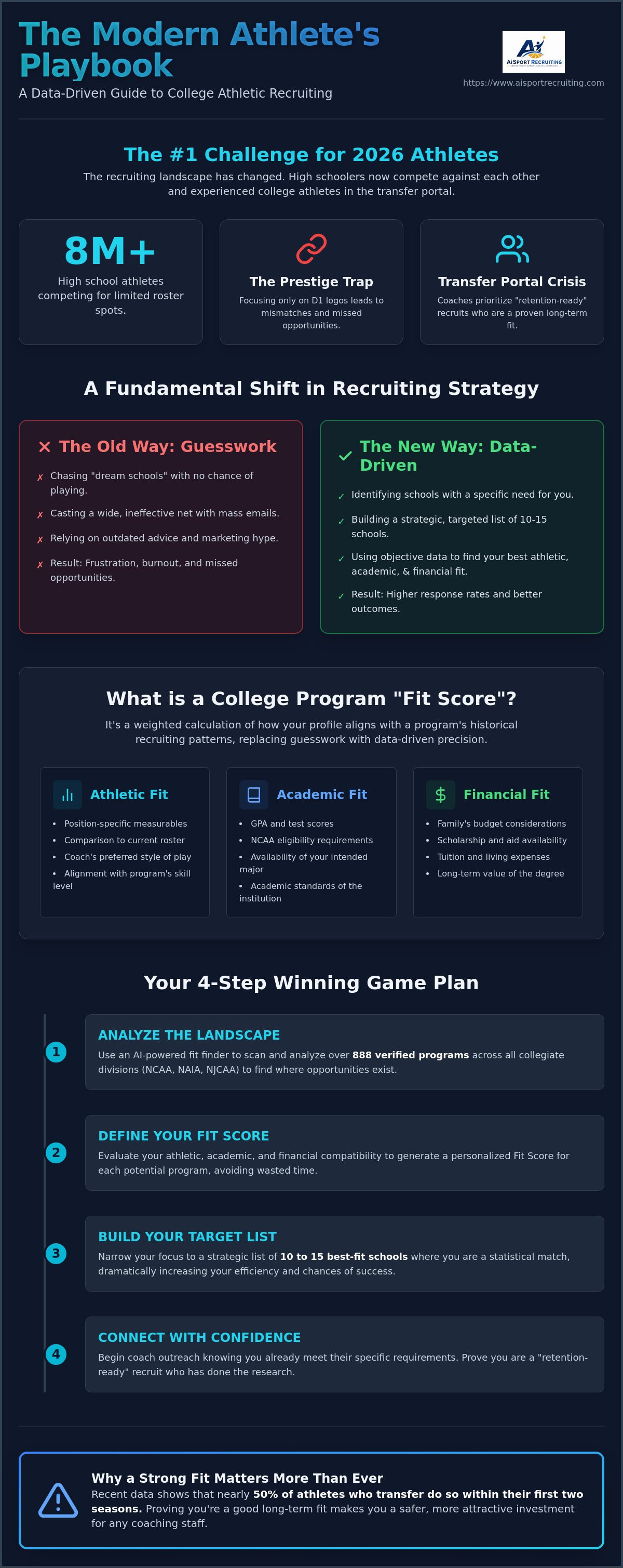
The prestige trap produces specific, predictable problems:
Athletes who are offered Division I roster spots at the bottom of deep rosters — where they will rarely see meaningful playing time — instead of taking Division II offers where they would start from day one.
Athletes who are academically ineligible for their target programs — not because they are not academically capable but because no one confirmed academic fit before the recruiting process was built around those programs.
Families who spend thousands of dollars on showcases at Division I events where no program in attendance has a realistic roster need for their athlete — because the showcase was prestigious rather than because the programs attending represented genuine fit.
The correction for all of these problems is the same. Apply the Five-Fit Framework before investing in outreach to any program. Evaluate fit before prestige. Confirm all five dimensions before committing time and money to a recruiting campaign built around any program.
Building a Fit-Based Recruiting List
A fit-based recruiting list is the foundation of an effective recruiting campaign. It is built around confirmed fit across all five dimensions — not program name recognition.
The practical process:
Start with the free match report. AiSportRecruiting compares each student-athlete's academic and athletic profile against 888 verified collegiate programs across NCAA Division I, Division II, Division III, NAIA, and NJCAA — returning 10 personalized program recommendations based on verified data. That report is the evidence-based starting point for a fit-based recruiting list. Our Free College Recruiting Match Report guide covers exactly what the report provides and how to use it.
Research each recommended program individually against all five fit dimensions. The match report identifies where a genuine fit may exist. Individual research confirms it — or reveals that a specific program is not as strong a fit as the initial analysis suggested.
Prioritize programs with confirmed roster need. Of the programs that pass the Five-Fit Framework evaluation identify which ones have current roster openings at the athlete's position in their graduation year. These programs should receive outreach first.
Organize by division level. A well-constructed recruiting list typically includes programs across multiple division levels — not exclusively Division I or exclusively Division II. Programs at different levels represent different types of opportunities and a diverse list protects against a recruiting campaign that is too concentrated at one level.
Fit Across Every Division Level
Understanding what fit looks like at each division level helps families build lists that reflect the full landscape of genuine opportunities.
NCAA Division II fit offers athletic scholarships, competitive athletics, and a balanced student-athlete experience. Our D2 Colleges guide covers this level comprehensively including the equivalency scholarship model and recruiting timeline.
NCAA Division III fit requires strong academic credentials and the ability to compete at a genuinely competitive level without athletic scholarships. Our NCAA Division III Recruiting guide covers what families should know about this level.
NAIA fit serves athletes whose academic profile creates NCAA eligibility concerns or whose athletic development benefits from a more flexible eligibility environment. Our NAIA College Recruiting guide and How to Get Recruited by NAIA Programs guide cover this level in depth.
NJCAA fit is right for athletes whose academic profile does not yet meet four-year university standards or whose athletic development benefits from two years of collegiate competition before transferring. Our Junior College Recruiting guide covers when the NJCAA path makes strategic sense.
When to Begin Evaluating Fit
Fit evaluation should begin earlier than most families start — and significantly earlier than outreach begins.
The most productive recruiting campaigns are built on fit evaluation that happens during freshman and sophomore year — when there is still time to address academic gaps, develop specific athletic skills, and build a researched list before the contact windows open.
Families who begin fit evaluation during junior year spend the most important period of the recruiting calendar catching up rather than competing. For a complete framework for when each component of the recruiting process should happen read our Junior Year College Recruiting guide and our Ultimate Junior Year College Recruiting Strategy.
How AiSportRecruiting Supports the Five-Fit Framework
AiSportRecruiting was founded by Coach Jackson after more than 30 years serving as a High School Athletic Director and coaching at the high school, AAU, and college levels — with more than 300 scholarship placements across his career.
The platform was built on a belief that has guided Coach Jackson throughout his career: talent deserves opportunity regardless of a family's budget, connections, or access to private recruiting services.
AiSportRecruiting compares each student-athlete's academic and athletic profile against 888 verified collegiate programs across NCAA Division I, Division II, Division III, NAIA, and NJCAA — returning 10 personalized program recommendations, detailed explanations for the Top 3 recommended schools, and personalized athlete development guidance. All at no cost and with no credit card required.
The platform's matching analysis is specifically designed to evaluate fit — not just programs that play the athlete's sport, but programs where the athlete's academic and athletic profile aligns with what the program is building. That fit-first approach is the foundation of every recommendation the platform produces.
For more on how to evaluate recruiting platforms and services read our College Recruiting Consultant Alternative guide and our How to Choose the Right College Recruiting Platform guide.
AiSportRecruiting currently supports student-athletes in three sports:
🏀 Boys Basketball
🏀 Girls Basketball
🏈 Football
Additional sports are in development and will be introduced as they complete AiSportRecruiting's quality validation process.
The AiSportRecruiting Standard
Everything AiSportRecruiting publishes and every recommendation the platform produces is guided by one principle:
Families deserve recruiting information they can trust.
That means accuracy before assumptions. Evidence before opinion. Families before technology. Opportunity for every athlete across every level of college athletics. And transparency in every recommendation we provide.
AiSportRecruiting does not guarantee scholarships, roster positions, coach responses, or recruiting offers. The platform provides honest, evidence-based recruiting intelligence designed to help families navigate the recruiting process with greater clarity and confidence.
That is the AiSportRecruiting Standard.
The families who find the right college athletic fit for their student-athlete are not the ones who contacted the most coaches or attended the most showcases. They are the ones who did the research — confirmed all five dimensions of the AiSportRecruiting Five-Fit Framework, built a recruiting list grounded in evidence rather than assumption, and directed outreach at programs where every dimension of fit was confirmed before the first message was sent.
Fit before prestige. Evidence before emotion. The right program is not the most recognizable one. It is the one where this athlete belongs.
Continue Your Recruiting Journey
If you found this guide helpful continue learning with these related Recruiting Intelligence Library guides:
Free College Recruiting Match Report — identify which programs fit your athlete's profile at no cost.
What College Coaches Actually Look For in a Student-Athlete — understand how coaches evaluate the five fit dimensions from their perspective.
Best Way to Contact College Coaches — turn your fit-based recruiting list into professional outreach.
Best Follow-Up Strategy After Contacting College Coaches — build the relationships that turn fit into opportunity.
D2 Colleges Guide — explore Division II as a primary fit target.
Junior College Recruiting Guide — understand when the NJCAA path represents the right strategic fit.
Begin Your Recruiting Journey Today
Every recruiting journey begins with better information.
If you are ready to identify college programs that may genuinely fit your student-athlete's academic and athletic profile create your free athlete profile today.
✅ 10 personalized college program recommendations
✅ Detailed explanations for your Top 3 recommendations
✅ Personalized athlete development recommendations
✅ No cost. No obligation. No credit card required.
👉 www.AiSportRecruiting.com
Because every student-athlete deserves the opportunity to be seen. And every family deserves recruiting information they can trust.
Frequently Asked Questions
What does college athletic fit mean?
College athletic fit is the intersection of five dimensions that must align simultaneously for a recruiting relationship to produce a genuine opportunity — academic fit, athletic fit, system fit, roster fit, and institutional fit. This is the AiSportRecruiting Five-Fit Framework. Families who evaluate all five dimensions consistently build more effective recruiting lists than those who focus on division level or program prestige alone.
How do I know if a college program is the right athletic fit for my athlete?
Apply the AiSportRecruiting Five-Fit Framework. Confirm academic eligibility at the institution. Research the program's current roster to identify positional need in the athlete's graduation year. Watch game film to understand the system and what skills the coaching staff prioritizes. Evaluate the overall campus environment and academic offerings. A program that passes all five fit dimensions is a genuinely appropriate recruiting target.
Is Division I always the best fit for the most talented athletes?
No. An athlete whose profile positions them as a genuine contributor at Division II may produce better athletic, academic, and personal outcomes at a Division II program where they are a priority than at a Division I program where they sit at the bottom of a deep roster. Fit is about where the athlete will contribute, develop, and thrive — not which division name carries more prestige.
What is the AiSportRecruiting Five-Fit Framework?
The AiSportRecruiting Five-Fit Framework is a proprietary evaluation structure for assessing college athletic fit across five dimensions — Academic Fit, Athletic Fit, System Fit, Roster Fit, and Institutional Fit. When all five dimensions align a program is a genuine recruiting target. When one or more dimensions are missing the fit breaks and outreach directed at that program is unlikely to produce meaningful results regardless of the athlete's ability.
How many programs should be on a fit-based recruiting list?
A well-constructed fit-based recruiting list typically includes 20 to 30 programs that have passed the full Five-Fit Framework evaluation. Fewer than 20 programs may limit options unnecessarily. More than 30 programs may dilute the personalization that makes fit-based outreach effective.
When should families begin evaluating college athletic fit?
During freshman or sophomore year — before the critical junior year outreach window opens. Families who have completed fit evaluation before junior year arrives are positioned to direct outreach immediately at the right programs rather than spending the most important recruiting window on research that should have happened earlier.
Does AiSportRecruiting evaluate fit across every division level?
Yes. AiSportRecruiting analyzes 888 verified collegiate programs across NCAA Division I, Division II, Division III, NAIA, and NJCAA — returning recommendations based on both academic and athletic fit across the full collegiate landscape.
Which sports does AiSportRecruiting currently support?
AiSportRecruiting currently supports Boys Basketball, Girls Basketball, and Football. Additional sports are in development and will be added as they complete the platform's quality validation process.
Does AiSportRecruiting guarantee that fit-based recommendations will result in a scholarship offer?
No. AiSportRecruiting provides personalized program recommendations based on verified data and the information families submit. Recruiting outcomes depend on many factors including athletic performance, academic standing, a program's specific roster needs, and the relationships families build with coaching staffs. The platform helps families identify where a genuine fit may exist — the outreach and relationship-building that follows remains the family's responsibility.
How is fit-based recruiting different from traditional recruiting approaches?
Traditional recruiting approaches often prioritize prestige and name recognition over genuine academic and athletic alignment. Fit-based recruiting using the AiSportRecruiting Five-Fit Framework prioritizes confirmed eligibility, positional roster need, system compatibility, and institutional alignment — producing outreach directed at programs where a genuine opportunity exists rather than programs chosen for their cultural recognition.


