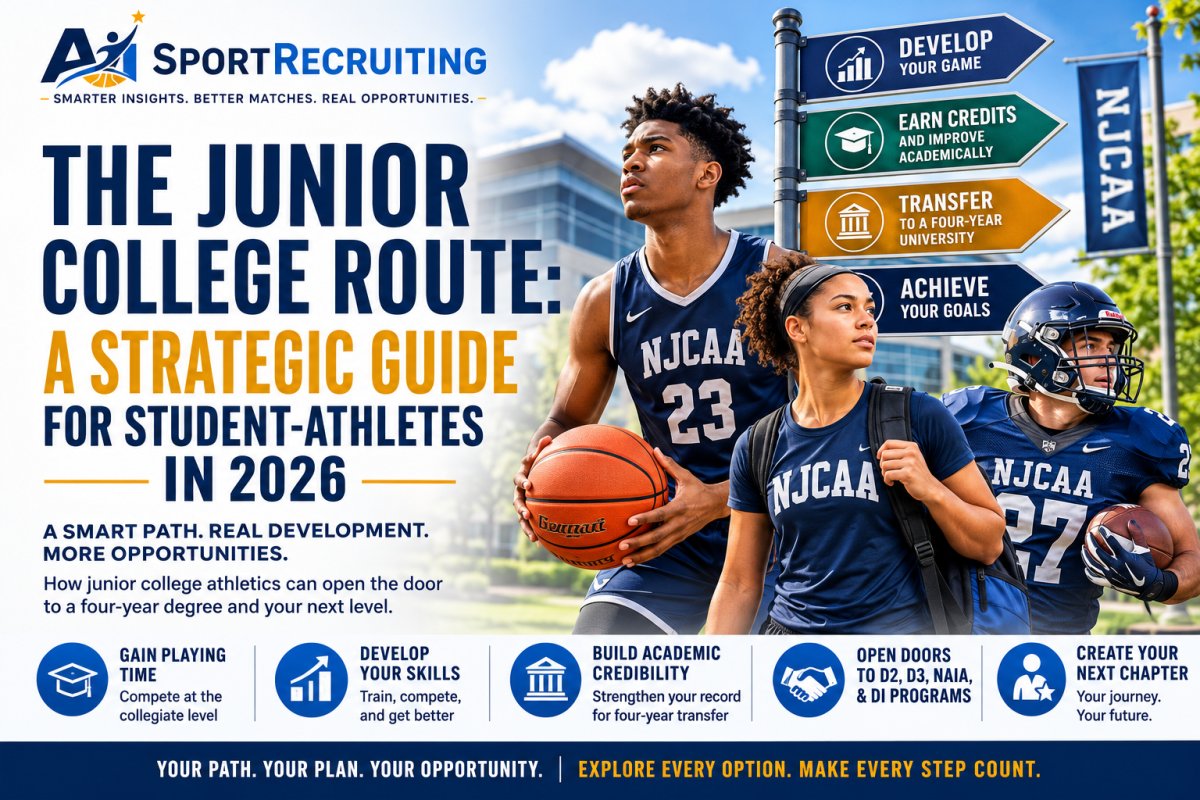
For many student-athletes and their families the junior college path is the one they never seriously considered — until it becomes the option that changes everything.
Junior college athletics — governed by the National Junior College Athletic Association, the NJCAA — represents one of the most genuinely strategic options in the college recruiting landscape. Not a fallback. Not a consolation prize. A deliberate, intelligent choice that thousands of athletes use every year to develop their academic and athletic profiles, earn genuine collegiate playing time, and position themselves for four-year opportunities that might not have been accessible directly from high school.
This guide is designed to help families understand what junior college recruiting actually involves — who it is right for, how it works, what the pathway to a four-year program looks like, and how to approach the process strategically rather than reactively.
Before reading further — if you are still building your overall recruiting foundation start with our Free College Recruiting Match Report to understand where genuine opportunities may exist across every level of college athletics including NJCAA programs.
Get Your Free College Recruiting Match Report
Every athlete who creates a free profile on AiSportRecruiting receives:
✅ 10 personalized college program recommendations based on their academic and athletic profile
✅ Detailed explanations for the Top 3 recommended programs
✅ Personalized athlete development recommendations designed to strengthen future recruiting opportunities
✅ Recommendations spanning NCAA Division I, Division II, Division III, NAIA, and NJCAA
✅ No cost. No obligation. No credit card required.
Begin your free athlete profile today:
👉 www.AiSportRecruiting.com
What Junior College Athletics Actually Is
Junior college athletics refers to competitive collegiate athletics at two-year institutions — commonly called junior colleges or community colleges. The NJCAA is the primary governing body for athletics at these institutions, operating independently from the NCAA and NAIA.
NJCAA member institutions offer two-year associate degree programs alongside competitive athletics across a wide range of sports. Student-athletes who compete at NJCAA programs are full college students — not athletes waiting to be discovered somewhere else. The academic and athletic experience at a well-run NJCAA program is genuine collegiate competition with real coaching, real development, and real academic progress.
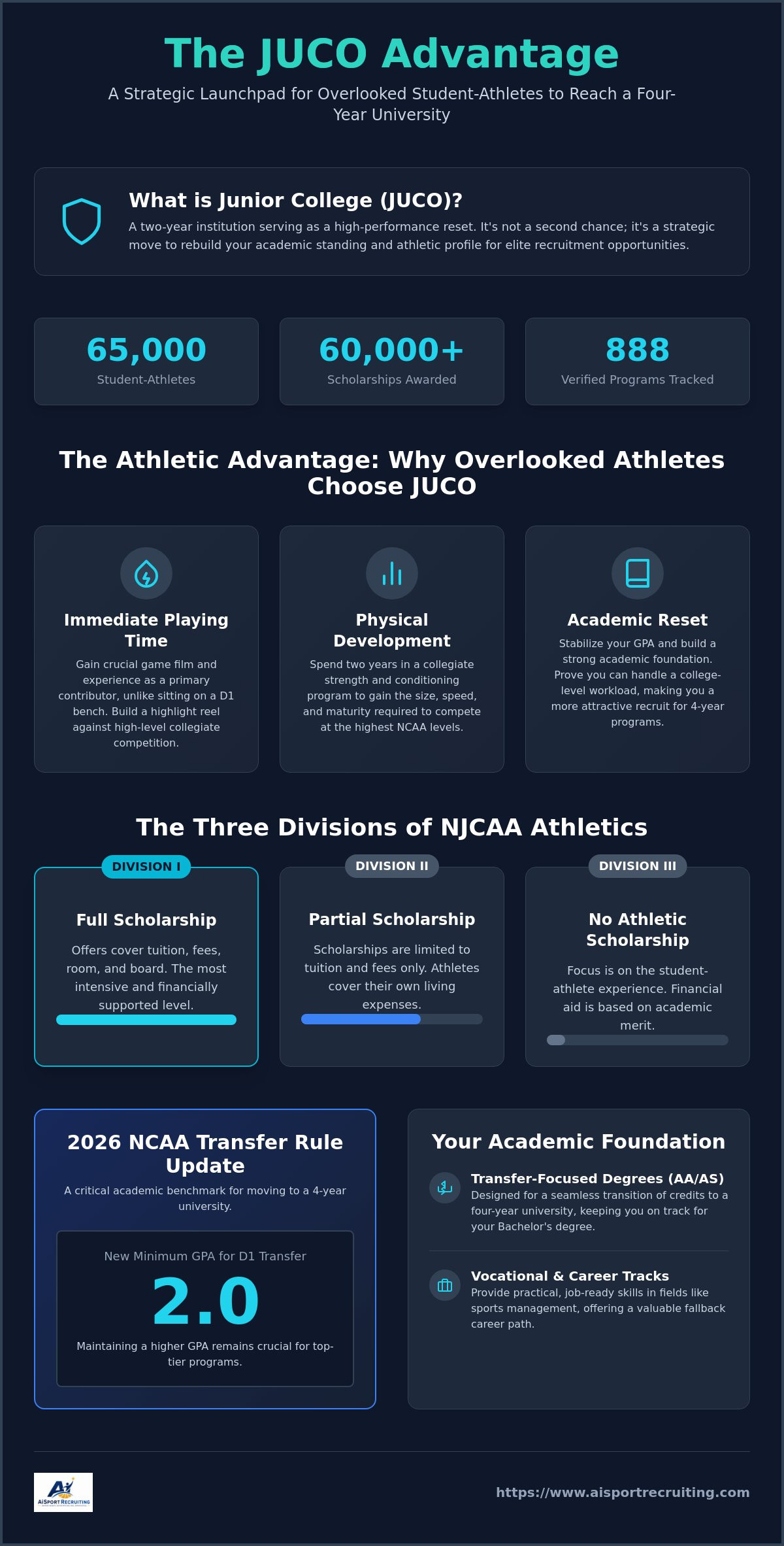
The NJCAA operates across three competitive divisions with different scholarship structures that families should understand before evaluating specific programs.
NJCAA Division I — programs can offer full athletic scholarships covering tuition, fees, room and board, and books. This is the highest scholarship level within the NJCAA structure.
NJCAA Division II — programs offer partial scholarships covering tuition and fees only. Room, board, and other expenses are the student-athlete's responsibility.
NJCAA Division III — programs do not offer athletic scholarships. Financial support comes through need-based and merit-based institutional aid.
Scholarship availability and amounts vary by sport, program, and institution within each division. Families should research and confirm scholarship details directly with each specific program under consideration rather than assuming based on division level alone.
Who Should Consider the Junior College Route
The junior college path is not appropriate for every student-athlete. It is genuinely valuable for specific situations — and understanding those situations honestly helps families evaluate whether it is the right choice for their athlete.
Athletes whose academic credentials do not yet meet four-year university admission standards. The NJCAA's eligibility requirements are generally more accessible than NCAA Division I and II requirements. Student-athletes who graduated from high school but whose GPA or course completion does not meet NCAA eligibility standards can often compete at NJCAA programs while building the academic record needed for a four-year transfer.
Athletes who need more development time before competing at their target level. Some athletes develop physically later than their peers. Two years of collegiate-level competition, strength and conditioning, and coaching development can close the gap between a high school athlete's current profile and what four-year programs at their target level are looking for.
Athletes who were not heavily recruited out of high school despite genuine ability. The recruiting process is imperfect. Talented athletes from small schools, rural areas, or programs without significant recruiting exposure are sometimes overlooked entirely despite having the ability to compete at the four-year level. NJCAA competition provides a platform where that ability can be demonstrated against collegiate competition — producing the film and performance data that four-year coaches can evaluate concretely.
Athletes who received four-year offers that were not the right fit academically or athletically. Some athletes choose the NJCAA path not because four-year options were unavailable but because the specific options available were not the right fit for their goals. The junior college path provides two years to develop, clarify goals, and pursue four-year opportunities more deliberately.
What the junior college route is not right for:
Athletes whose academic and athletic profiles already align well with four-year programs at a realistic division level are generally better served by pursuing four-year opportunities directly. The junior college path adds time to the college journey and introduces transfer complexity that families should weigh honestly before choosing it.
The Athletic Benefits of the Junior College Path
Immediate playing time. One of the most significant advantages of NJCAA competition for athletes considering the junior college path is the opportunity to play meaningful minutes from the first season. An athlete who contributes meaningfully at an NJCAA program — starting, producing statistics, and developing within a well-coached system — is building a collegiate track record that four-year coaches can evaluate with far more confidence than they can evaluate high school performance alone.
Sitting at the end of a Division I bench for two years without meaningful playing time produces neither the development nor the film that advances a recruiting career. Two years of genuine contribution at an NJCAA program produces both.
Collegiate-level development. The jump from high school athletics to four-year collegiate athletics is significant — physically, technically, and mentally. Two years in a collegiate strength and conditioning program, competing against collegiate-level opponents, and learning within a collegiate coaching system closes that gap in ways that high school competition alone cannot replicate.
Athletes who arrive at four-year programs as NJCAA transfers have already experienced collegiate competition. They have already adjusted to the pace, physicality, and demands of college athletics. Four-year coaches consistently value that adjustment — it reduces the development curve and increases the likelihood of immediate contribution.
Film against collegiate competition. Highlight video produced against collegiate opponents carries more weight with four-year recruiting coordinators than high school film — because it demonstrates ability at a higher competition level. An athlete who excels against NJCAA competition is demonstrating more than potential. They are demonstrating proven performance.
The Academic Benefits of the Junior College Path
For athletes whose academic records from high school do not meet four-year university admission standards the junior college path provides a genuine, legitimate pathway to four-year eligibility.
Two years of strong academic performance at an NJCAA institution demonstrates to four-year admissions offices and coaching staffs that the academic concerns from high school have been addressed — not excused. A student-athlete who struggled academically in high school but earns strong grades in college-level coursework is making the strongest possible case for four-year admission.
The most important academic guidance for athletes on the junior college path is to focus on core transferable courses — English composition, mathematics, natural science, social science — from the beginning. These are the credits that transfer most reliably to four-year institutions regardless of which specific program the athlete transfers to. Credits in non-transferable courses may not follow the athlete to their four-year destination and may add time to degree completion.
Families should research the specific credit transfer requirements for each four-year program being targeted and plan coursework accordingly from the first semester at the NJCAA institution.
On academic eligibility for transfer:
NCAA transfer eligibility rules for student-athletes coming from two-year institutions are specific and can change. Families should verify current transfer eligibility requirements directly through the NCAA website — ncaa.org — and through the specific four-year institutions being targeted rather than relying on information that may be outdated. NAIA and NJCAA transfer rules differ from NCAA rules and should be verified directly through naia.org and njcaa.org respectively.
How Junior College Recruiting Works
NJCAA recruiting is generally less structured and less governed by formal contact rules than NCAA Division I recruiting. NJCAA coaches can communicate more freely with prospective student-athletes across the recruiting calendar — which means proactive outreach from families is both appropriate and important.
NJCAA coaches often have smaller recruiting budgets and less national visibility than four-year programs. They are less likely to find athletes through passive channels. Families who reach out proactively — with professional, personalized messages that demonstrate genuine research on the specific program — are far more likely to generate responses than those who wait to be discovered.
Research programs the same way you would research four-year programs:
Confirm the program's division level and scholarship structure. Research the coaching staff's background and the program's track record of developing athletes and facilitating successful transfers to four-year institutions. Confirm that the institution's academic programs include the courses needed for your athlete's intended four-year major. Visit the campus when possible.
The program's transfer track record matters more than almost anything else for athletes whose primary goal is reaching a four-year program. Ask specifically where recent NJCAA athletes from the program have transferred and what support the coaching staff provides during the transfer process. Programs with strong four-year transfer records are significantly more valuable for athletes pursuing the four-year pathway than programs that produce athletic competition without a clear transfer pipeline.
For guidance on how to approach outreach to NJCAA coaches read our Best Way to Contact College Coaches guide — the principles of personalized, professional, fit-first outreach apply at every division level including NJCAA.
For a complete guide to following up after initial outreach read our Best Follow-Up Strategy After Contacting College Coaches guide.
Common Mistakes Families Make When Considering the Junior College Path
Treating it as a last resort rather than a strategic choice. Families who arrive at junior college recruiting demoralized and without a plan produce worse outcomes than families who approach it as a deliberate strategic decision. The mindset with which a family enters the NJCAA process significantly affects how those two years are spent and what outcomes they produce.
Choosing a program without researching the transfer track record. The most important question for any NJCAA program under consideration is not scholarship amount or competitive level — it is where athletes from this program have transferred in recent years and how the coaching staff supports that process.
Neglecting the academic work. The academic record built during NJCAA years is what opens or closes four-year transfer options. Athletes who focus exclusively on athletic performance while neglecting coursework limit their four-year options regardless of how well they play.
Not actively recruiting four-year programs during NJCAA years. The transfer to a four-year program does not happen automatically. Athletes need to actively pursue four-year opportunities — building film, reaching out to coaches, attending showcases — throughout their NJCAA experience. Waiting until the second year to begin the transfer recruiting process is too late to compete effectively for the best four-year opportunities.
Underestimating the eligibility complexity. NJCAA to four-year transfer involves eligibility rules that vary by the specific four-year program and governing body. Families should seek eligibility guidance early — from the NJCAA, from the NCAA Eligibility Center if targeting NCAA programs, and from the compliance offices at specific target four-year institutions — rather than assuming a standard process applies universally.
For a complete framework on how to stand out during the recruiting process read our How to Stand Out to College Recruiters guide.
The Transfer Strategy — Moving from Junior College to a Four-Year Program
The exit strategy is as important as the entry when a family chooses the junior college route.
For athletes whose primary goal is reaching a four-year NCAA, NAIA, or NJCAA Division I program the two years at a junior college are not simply a holding period. They are an active recruiting and development phase that should be approached with the same intentionality as the original high school recruiting process.
During NJCAA Year 1:
Focus on academic performance, athletic development, and beginning to build a highlight video against collegiate competition. Research target four-year programs and begin introductory outreach to Recruiting Coordinators. Establish academic standing that meets the transfer requirements for target four-year programs.
During NJCAA Year 2:
Intensify four-year recruiting outreach with updated film and statistics from NJCAA competition. Attend showcases and events where four-year coaches from target programs will be evaluating prospects. Confirm academic credit transfer compatibility with target four-year institutions. Make transfer decisions with adequate time to participate in four-year programs' official visit processes.
For more on the tactical framework that governs effective outreach at every stage of the recruiting process read our Ultimate Junior Year College Recruiting Strategy and our Junior Year College Recruiting guide — both of which apply directly to athletes recruiting from NJCAA programs toward four-year destinations.
Junior College Recruiting for Basketball and Football Families
AiSportRecruiting currently supports student-athletes in Boys Basketball, Girls Basketball, and Football — the three sports where the platform's program data and AI matching capabilities are fully live.
For basketball families the NJCAA has a long and well-established tradition of developing players who go on to compete successfully at the four-year level. NJCAA basketball is known for high-tempo, competitive play that accelerates the development of guards and perimeter players in particular. Programs with strong coaching staffs and established four-year transfer networks provide basketball athletes with genuine developmental platforms. Our Girls Basketball College Recruiting guide covers what basketball families should know about pursuing opportunities across every division level including NJCAA.
For football families NJCAA football programs provide a pathway for athletes who need additional development time, athletes whose academic profiles require additional work before four-year admission is realistic, and athletes who were not recruited out of high school despite genuine ability. Our Football Recruiting Platform guide covers what football families should know about the full recruiting landscape including NJCAA programs.
NJCAA vs Other Division Levels — Making the Right Choice
For families evaluating the junior college path alongside other options it is worth understanding clearly how NJCAA compares to the alternatives.
NJCAA vs NCAA Division III — Division III does not offer athletic scholarships but provides a four-year degree experience at institutions that are often academically strong. NJCAA Division I programs can offer full scholarships that Division III cannot. For academically eligible athletes who do not need the two-year development period Division III may be the stronger option. Our NCAA Division III Recruiting guide covers that comparison in depth.
NJCAA vs NAIA — NAIA programs offer athletic scholarships at four-year institutions. For athletes who are academically eligible and athletically competitive at the NAIA level the NAIA may represent a better fit than beginning at the NJCAA — providing a four-year degree experience, four years of athletic competition, and scholarship support without the transfer complexity of the junior college path. Our NAIA College Recruiting guide and our How to Get Recruited by NAIA Programs guide cover what the NAIA specifically offers.
NJCAA vs NCAA Division II — Division II offers athletic scholarships at four-year institutions with competitive athletics and a balanced student-athlete experience. For athletes whose academic and athletic profiles align with Division II programs directly from high school the four-year path is generally preferable to the junior college route. Our D2 Colleges guide covers what Division II specifically offers.
The right choice depends on the athlete's specific academic situation, development stage, athletic profile, and long-term goals — not on which option sounds most prestigious or most accessible. Understanding what coaches actually look for at each level helps families make that choice more accurately. Our What College Coaches Actually Look For guide covers the evaluation criteria that apply across every division level.
How AiSportRecruiting Supports Families Exploring Junior College
AiSportRecruiting was founded by Coach Jackson after more than 30 years serving as a High School Athletic Director and coaching at the high school, AAU, and college levels — with more than 300 scholarship placements across his career.
The platform was built on a belief that has guided Coach Jackson throughout his career: talent deserves opportunity regardless of a family's budget, connections, or access to private recruiting services.
AiSportRecruiting compares each student-athlete's academic and athletic profile against 888 verified collegiate programs across NCAA Division I, Division II, Division III, NAIA, and NJCAA — returning 10 personalized program recommendations, detailed explanations for the Top 3 recommended schools, and personalized athlete development guidance. All at no cost and with no credit card required.
For families exploring the junior college path the platform may surface NJCAA programs where the athlete's current academic and athletic profile represents a genuine fit — as well as four-year programs across Division II, Division III, and NAIA where the athlete may be a direct fit without needing the two-year bridge. That complete picture helps families make informed decisions about which path is actually right for their specific athlete rather than defaulting to the junior college route without understanding all available options.
To understand fully how the platform works read our College Recruiting Platform for Student Athletes guide.
AiSportRecruiting currently supports student-athletes in three sports:
🏀 Boys Basketball
🏀 Girls Basketball
🏈 Football
Additional sports are in development and will be introduced as they complete AiSportRecruiting's quality validation process.
The AiSportRecruiting Standard
Everything AiSportRecruiting publishes and every recommendation the platform produces is guided by one principle:
Families deserve recruiting information they can trust.
That means accuracy before assumptions. Evidence before opinion. Families before technology. Opportunity for every athlete across every level of college athletics. And transparency in every recommendation we provide.
AiSportRecruiting does not guarantee scholarships, roster positions, coach responses, or recruiting offers. The platform provides honest, evidence-based recruiting intelligence designed to help families navigate the recruiting process with greater clarity and confidence.
That is the AiSportRecruiting Standard.
The junior college path is not for every student-athlete. But for the athlete whose academic situation, development timeline, or recruiting circumstances align with what two-year NJCAA programs offer — it is one of the most genuinely strategic options in college athletics. The families who approach it with clear eyes, honest expectations, and a proactive plan consistently produce better outcomes than those who stumble into it without direction.
Two years invested intentionally in the right NJCAA program can open four-year doors that were not accessible before. That is not a consolation prize. That is the plan working.
Begin Your Recruiting Journey Today
Every recruiting journey begins with better information.
If you are ready to identify college programs — including NJCAA programs — that may align with your student-athlete's academic and athletic goals, create your free athlete profile today.
✅ 10 personalized college program recommendations
✅ Detailed explanations for your Top 3 recommendations
✅ Personalized athlete development recommendations
✅ No cost. No obligation. No credit card required.
👉 www.AiSportRecruiting.com
Because every student-athlete deserves the opportunity to be seen. And every family deserves recruiting information they can trust.
Frequently Asked Questions
What is junior college recruiting?
Junior college recruiting refers to the process of identifying and pursuing athletic opportunities at two-year NJCAA member institutions. It involves the same fundamental elements as four-year recruiting — researching programs, confirming academic and athletic fit, reaching out to coaches, and building relationships — with the added strategic dimension of planning for a four-year transfer.
Who should consider the junior college path?
Athletes whose academic credentials do not yet meet four-year university admission standards, athletes who need additional development time before competing at their target level, athletes who were overlooked during high school recruiting despite genuine ability, and athletes whose available four-year options were not the right academic or athletic fit. The junior college path is not right for every athlete — families should evaluate it honestly against available four-year options before choosing it.
Does the NJCAA offer athletic scholarships?
Yes at Division I and Division II levels. NJCAA Division I programs can offer full athletic scholarships. Division II programs offer partial scholarships covering tuition and fees. Division III programs do not offer athletic scholarships. Scholarship availability and amounts vary by sport, program, and institution — families should confirm details directly with each specific program under consideration.
How does transferring from a junior college to a four-year program work?
The transfer process involves meeting academic requirements at the four-year institution, satisfying eligibility requirements set by the four-year program's governing body — NCAA, NAIA, or NJCAA — and actively recruiting four-year programs during NJCAA years rather than waiting until the transfer window approaches. Eligibility rules for two-year to four-year transfers are specific and can change — families should verify current requirements directly through the relevant governing body and through compliance offices at target four-year institutions.
How important is the junior college program's transfer track record?
Extremely important for athletes whose primary goal is reaching a four-year program. Programs with strong records of facilitating successful transfers to four-year institutions are significantly more valuable than programs that provide strong competition without a transfer pipeline. Ask specifically where recent athletes from the program have transferred before making a commitment.
Should athletes actively recruit four-year programs during their NJCAA years?
Yes — throughout their NJCAA experience, not just at the end. Building film against NJCAA competition, reaching out to four-year coaching staffs, attending showcases, and maintaining an active recruiting presence throughout NJCAA years consistently produces better four-year outcomes than beginning the transfer recruiting process late in the second year.
How does NJCAA compare to NAIA for athletes considering the two-year path?
NAIA programs offer athletic scholarships at four-year institutions without the transfer complexity of the junior college route. For athletes who are academically eligible and athletically competitive at the NAIA level directly from high school the NAIA may be a stronger fit than starting at an NJCAA program. Our NAIA College Recruiting guide covers that comparison in depth.
Does AiSportRecruiting include NJCAA programs in its matching analysis?
Yes. AiSportRecruiting analyzes 888 verified collegiate programs including NJCAA programs across Boys Basketball, Girls Basketball, and Football. Athletes whose profile aligns with NJCAA programs may see those schools represented in their personalized match results.
Which sports does AiSportRecruiting currently support?
AiSportRecruiting currently supports Boys Basketball, Girls Basketball, and Football. Additional sports are in development and will be added as they complete the platform's quality validation process.
Does AiSportRecruiting guarantee transfer outcomes or scholarship offers at NJCAA programs?
No. AiSportRecruiting provides personalized program recommendations and athlete development guidance based on the information families submit. Recruiting outcomes depend on many factors including athletic performance, academic standing, a program's specific roster needs, and the relationships families build with coaching staffs. The platform helps families identify programs where a genuine fit may exist — the outreach and relationship-building that follows is the family's responsibility.


