:
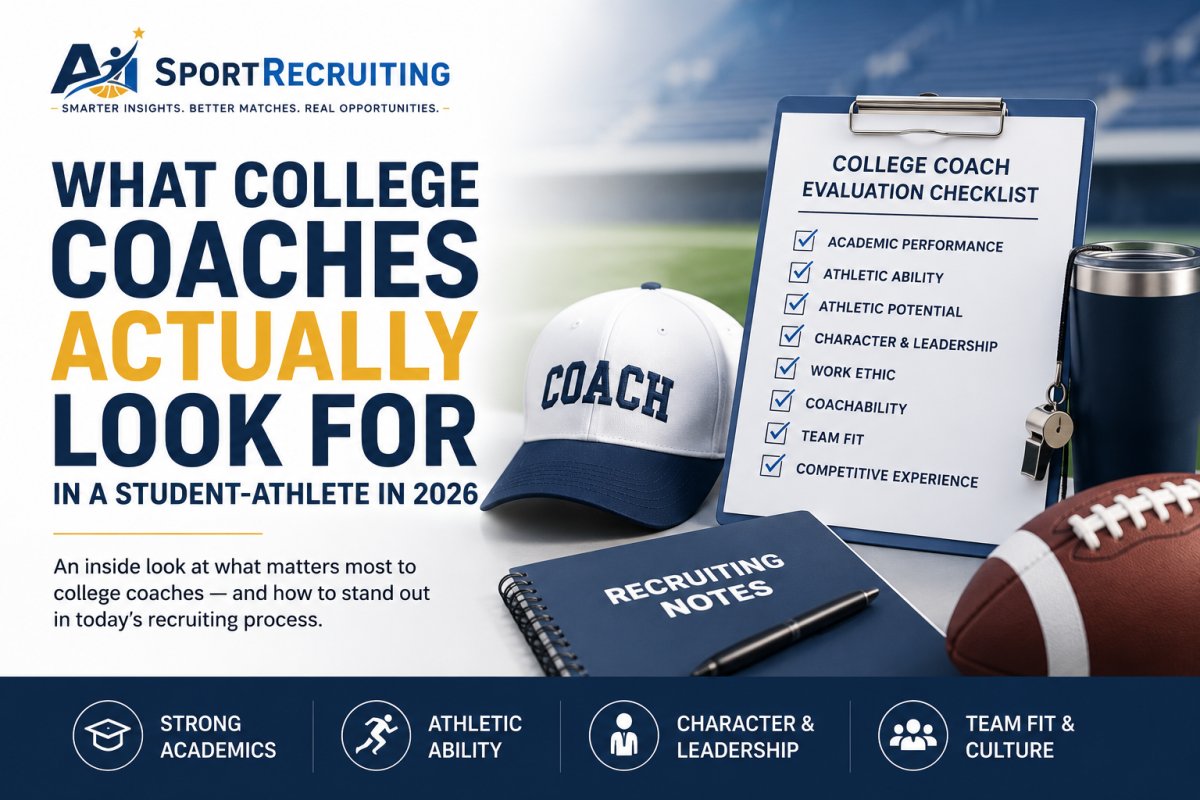
What College Coaches Actually Look For in a Student-Athlete in 2026
Every family involved in college recruiting eventually asks the same question.
What do college coaches actually want?
It sounds simple. The answer is not. College coaches evaluate recruits across multiple dimensions simultaneously — and the dimensions that matter most are not always the ones families assume. Athletic ability matters. But it is rarely the first thing a coach evaluates and it is almost never the only thing that determines whether a recruit earns a roster spot.
This guide is designed to give families an honest, accurate picture of what college coaches look for — drawn from more than 30 years of high school athletic administration, coaching, and scholarship placement experience — so families can present their athlete's profile most effectively and pursue programs where a genuine fit actually exists.
If you have not yet created your free athlete profile start with our Free College Recruiting Match Report to understand which programs may represent realistic opportunities for your athlete before outreach begins.
Get Your Free College Recruiting Match Report
Every athlete who creates a free profile on AiSportRecruiting receives:
✅ 10 personalized college program recommendations based on their academic and athletic profile
✅ Detailed explanations for the Top 3 recommended programs
✅ Personalized athlete development recommendations designed to strengthen future recruiting opportunities
✅ Recommendations spanning NCAA Division I, Division II, Division III, NAIA, and NJCAA
✅ No cost. No obligation. No credit card required.
Begin your free athlete profile today:
👉 www.AiSportRecruiting.com
The Most Important Thing Families Get Wrong
The most common mistake families make when thinking about what coaches look for is assuming athletic ability is the primary filter.
It is not.
Athletic ability is the last filter — not the first. A coach evaluates academic eligibility before they evaluate athletic talent. They evaluate positional fit before they evaluate raw athleticism. They evaluate character before they offer a scholarship. An athlete who is academically ineligible, positionally redundant, or whose character raises concerns will not be recruited regardless of how fast they run or how high they jump.
Understanding the actual sequence in which coaches evaluate recruits — and preparing accordingly — is what separates families who generate genuine recruiting interest from those who invest significant time and energy into the process and wonder why coaches are not responding.
What Coaches Notice Within the First 60 Seconds
During an initial evaluation coaches often decide whether to continue reviewing an athlete within the first minute. That first impression determines whether the evaluation continues — not whether an offer is made, but whether the coach keeps watching at all.
In the first 60 seconds coaches typically notice:
Graduation year — is this athlete in the right class for our current roster needs?
GPA — does this athlete meet our academic admission standards?
Position — do we have a need at this position in this graduation year?
Height and measurable traits — does this athlete have the physical profile we look for at this position?
Highlight video opening plays — does this athlete demonstrate the skill and movement that fits our system in the first thirty seconds of film?
Competitive level — what level of competition has this athlete been playing against?
Overall professionalism — is this message and profile presented in a way that reflects the kind of student-athlete we want in our program?
The remainder of the evaluation determines whether genuine recruiting interest develops — but those first impressions often decide whether a coach continues watching at all. A highlight video that buries the best plays, a message that leads with generic language instead of academic credentials, or a profile missing key information can end an evaluation before it starts.
This is why preparation matters so much before the first message is sent.
What College Coaches Look For — In Order
- Academic Eligibility
Academic eligibility is the first filter every college coach applies — at every division level across every sport.
A coach cannot offer a roster spot to an athlete who cannot be admitted to the institution. If an athlete's GPA or standardized test scores do not meet a program's academic admission standards the athletic evaluation does not begin. The coach has no reason to invest recruiting resources in a player who represents an academic eligibility risk.
This means academic credentials belong at the front of every recruiting message and every athlete profile. Graduation year, GPA, and test scores should be the first information a coach sees — not an afterthought buried after athletic highlights.
Strong academic credentials do more than establish eligibility. They make an athlete more attractive to coaches managing limited scholarship budgets because academically strong athletes may qualify for institutional merit aid that reduces the athletic scholarship resources the coach needs to commit. An athlete with a 3.8 GPA is a lower financial risk than an athlete with a 2.4 GPA even if their athletic profiles are identical.
For more on how academic eligibility affects recruiting options across every division level read our How to Stand Out to College Recruiters guide.
- Positional Fit and Roster Need
A college coach is not recruiting athletes in the abstract. They are building a specific roster for a specific system in a specific season — and they have specific needs at specific positions in specific graduation years.
An athlete who is genuinely talented but whose position is already deep on the roster — or whose graduation year does not align with an open scholarship slot — is not a realistic recruit at that program regardless of athletic ability. The coach has no room.
This is why understanding roster composition at target programs before outreach begins is so important. An outreach message that demonstrates specific knowledge of what the program needs — and communicates specifically why the athlete addresses that need — is far more likely to generate a genuine response than a generic message sent to every program in a sport.
Families who research roster needs before reaching out consistently generate more coaching engagement than families who contact programs without that research. For guidance on how to structure outreach that demonstrates roster awareness read our Best Way to Contact College Coaches guide.
- Athletic Ability and Fit Within the System
Once academic eligibility is confirmed and positional fit is established coaches evaluate athletic ability — specifically within the context of their system.
A guard who excels in an uptempo transition offense may not be the right fit for a program that runs a methodical half-court system. A wide receiver who thrives in a spread offense may struggle to find the right program fit in a run-heavy pro-style system. Athletic ability divorced from system fit produces talented athletes who sit on benches rather than contribute.
Coaches evaluate film through the lens of their system. They are not asking "is this athlete talented?" They are asking "does this athlete's specific skill set fit what we are building?" Families who research each program's system and communicate specifically how their athlete fits that system — not just that they are a good player generally — produce significantly stronger responses from coaching staffs.
What coaches look for by position:
For guards and perimeter players — decision-making under pressure, ball handling consistency, shooting efficiency from relevant range, the ability to create for teammates, and defensive awareness.
For post players and forwards — footwork and positioning, rebounding instincts, the ability to finish around the basket, screening effectiveness, and versatility to play multiple positions.
For quarterbacks — leadership presence, decision-making speed, accuracy under pressure, the ability to read defenses pre-snap, and composure in critical moments.
For skill position players in football — route running precision, hands and ball security, separation ability, yards after contact, and the ability to contribute in multiple formations.
For linemen — footwork and leverage, the ability to execute both run and pass assignments, size relative to division benchmarks, and technique consistency across an entire game.
For defensive players — instincts and anticipation, the ability to diagnose play action and react quickly, physical tools relative to position requirements, and consistent effort across every play.
- Film Quality and Accessibility
A highlight video is how most coaching evaluations begin. It is the first impression a coach has of an athlete's actual play — and it either earns a deeper look or ends the evaluation before it starts.
The most common film mistakes families make:
A video that requires a login, password, or download to access. Coaches evaluating dozens of prospects will not create an account to watch film. If the link does not open immediately the video does not get watched.
A video that buries the athlete's best moments. Coaches do not watch five minutes of footage to find two good plays. Lead with the strongest moments in the first thirty seconds or lose the coach's attention before they reach them.
A video that does not clearly identify the athlete. Twenty-two players on a football field or ten on a basketball court means a coach cannot find the athlete without a number or arrow identifying them in every clip.
Outdated film that does not reflect current ability. A sophomore year highlight video submitted during junior year recruiting tells a coach what the athlete used to do — not what they can do now. Film should reflect current performance.
- Character and Coachability
Coaches invest significant institutional resources in every recruit — scholarship money, coaching time, facilities access, and program culture investment. They want high confidence that the athlete they recruit will be a positive contributor to the program over four years.
Character evaluation happens through multiple channels simultaneously. Social media presence is reviewed as part of the evaluation process. References from high school and club coaches are sought to understand how the athlete responds to coaching, behaves in practice, and treats teammates. The professionalism of recruiting communication itself — how the family writes emails, how the athlete handles follow-up, and how they respond to rejection — all factor into the character picture coaches build.
Coaches also talk to each other. A family known for professional, respectful communication throughout the recruiting process builds a reputation that travels across the recruiting landscape.
- Genuine Interest in the Program
One thing coaches value that families consistently underestimate is genuine interest — demonstrated clearly and specifically — in their program in particular.
A recruit who references specific aspects of the program — the coaching staff's philosophy, the conference, an academic program at the institution, the campus environment, or the team's recent performance — signals genuine research and genuine interest. A recruit who sends the same generic message to fifty programs signals that they are not particularly interested in any of them.
Coaches invest in recruits who want to be there. All other things being equal the recruit who communicates genuine, specific interest in the program will consistently receive more attention and more scholarship resources than the recruit whose outreach feels transactional.
The Recruiting Evaluation Sequence — A Summary
Understanding the sequence in which coaches filter recruits helps families prioritize their preparation correctly.
Academic eligibility — confirmed before athletic evaluation begins.
Positional fit and roster need — confirmed before film is watched.
Athletic ability within the system — evaluated through film and in-person observation.
Film quality and accessibility — determines whether the athletic evaluation happens at all.
Character and coachability — evaluated throughout every stage of the process.
Genuine interest in the program — differentiates recruits when everything else is equal.
Families who prepare in this sequence — academic credentials first, then positioning and research, then film, then outreach — consistently produce stronger recruiting outcomes than families who lead with athletic highlights and address everything else as an afterthought.
What Coaches Notice Within the First 60 Seconds — Applied
Understanding what coaches notice immediately helps families prioritize what appears first in every recruiting touchpoint.
In the subject line of a recruiting email — graduation year, position, and name — so the coach can answer the roster need question before opening the message.
In the first sentence of the email body — GPA and academic credentials — so the coach can confirm eligibility before evaluating anything else.
In the first thirty seconds of the highlight video — the athlete's two or three strongest plays — so the coach can assess athletic and system fit immediately without searching through footage.
In the overall presentation — professional, organized, and specific — so the coach's character assessment begins positively from the first contact.
Every recruiting touchpoint has a first 60 seconds. Families who optimize those moments — in emails, in film, and in follow-up communication — consistently earn more of the evaluation time that determines recruiting outcomes. For a complete guide on how to stand out from the first moment of contact read our Best Follow-Up Strategy After Contacting College Coaches guide.
What Coaches Do Not Look For
It is worth naming clearly what college coaches do not prioritize — because these are areas where families frequently invest energy that does not produce recruiting results.
Social media follower counts. Coaches evaluate what a recruit does on social media — not how many people follow them. A large following with concerning content is a negative signal. A smaller following with professional, positive content is a neutral to positive signal.
Recruiting service rankings. Published recruiting rankings from third-party services influence some coaches at some levels — but they are not a primary evaluation tool for most programs outside the Power Four Division I environment.
Camp attendance without fit research. Attending camps and showcases at programs where the athlete is not a realistic fit produces exposure without results. The investment of time, money, and energy in camp fees and travel is only valuable when the programs attending are programs where the athlete represents a genuine academic and athletic match.
Volume of outreach without fit research. Contacting one hundred programs with a generic message produces worse results than contacting twenty programs with personalized, researched messages. The goal is not to contact the most coaches — it is to contact the right coaches. For more on this read our How to Get Recruited by NAIA Programs guide which covers the fit-first philosophy in the context of a specific division level.
How the AiSR Four-Pillar Junior Year Framework Connects to What Coaches Look For
The AiSR Four-Pillar Junior Year Framework — Academic Standing, Athletic Profile and Film, Program Research and Target List, and Outreach and Relationship Building — maps directly onto what coaches evaluate.
Pillar 1 addresses academic eligibility. Pillar 2 addresses athletic ability and film quality. Pillar 3 addresses positional fit and roster need. Pillar 4 addresses genuine interest and professional communication.
Families who execute all four pillars simultaneously arrive at the recruiting process with exactly what coaches need to evaluate a recruit seriously. For the complete tactical execution framework read our Ultimate Junior Year College Recruiting Strategy.
What This Means for Different Division Levels
The six factors coaches look for apply across every division level — but the relative weight of each factor varies meaningfully by division.
At NCAA Division I programs athletic ability and system fit carry enormous weight because the pool of academically eligible, positionally appropriate recruits is large.
At NCAA Division II programs the balance shifts. Academic credentials matter more because coaches managing limited equivalency scholarship budgets are more sensitive to financial risk. Character matters more because coaches at smaller programs invest more personal time in each recruit.
At NCAA Division III programs academic credentials are the primary filter because admission is the first hurdle and coaches cannot guarantee it. Character and genuine interest in the specific institution are weighted heavily.
At NAIA and NJCAA programs the head coach manages recruiting more personally and directly. Character, coachability, and genuine interest carry significant weight because the head coach is investing personal attention in every recruit they pursue.
For division-specific recruiting guidance our library covers each level in depth. Our D2 Colleges guide, NCAA Division III Recruiting guide, NAIA College Recruiting guide, and College Recruiting Platform for Student Athletes guide each address what coaches at those levels specifically prioritize.
How AiSportRecruiting Helps Families Prepare for What Coaches Look For
AiSportRecruiting was founded by Coach Jackson after more than 30 years serving as a High School Athletic Director and coaching at the high school, AAU, and college levels — with more than 300 scholarship placements across his career.
The platform was built on a belief that has guided Coach Jackson throughout his career: talent deserves opportunity regardless of a family's budget, connections, or access to private recruiting services.
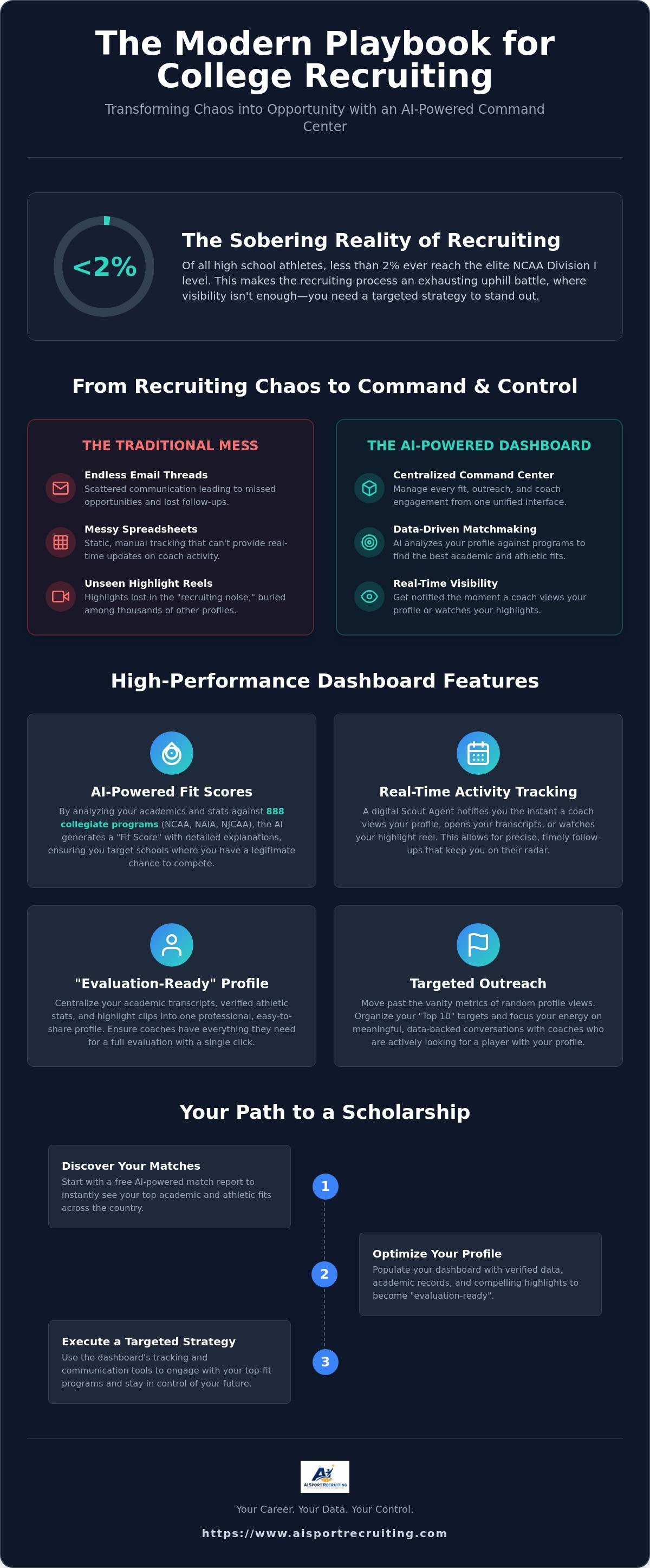
Every factor coaches look for — academic eligibility, positional fit, athletic profile, and program alignment — is reflected in how AiSportRecruiting evaluates athletes and generates program recommendations. The platform compares each student-athlete's academic and athletic profile against 888 verified collegiate programs across NCAA Division I, Division II, Division III, NAIA, and NJCAA — returning 10 personalized program recommendations, detailed explanations for the Top 3 recommended schools, and personalized athlete development guidance designed to strengthen the areas coaches evaluate most. All at no cost and with no credit card required.
AiSportRecruiting currently supports student-athletes in three sports:
🏀 Boys Basketball
🏀 Girls Basketball
🏈 Football
Additional sports are in development and will be introduced as they complete AiSportRecruiting's quality validation process.
The AiSportRecruiting Standard
Everything AiSportRecruiting publishes and every recommendation the platform produces is guided by one principle:
Families deserve recruiting information they can trust.
That means accuracy before assumptions. Evidence before opinion. Families before technology. Opportunity for every athlete across every level of college athletics. And transparency in every recommendation we provide.
AiSportRecruiting does not guarantee scholarships, roster positions, coach responses, or recruiting offers. The platform provides honest, evidence-based recruiting intelligence designed to help families navigate the recruiting process with greater clarity and confidence.
That is the AiSportRecruiting Standard.
College coaches are not looking for the most talented athlete on every recruiting board. They are looking for the right athlete — academically eligible, positionally appropriate, athletically aligned with their system, professionally presented through quality film, and genuinely interested in what the program specifically offers.
The families who understand that and prepare accordingly consistently produce better recruiting outcomes than those who focus on athletic ability alone and wonder why the results do not follow.
Better preparation produces better conversations. Better conversations produce better opportunities.
Begin Your Recruiting Journey Today
Every recruiting journey begins with better information.
If you are ready to identify college programs where your student-athlete may represent a genuine academic and athletic fit, create your free athlete profile today.
✅ 10 personalized college program recommendations
✅ Detailed explanations for your Top 3 recommendations
✅ Personalized athlete development recommendations
✅ No cost. No obligation. No credit card required.
👉 www.AiSportRecruiting.com
Because every student-athlete deserves the opportunity to be seen. And every family deserves recruiting information they can trust.
Frequently Asked Questions
Do college coaches care more about grades or athletic ability?
Academic eligibility comes before athletic evaluation at every division level. A coach cannot recruit an athlete who cannot be admitted to the institution. Once academic eligibility is confirmed athletic ability and system fit become the primary evaluation criteria. Strong academic credentials also make athletes more financially attractive to coaches managing limited scholarship budgets.
What do coaches notice first when they receive a recruiting email?
In the first 60 seconds coaches typically notice graduation year, GPA, position, height, the opening plays of the highlight video, the competitive level the athlete plays at, and the overall professionalism of the message. These first impressions determine whether the evaluation continues — not whether an offer is made, but whether the coach keeps reading and watching.
What GPA do you need to get recruited by a college coach?
GPA requirements vary by institution and division. NCAA Division I and Division II have specific sliding scale eligibility requirements through the NCAA Eligibility Center. NAIA uses a two-of-three rule involving GPA, test scores, and class rank. NCAA Division III admission standards are set by individual institutions. Families should research the specific academic requirements at each target program rather than assuming a universal standard applies.
Do college coaches watch full game film or just highlights?
Most coaches begin with highlight film — specifically the first thirty seconds. If the highlights generate genuine interest coaches may request full game film for deeper evaluation. A highlight video that does not open immediately or does not lead with the strongest moments reduces the likelihood that a coach ever reaches the full game film stage.
What do coaches look for in a recruiting email?
Academic credentials upfront — graduation year, GPA, and test scores. A direct link to a highlight video that opens immediately. One specific reason the program interests the athlete. A direct question about roster availability or the coach's recruiting timeline. For a complete guide to writing effective recruiting emails read our Best Way to Contact College Coaches guide.
How important is character in college recruiting?
Extremely important — and evaluated throughout the entire recruiting process. Social media, references from coaches, and the professionalism of recruiting communication all contribute to the character picture coaches build. A recruit whose character raises concerns will not be offered a scholarship regardless of athletic ability.
When do coaches start evaluating recruits?
Contact rules vary by division and sport but coaches begin building recruiting boards well before official contact windows open. Junior year is the most critical window across most division levels. Families should be prepared before the contact window opens not after. For a complete timeline read our Junior Year College Recruiting guide.
Does playing for a top AAU or club program help with recruiting?
It helps at Division I and high Division II levels where coaches attend showcase events to evaluate prospects. It is less determinative at Division III, NAIA, and NJCAA levels where coaches rely more heavily on direct outreach and film than on showcase attendance.
What is the biggest mistake families make in the recruiting process?
Leading with athletic ability and assuming coaches will find them. The most common and costly recruiting mistake is waiting to be discovered rather than proactively researching programs, confirming fit, and initiating professional outreach.
Which sports does AiSportRecruiting currently support?
AiSportRecruiting currently supports Boys Basketball, Girls Basketball, and Football. Additional sports are in development and will be added as they complete the platform's quality validation process.
Does AiSportRecruiting guarantee that following its recommendations will result in a scholarship offer?
No. AiSportRecruiting provides personalized program recommendations and athlete development guidance based on the information families submit. Recruiting outcomes depend on many factors including athletic performance, academic standing, a program's specific roster needs, and the relationships families build with coaching staffs.


